Valuing our urban trees – part II

Assessing the condition of urban tree habitats using Biodiversity Metric 3.0

Our recent blog – Valuing our urban trees I, pointed out the failings of the methodology for calculating the size of urban tree habitats as set out in Biodiversity Metric 3.0 (BNG 3.0). We would now like to show how this is compounded by the inappropriate assessment criteria used to determine the condition of Urban Tree habitats, as also set out in BNG 3.0 (see Annex 1).

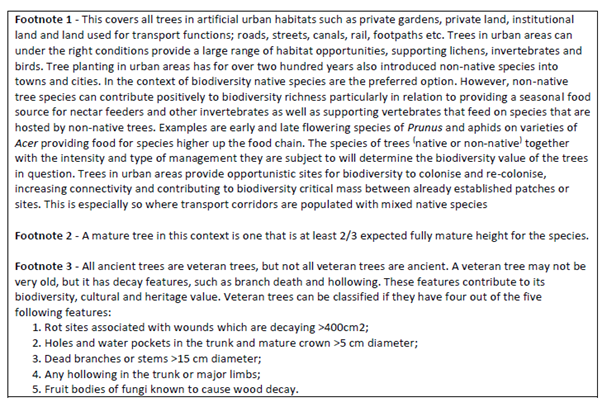
We use the following example – taken from a recently approved planning application [1] which will result in the removal of 13 urban trees – to demonstrate why this is approach is inappropriate.

Figure 1 The example tree – Google Street View 2020

This street tree is a London Plane (Platanus × acerifolia) with a stem diameter (called DBH) of 118 cm. It is a non-native species planted in hard standing on Bridge St, Bristol BS1 2AN in about 1967. Using BS 5837:2012Trees in relation to design, demolition and construction – Recommendations (a BSI Standards Publication), it has been categorised as A,1,2 (see Annex 2). The developer’s Arboriculturalist described it as having a ‘Large, broad crown with excellent form and vigour.’

The tree’s BS 5837:2012-calculated Root Protection Area (RPA) radius[3] is 14.6 metres, so it has an RPA of 630 square metres. The tree has an average crown radius of 9.88 metres and a calculated canopy area of 306 square metres.

Using BNG 3.0 TABLE 7-2: Urban tree size by girth and their area equivalent (see Annex 1), the calculated RPA of the tree is set at Large, so its habitat size is limited to just 113 square metres – a discount of 82% of its calculated RPA and 37% of its canopy area.

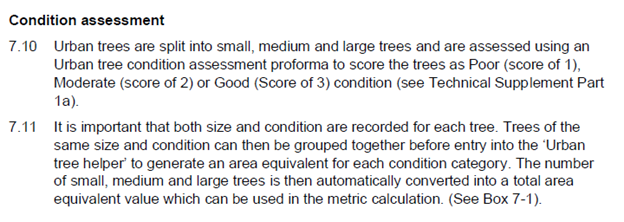
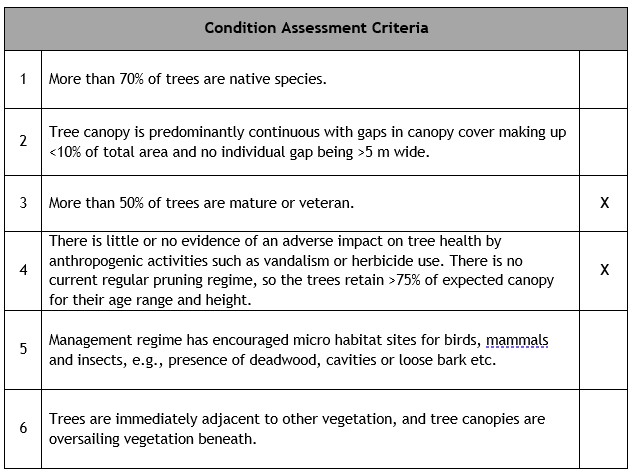
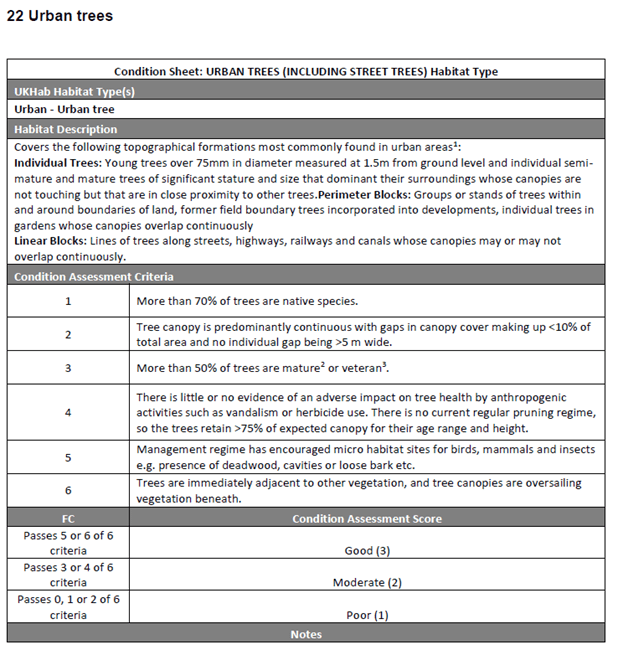
Notwithstanding categorisation of the tree as A,1,2, the BNG 3.0 Condition Assessment Criteria categorises the condition of this tree as Poor because it meets only two of the six criteria, as shown below:
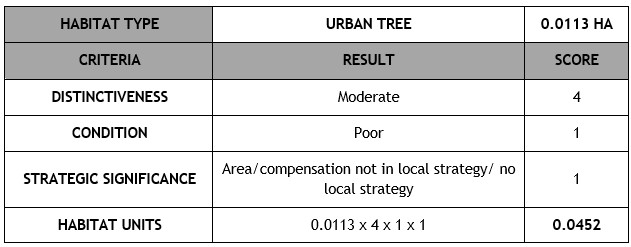
Using BNG 3.0, the calculation of the baseline habitat (called Habitat Units) of this tree is as follows:
Had the BS 5837:2012 condition of the tree been allowed for and its condition set to ‘Good’, then the habitat units of this tree would be three times the habitat unit value of 0.0452, i.e., 0.1356 as shown below.
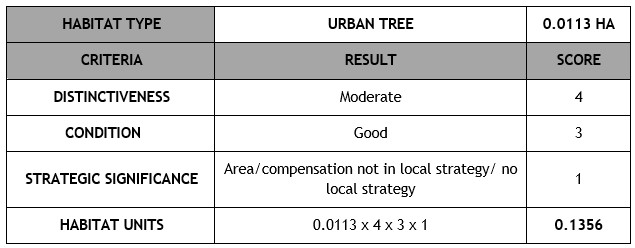
Not only has the true size of the urban tree habitat been significantly undervalued (because its actual RPA has not been used), but its assessed condition using the BNG 3.0 criteria is also clearly inappropriate given that this tree has been assessed at the highest category under BS 5837:2012:

Category A – Trees of high quality with an estimated remaining life expectancy of at least 40 years …that are particularly good examples of their species, especially if rare or unusual; or those that are essential components of groups or formal or semi-formal arboricultural features (e.g., the dominant and/or principal trees within an avenue).

The proposed solution

BNG 3.0 is seriously flawed when it comes to evaluating Urban Tree habitats. We have already commented on this when it comes to calculating habitat size.

In our view, the solution to the issue of assessing the correct condition of urban tree habitats is already available in BS 5837:2012. The standard may require some amendment to align it with BNG 3.0, but it is a well-established and practical approach used by the arboricultural community. This British Standard gives recommendations and guidance on the relationship between trees and design, demolition and construction processes and is used whether or not planning permission is required.

A copy of this blog can be downloaded here.


Our third blog dealing with habitat selection is available here – Valuing our urban trees – part III.


Annex 1

The Biodiversity Metric 3.0 – auditing and accounting for biodiversity

USER GUIDE (page 68)
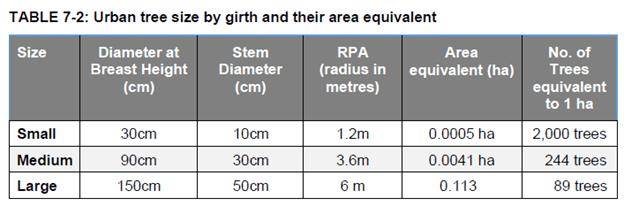
TECHNICAL SUPPLEMENT (pages 193-194)

Annex 2

BS5837:2012 – 4.5 Tree categorization method – tree category definitions


[1] The Developer used BNG 2.0 in its submissions and applied a different Condition assessment to the one used here.

Bristol Tree Forum tree planting campaign – free Birch, Alder and Oak saplings available for planting

Last year we were pleased to be able to provide – free of charge – 1,600 oak saplings for tree lovers to plant around Bristol, and as it turns out, around the country.

STOP PRESS 11 Feb 2022 – We have now reached our target and are no longer taking any new Orders. Thank you all for your support.

Due to COVID-19 restrictions in 2020 and delays in government funding, there were postponements and cancellations of many major tree planting projects. A consequence of this was that large numbers of tree saplings planned for planting projects were threatened with destruction, including 750,000 two year old English oak tree saplings at the Maelor Forest Nursery in Wrexham.

Rather than see these trees destroyed, Bristol Tree Forum purchased 1,000 of the oak saplings for free distribution to anyone able to plant them.

As a result of the amazing response to this scheme we increased our order to 1600 saplings all of which were distributed and planted.

Oak plantings in and around Bristol
…. and beyond

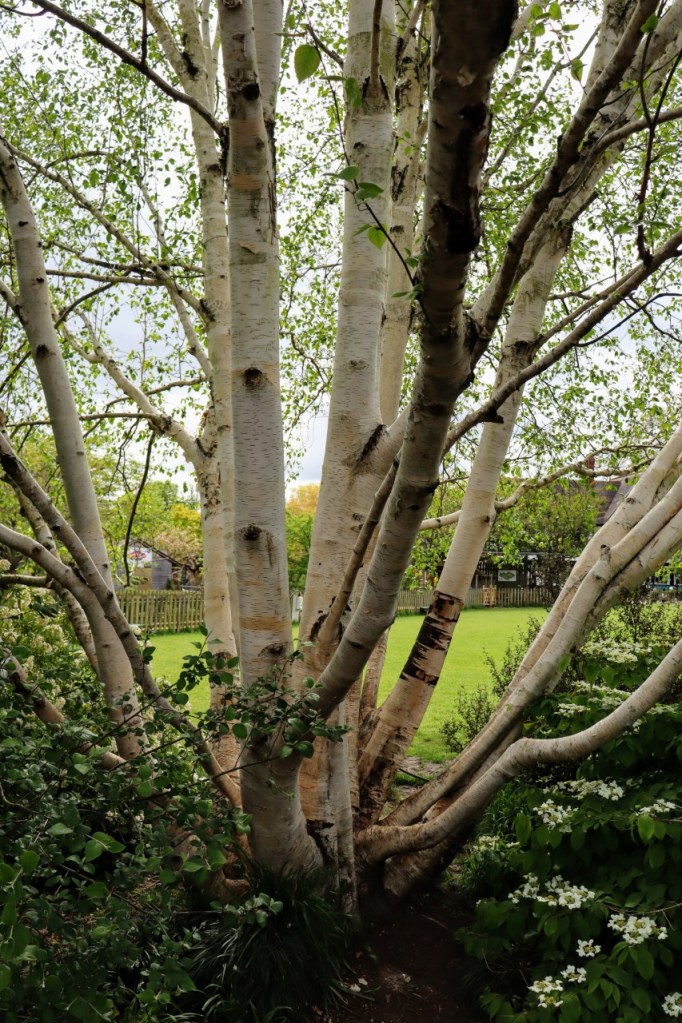
Due to the success of last year’s project, the Bristol Tree Forum have ordered another thousand saplings. Because we may have somewhat exhausted the demand for oaks, this year we have ordered a mixture of white (or downy) birch  and alder. Both are native trees of great benefit to wildlife, and are tolerant of poor soil and wet conditions.

White Birch
Black alder (T Davis Sydnor)

For those that would prefer oak saplings, we have partnered with the Arkbound Foundation who are distributing oaks as part of their Oakupy project. These can either be ordered using the form below, or directly from Oakupy. We will get delivery in late January or early February. The trees can be collected from a site in Redland, Bristol.

The saplings come bare-rooted (i.e. out of the soil) and need to be planted as soon as possible after collection, although the viability of the trees over winter can be extended by storing the trees with the roots covered in damp soil.

The form below is to find out who would like to have saplings for planting and how many, and for you to provide basic contact details (email and/or phone number) for us to organise collection of the trees. Contact details will not be used for any other purpose.

The importance of planting trees?

Despite advances in carbon capture technology, the most efficient and cost-effective way to sequester carbon from the atmosphere is to plant trees. For instance, a single mature oak tree is the equivalent of 18 tonnes of CO2 or 16 passenger return transatlantic flights.

Recent scientific reports estimate that planting trees wherever we can, without occupying land used for other purposes, would absorb up to two thirds of the carbon emitted in the last century.

Trees are vital in supporting biodiversity, with oak trees capable of supporting over 2,300 different species, including birds, mammals, invertebrates, mosses, lichen and fungi.

Trees improve air quality by absorbing both gaseous (e.g., NO2) and particulate pollution. They reduce traffic noise and flooding and improve physical and mental wellbeing. Crucially, with life threatening heat waves predicted to occur every other year by 2050, trees can reduce the city heat island effect, potentially saving lives.

This project is funded by the Bristol Tree Forum in partnership with the Arkbound Foundation.

Bristol Tree Forum Annual General Meeting

Bristol Tree Forum
Annual General Meeting
Bristol City Hall
6 December 2021
18:30 – 20:00

Draft Agenda (may be modified nearer the date)
Bristol Tree Forum – bristoltreeforum.org – 6 December 2021

  1. Update from Mark Ashdown (Chair)
  2. Treasurer’s Report (John Tarlton)
  3. Election of Officers
  4. Message from Marvin Rees, Bristol Mayor
  5. BCC Communities Scrutiny Working Group – Trees (Councillor Martin
    Fodor)
  6. Tree planting & maintenance update (Richard Ennion)
  7. Tree Champions (Jim Smith)
  8. Any other business