Council no longer manages trees on educational sites – Part II

Our worst fears have been realised. Schools have been left to care for the trees growing on their own sites, including those growing on school playing fields.

This blog follows on from our recent article on this subject – Council no longer manages trees on educational sites.

We have now had a response to a recent Freedom of Information request.

Trying to avoid the Council’s earlier refusals to answer our earlier FoIs about this, we asked for the same information as before, but just about one school which we selected randomly.

The school’s identity has no particular significance. We believe that these responses reflect the same situation across many other schools in Bristol (and the rest of the country?) – the lease disclosed is a Department for Education (DfE) standard Academy Lease’.

We asked…

[We] have been advised that Bristol City Council no longer maintains or manages trees growing on some sites owned by it.

In respect of Henleaze Junior School, is it a site where the responsibility for the care of the trees growing on its site has been passed to the school?

If so, please provide the following information:

1. Does the Council retain the ownership of the trees on the site?
2. If it no longer retains ownership, who does?
3. Does the Council still retain liability for any damage caused by trees on this site?
4. If it no longer retains liability, who does?
5. is this site available for tree planting by the public through sponsorship schemes such as TreeBristol or through tree-planting initiatives such as One Tree Per Child or the Urban Tree Challenge Fund?
8. Who makes decisions about the planting, maintenance or felling of trees on this site?
9. If it is not the Council, is the decision maker obliged to consult the Council before proceeding to maintain or fell a tree, whether or not the tree is growing in a Conservation area, or is protected by a Tree Preservation Order or is the subject of a planning application?

Please provide a copy of any lease entered into between to Council and Henleaze Junior School for the lease of its site.

The Council has responded to say…

The site is let to the Academy on a 125 year Department for Education standard Academy Lease.  The Council holds the Freehold of the site, but the responsibility for the management of the trees has passed to the Academy and the Council no longer retains liability for any damage caused by trees on this site?  The Academy does.

While the the site is available for tree planting by the public through sponsorship schemes such as TreeBristol or through tree-planting initiatives such as One Tree Per Child or the Urban Tree Challenge Fund, consent by the Academy is required for this.

The Academy is not obliged to consult the Council regarding the maintenance, removal or planting of trees on site and has the sole responsibility for these activities. This is subject only to any Tree Protection Orders (TPO’s) and/or Conservation Area requirements that may exist for trees on the site. In these cases, a planning application must first be made and permission given before the school can proceed.

A copy of the lease is available here. There is no mention of trees in the lease.

We are intrigued to note however, that the Council retains the right to develop the school and playing fields – Schedule Three – Rights Excepted and Reserved:
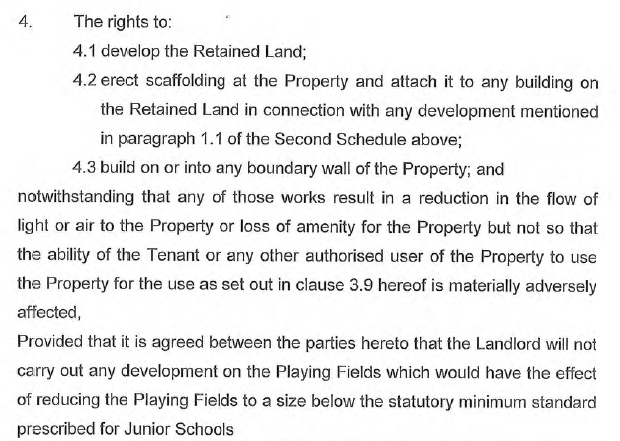
It appears very likely that similar arrangements to this will be found across most of the city’s 78 Academy schools (and possibly many Maintained and Special schools), by leaving them to make their own ad hoc arrangements to care for and/or plant trees as they may/or not desire.

Given that the One City Plan aims to double tree canopy cover over the next 25 years, it seems a great shame that this important land bank (we estimate some 188 hectares – land and buildings – for Academies alone) of possible new planting sites might have been excluded from helping to achieve Bristol’s ambitious plans.

What about protecting all the trees with a TPO?

There are already at least 3,400+ established trees growing on educational sites that could be at risk. As far as we can tell, very few of these trees are protected by a TPO, though some will be are growing in a Conservation area.

So, is it possible possible to protect all the remaining unprotected trees with TPOs? At least then all schools would be obliged to get planning permission before removing or ‘managing’ trees and we will be able to see what is planned.

Local Authorities have the power to make four types of TPO:

  • Individual TPOs: A single tree, illustrated as a trunk and approximate canopy spread. If trees merit protection in their own right, authorities should specify them as individual trees in the Order. 
  • Group TPOs: A group of trees, usually shown as a canopy, or group of canopies, with or without stems shown. The group category should be used to protect groups of trees where the individual category would not be appropriate and the group’s overall impact and quality merits protection. 
  • Woodland: Shown as an area of land. The woodland category’s purpose is to safeguard a woodland as a whole. So it follows that, while some trees may lack individual merit, all trees within a woodland that merits protection are protected and made subject to the same provisions and exemptions. 
  • Area TPO: Shown as an area, without stems highlighted. The area category is one way of protecting individual trees dispersed over an area. Authorities may either protect all trees within an area defined on the Order’s map or only those species which it is expedient to protect in the interests of amenity. 

We were recently been copied this answer when this issue was raised about some trees growing in the Bearpit:

Thank you for your email requesting a Tree Preservation Order for trees within the St James Barton roundabout/ Bearpit area. We have reviewed these trees following your TPO request. We understand that you are concerned about any future plans for the Bearpit which could affect these trees and the amenity they provide. 

The national guidance on ‘Tree Preservation Orders and Trees in conservation areas’ (https://www.gov.uk/guidance/tree-preservation-orders-and-trees-in-conservation-areas#making-tree-preservation-orders ) advises: 

“though some trees or woodlands may merit protection on amenity grounds it may not be expedient to make them the subject of an Order. For example, it is unlikely to be necessary to make an Order in respect of trees which are under good arboricultural or silvicultural management.” 

Furthermore, the potential effect of development on trees, whether statutorily protected (e.g. by a tree preservation order or by their inclusion within a conservation area) or not, is a material consideration. This means that tree matters must be taken into account by Bristol City Council as the Local Planning Authority when dealing with planning applications, and when undertaking consultations, and that members of the public can make clear their views. 

Given that these trees are already under existing arboricultural management, and that they would automatically be a material consideration should any future planning application come forward, it is not expedient or necessary for a Tree Preservation Order to be placed on these trees.

It appears that trees on educational land can, in theory, have TPO protection if it can be shown that they are not ‘under good arboricultural or silvicultural management’. But, how can the Local Authority know this?

However, our experience when we have requested that TPOs are made, is that the council will rarely do so, unless the trees are considered to have Amenity value and they are shown to be under immediate threat of destruction or damage. But, how can the Local Authority know this if the school is not obliged to tell them?

And…bitter experience has taught us that, whilst ‘…the potential effect of development on trees, whether statutorily protected…or not, may be ‘a material consideration’, other considerations often result in the welfare of trees being a very distant secondary consideration, with the result that they are frequently sacrificed to the too-oft-repeated argument that it is either the development or the trees, when there is no reason why it cannot be both.

So, the reality is that these trees are unlikely to be granted TPO status, save in exceptional circumstances and, even if they are, this is no guarantee of their future protection.

Our original concerns remain

We remain concerned that school governors (quite apart from lacking the necessary skills to manage the trees growing on their sites) may not yet have realised the full implications of the practical and strategic obligations that taking on such an important part of Bristol’s Natural Capital places upon them.

As a result, they are likely to buy in (at our eventual expense) ad hoc expertise, with the risk that they will overlook the wider strategic considerations that are needed when it comes to managing and promoting Bristol’s trees.

This, coupled with the distinct possibility that well-meaning, but unqualified Council officers in departments with no expertise in the management of trees may be making critical decisions about the welfare of trees across a wide range educational sites across the city, makes for a very worrying situation.

Our view is that the Council should take back the control and management of trees growing on land owned by it whether it is leased or not. Only then can we be assured that there is at least some degree of oversight and accountability, while helping us to achieve the wider strategic vision for the development of Bristol’s urban forest.

Shocking treatment of Lower Ashley Road trees shows urgent need for Bristol Planning rethink

Bristol has declared a climate emergency. There is an urgent need for all council departments to re-think the way that they work.

At the time of writing, four of the trees in this image have been felled (two Norway Naples and two Indian Bean trees on a different plot).  The value of the five maple trees along Lower Ashley Road was calculated at £200,000 using CAVAT.  Local residents are desperately trying to save the three remaining maples.

This blog discusses six changes that are desperately needed to protect trees on development sites.

  • Planning Decisions regarding important or TPO trees should be considered by committee and not delegated to one officer.
  • It is practically impossible for local residents and other stakeholders to wade through all planning documents online. Planning Officers must highlight important tree issues and have a duty of care to act positively in favour of trees.
  • Bristol should implement policies to retain trees on development sites in the way that has been done in London, Oxford and elsewhere. This includes enforcement and a presumption to retain trees at the edge of development sites.
  • An emergency number to address immediate tree felling issues. 
  • It is a false choice to say that we can either have social housing or trees. With clever designs, we can retain existing trees and have better social housing.
  • Replacing felled trees, even when applying the Bristol Tree Replacement Standard, is second best to retaining existing large urban trees. We get the benefits from existing trees now – we have to wait decades for their replacements to grow.

Over the last six months there have been half a dozen articles in the local press and now one Guardian article about the shocking planning decision to allow removal of five Norway maple trees with Tree Preservation Orders (TPOs) on Lower Ashley Road, one of the most polluted streets in Bristol. There have been two meetings with the mayor who also visited the site and there is now a vigil by protesters on the site: police have been called on several occasions. All this indicates a planning process that has marginalised local residents and failed to take into account the value of the trees.

The Bristol Tree Forum appreciates the efforts by Mayor Marvin Rees to try and resolve the situation after the event. He visited the site and then convened two meetings in City Hall which he chaired. We have been impressed by his serious engagement and the way that he has brought all the interested parties into the room and handled the discussion. But, as we think he would agree, this is the wrong way around. Discussions such as this should happen before the planning decisions are taken so that there is community engagement in the decision making.

Planning Decisions regarding important or TPO trees should be considered by committee and not delegated to one officer

That we have got to this stage shows a serious failure of both Bristol City Council Planning policy and its implementation. The decision to remove the trees was taken in 2015/16 by one planning officer as a reserved decision. It did not go for to the Planning Development committee for a considered decision. Looking over the documents it doesn’t seem that any time or thought was given to the trees. The Arboricultural Report provided by the developer does not even state whether the trees had TPOs, and indeed there is no discussion of the TPOs in any of the documents in that planning application, with the only mention on the “constraints” page. In 2015, The Bristol Tree Forum commented in opposition to the proposal but even the BTF was unaware that the trees had TPOs. Whilst BCC insists that the decision was “valid”, without a mention of the TPOs there was insufficient information to allow intelligent consideration of the proposal, so we question that decision. Sufficient information for intelligent consideration is one of the fundamental principles of a “proper consultation” as decided by Lord Woolf*. The first mention of the TPOs in a document is in the Officer’s Report outlining the delegated decision. 

Unfortunately this is not an isolated failure: trees all over Bristol are being unnecessarily sacrificed as a result of applying ideology from the 1960s. For example a single planning officer gave the green light for the removal of some 25 trees on the Redland Girls School site, in a conservation area, despite the fact that the removal is purely for landscaping.

Redland Green Trees: damage to tree roots caused by driving construction vehicles over them can result in the eventual failure of the trees. In a failure of planning, no root protection zones or Arboricultural Methods Statements were ever established for these trees, despite permission being given for the construction company to store materials on Redland Green.
It is practically impossible for local residents and other stakeholders to wade through all planning documents on line.  Planning Officers must highlight important tree issues and have a duty of care to act positively in favour of trees

Important tree issues need to be highlighted and openly discussed during the planning process. Planning Officers already implement policy regarding flood risk, traffic management and other construction matters. The Bristol Tree Forum is asking that tree protection is included too as is done in other local authorities (Examples are Oxford and Islington, below). In addition, trees on or near active development sites must be properly protected.

We see applications with no information on the Bristol Tree Replacement Standard calculations, or obviously incorrect information being supplied. Documents such as these should be rejected by the planning officer.

Redland Green Trees. Permission was given for this TPO Ash tree on Redland Hill to be removed (in addition to several others on the site) to allow articulated lorries to enter the building site. In the event, the gateposts were never widened, articulated lorries didn’t enter the site as this would have been extremely difficult even with gate widening and the tree was retained until Aug 2019, when it was removed anyway.
The Indian Bean trees growing on the next-door site on Lower Ashley Road before they were felled. Together with the Maples nearby, they formed a welcome green oasis in an otherwise treeless urban setting.
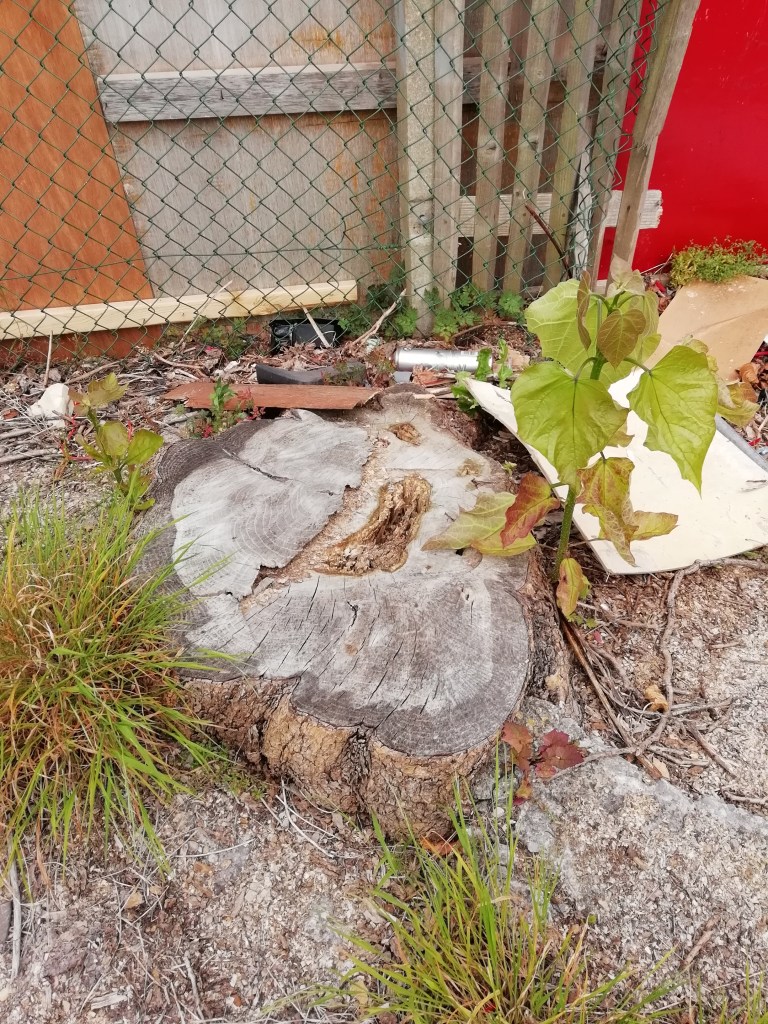
All that remains of the Indian Bean trees which were chainsawed following rejection of an application that was refused because the trees were felt important and merited TPOs.  The trees were removed anyway. We are trying to find out why the trees were not then protected with TPOs.
An emergency 24-hour number to address immediate tree felling issues. 

Bristol is at risk of becoming known as a Mad Max world now that unqualified people are wielding chainsaws from ladders above passing pedestrians with no enforcement consequences, often on public holidays, sometimes in the evenings and even at night. A proper approach for addressing this problem needs to be developed in collaboration with the police. It is unfair to send a single tree officer on their own to deal with issues of public order. Multiple phone calls and sometimes hundreds of emails to numerous council departments very quickly overload already overstretched council officers. It is no good passing the buck to the Health and Safety Executive. Therefore we need one emergency Bristol City Council number.

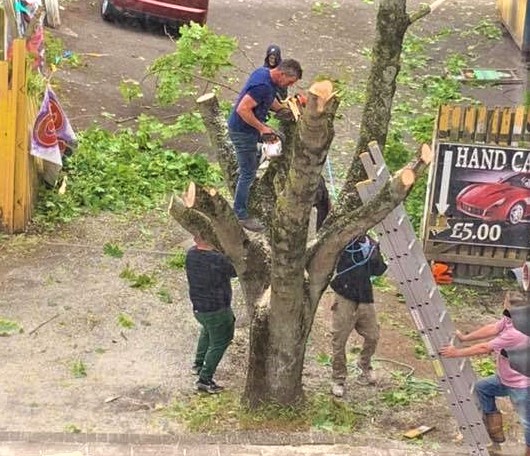
Lower Ashley Road.  Bristol City Council urgently needs to come up with a procedure to address dangerous activities by unqualified people using chainsaws over pavements and roads.
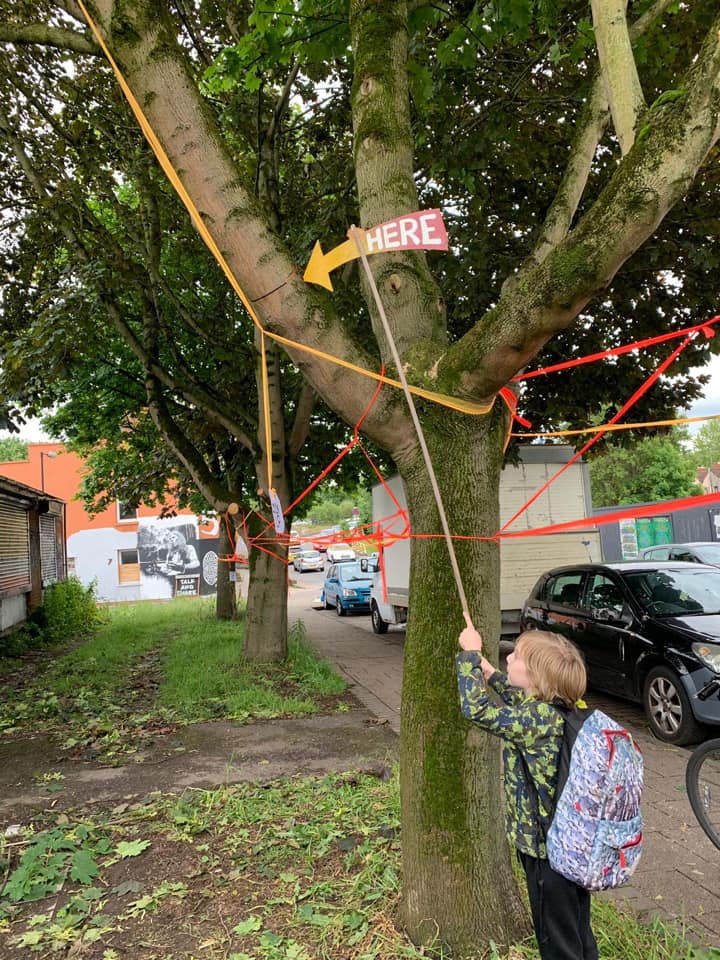
A Maple with the arrow sign captioned ‘here’ pointing at a partially sawn limb : Following complaints over an entire week, this dangerous almost severed branch was only addressed after an article appeared in the Bristol Post.
Trees growing at Cotham School were removed by Skanska (2008) in the afternoon before Good Friday when no enforcement action could be taken.
Bristol should implement policies to retain trees on development sites

Where possible we should build developments around existing trees. There should be a presumption to build around existing trees and particularly to retain trees at the edge of development sites. 

The developer’s arboricultural report for Lower Ashley Road states that “In order to retain the trees within any new scheme, the front of any new building will need to be sited a minimum of ten metres from the existing site boundary”. We have heard this assertion stated by developer and planner as “the ten metre rule”.

There are many examples where mature trees are retained close to new buildings, in London, Oxford and elsewhere. This must become commonplace in Bristol too.  A Trees and Design Action Group article describes the construction of the Angel Building (Islington, London) around existing mature trees. No cowboy chainsawing there. Instead extreme care was taken in a project that was led by landscape architects. For example:

Deliveries needed to be conducted on a daily basis. To enable this, the Tree Protection Plan (TPP) and Arboricultural Method Statement (AMS), developed by appointed tree specialist JCA, in coordination with the project landscape architect and the council tree officer, proposed the use of a porous load-spreading cellular confinement system (Geoweb) braced with timber frames.

All existing trees were irrigated during the two-year construction period following a sporadic pattern imitating rain. Because irrigation was fed with calcium-rich London tap water, the system was fitted with filters to avoid increasing the soil pH.

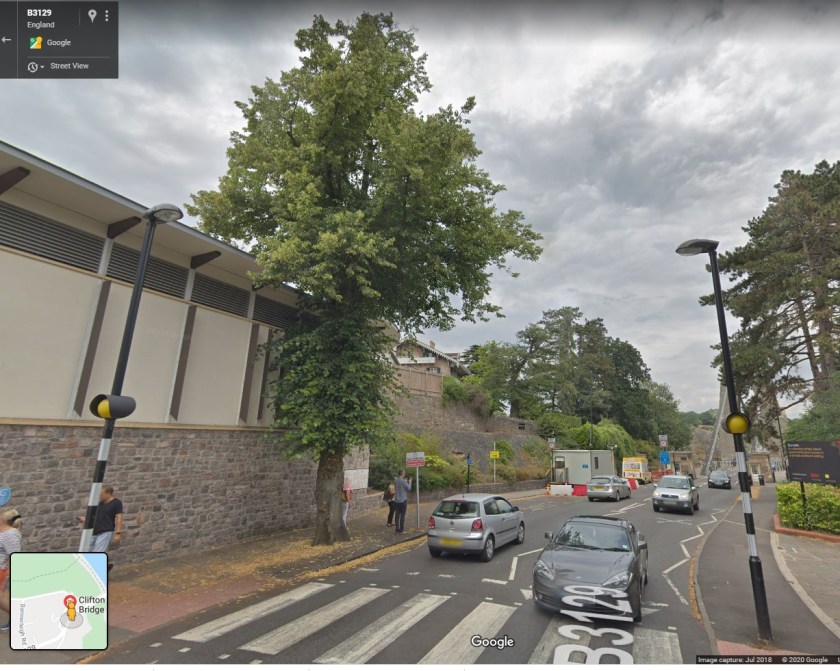
The Clifton Suspension Bridge visitor Centre (Alec French Architects) in North Somerset, not Bristol, is within 2 metres of an important tree.  The roof line has been cut away to accommodate a branch.
Aurora Building, Counterslip, Bristol.  Energy efficient, outstanding architecture and built extremely close to an existing plane tree.
It is a false choice to say that we can either have social housing or trees. 

Although the 2015/16 planning approval that is being used to justify removal of the trees was for student accommodation, the current proposal, still under consideration, is for social housing that Bristol desperately needs.  We are surprised that, despite this new undecided application, the developer is still able to undertake work under the old approved application which they no longer intend to pursue.  Shouldn’t the slate be wiped clean so we have a chance to revisit the whole plan with the trees still in place rather than be forced to decide without them?

The developer, planners and others have presented a false choice stating either we retain the trees, keep the site derelict and leave 28 families homeless, or we remove the trees. 

These trees are right on the edge of the development site. With clever designs, led by a landscape architect (not even apparent that one has been engaged for this project), and carefully constructed foundations (e.g. screw piling), the developer could build close to the existing trees. The result? Better social housing which benefits from existing green infrastructure and provides a more pleasant environment with some protection from the noise and pollution of this busy road.


  • Lord Woolf MR in R v North and East Devon Health Authority, ex parte Coughlan [2001] QB 213, [2000] 3 All ER 850, [108] as follows: whether or not consultation is a legal requirement, if it is embarked upon it must be carried out properly; to be proper, consultation must be undertaken at a time when proposals are still at a formative stage; it must include sufficient reasons for particular proposals to allow those consulted to give intelligent consideration and an intelligent response; adequate time must be given for this purpose; and the product of consultation must be conscientiously taken into account when the ultimate decision is taken.