Towards a Bristol Tree Strategy

Representatives of the Woodland Trust, The Bristol Tree Forum, The Forest of Avon Trust and Bristol City Council met last Thursday 1 March to start the process of developing a Tree Strategy for Bristol.  This is the first tentative step in a process which will include consultation and involvement of all those groups and individuals who have an interest in Bristol’s trees.

The process of developing a strategy will need a lot of thought: Bristol has woodland trees, park trees, trees on private land, street trees and trees on corporate land (including university trees).  In each case, the costs and benefits and what we would like to achieve are different, as are those we would want to involve.  The idea is to start a “conversation” which would include an online platform, a number of exploratory meetings with key partners and then, in June, a public meeting which would be convened by the Woodland Trust, the Bristol Tree Forum and the Forest of Avon Trust in collaboration with Bristol City Council.

Without pre-judging what might be in a tree strategy, these are some of the considerations:

Bristol already has a lot of good practice in place, both at a policy level and through individual case studies.  The idea would be to collate all this together with a clear approach to improve the management of existing trees, the planting of new trees and to increase community engagement in tree management.  Inevitably we will need to bring funding to Bristol to meet these goals and a good tree strategy will help with this.

The initial discussion was very positive – it is something we have talked about for some time and I am really pleased that there is now the momentum to carry it forward.

Vassili Papastavrou,

Vice-chair Bristol Tree Forum

The Oakenhill Apple

In a quiet street in Brislington East there used to stand an apple tree, planted, the residents think, at about the same time that the street was developed, sometime in the 1930s.

It was an unusual, red-fleshed variety with very deep pink blossom and red inner flesh when a stem or its fruit was cut. It gave delight to all who passed by it, shelter to local wildlife and provided fruit to anyone who chose to take them, for they made quite good eaters and were delicious when cooked well. The birds also enjoyed them as autumn turned to winter.

BCC-64242 - .JPG

The passage of the years had exaggerated its natural lean and caused it to become dangerous so, sadly, it had to come down.

However, before it was felled, a resident took cuttings for budding and sent them to two nurseries and an amateur gardener. This winter these produced eight new trees on MM106 rootstocks, for which homes have been found across the country. Three have been returned to the street and planted in front and back gardens nearby and one has been planted in Horfield. There are now also specimens to be found in Hawksbury Upton, Wootton-under-Edge and in Wales.

The last one is going to a red-fleshed apple expert in Leicestershire in the hope that they will be able to identify the variety.

So, what to replace it with?

The location, on a north-facing pavement, is just five metres from nearby houses (so neighbours are particularly concerned not to lose too much light), requires a tree which is small, light canopied, preferably has both blossom and fruit and definitely has value for insects and birds.

The street supports a rare swift colony and there are breeding starlings and sparrows using the nearby house eaves to nest and raise their young. The residents are keen to support all these declining species, especially the swifts which have a very high demand for insect food.

The majority of trees in the neighbourhood are small to medium sized, blossoming and bearing either berries or fruits – typical of a 1930s housing estate. These trees bring a lot of pleasure to all and support bio-diversity.

What do you think would suite this location? Please let us know.

Get your tree replacement orders in now!

If you would like to get a tree planted on a street near you this winter, you will need to make sure that you have submitted your sponsorship request well before the end of this December.

To do this, go to the Council’s TreeBristol: Sponsor or adopt a tree page and follow the guidance. You can find more information on our own Sponsor or adopt a Bristol tree page.

If the tree site you want to sponsor is not shown on the Council’s map, then send an email to Simon Cuthill, Business Support Assistant at treebristol@bristol.gov.uk identifying the site you have in mind and ask for it to be included.

Good luck & let’s get planting!


Eastgate woodland

Over the summer, the owners of the Eastgate Retail Park, Consolidated Properties Group, submitted plans for the redevelopment of the east end of the retail park. (170/01580/P)  Currently the area comprises a drive-thru Burger King, a car park in front and an area of woodland behind.

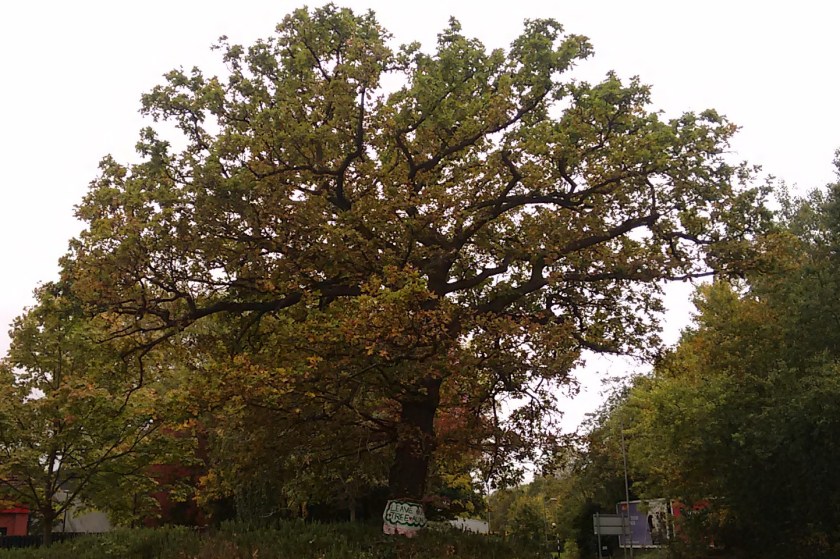
The proposal is to replace the Burger King building with 5 new retail units and move the drive-thru restaurant into the car park. Rear service entrance to the units will be required, necessitating a service road which effectively removes the woodland. Marked for re-development were a fine 120 year-old Oak, protected by a Tree Preservation Order (TPO), overlooking the roundabout and and an area of woodland also protected by a TPO which includes 12 specific trees with an understory of younger trees and bushes.

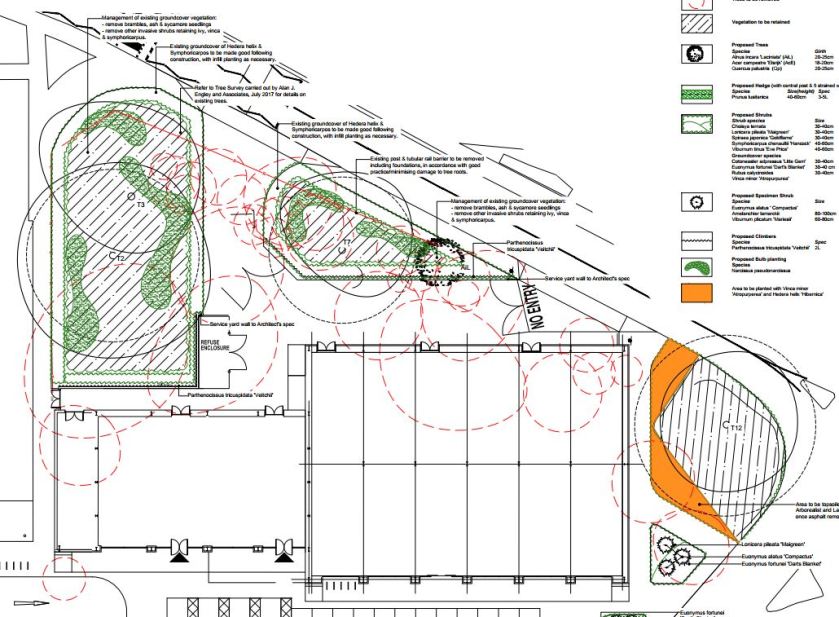
eastgate_oakOver summer there was great public outcry about the loss of the prominent oak  (Bristol Tree Forum) and plans were resubmitted which mark the oak, two poplars and an ash for retention, but with no change to the location of the buildings. The woodland area is still destroyed, leaving only three isolated trees from the original canopy and understory.

revised-construction

The aboricultural report produced by Matthew Bennett of the Bristol City Planning Department is very critical of the plans, pointing out that the proposal takes no account of the Bristol core strategy nor of the tree replacement scheme and remarks that “The group of trees are an important green infrastructure asset which has a historical reference and provided a significant visual amenity to an already heavily developed site.”

eastgate-spinney

Consolidated Properties Group  owns over 40 retail parks and retail units throughout the UK, having bought Eastgate in 2011 . The company is one the the richest family-owned businesses in the UK and is chaired by the founder, Peter Stuart Dawson. The company acquired Eastgate in 2011.

Looking at the aerial photographs of retail parks on their website, the absence of green spaces is very striking . Retail parks take up large areas of ground, comprising only buildings and tarmac. Very little land is given to green spaces or exposed ground. Trees where they are planted are largely functional, used for screening purposes.

Isn’t it high time that a significant part of retail parks should be reserved for trees and woodland.  This is after all more in line with the meaning of “park”. If not, then at least we should resist the urge to remove what little woodland does still exist.

Public consultation on the revised proposal is now closed but comments can still be addressed to councillors and officers.

Chris Wallace

17th October 2017

Bristol Trees Trust meeting – 2 August 2017 minutes

Cost of planting replacement trees will remain at £295. Only trees planted in new sites will be charged at £765.

Bristol City Council is looking for new ways to fund street tree maintenance – both short and long-term.

Attendance Bristol City Council:

Cllr Charlie Bolton, Cllr Asher Craig (Chair), Gemma Dando, Richard Ennion, Peter Mann, Shaun Taylor.

Attendance External:

Avon Wildlife Trust:  Eric Heath

Bristol Tree Forum: Mark Ashdown, Stephanie French, Peter Harnett, Vassili Papastavrou (minutes) and John Tarlton

Forest of Avon Trust: Jon Clark

BCR Streetscene Group: Rob Umphray

University of Bristol: John Tarlton

University of Birmingham Chris Bouch

Woodland Trust: Catherine Brabner-Evans and Ross Kennerley

Apologies:  Councillors Anthony Negus, Clive Stevens and Gill Kirk; Richard Fletcher; Liz Kew.

Councillor Craig welcomed the participants and summarised the present financial situation within Bristol City Council, which is being forced to make substantial cuts to its services.  In response to a question as to whether there is an acceptance that the cut in the street tree maintenance budget will result in fellings in 3-5 years, Councillor Craig agreed that there would be knock on effects.   The purpose of the meeting was to work together to find a solution to the problem and mitigate the impact.  The cuts in budgets across the council would have consequences.

It was decided that the group would focus on street trees but also consider the context of Bristol’s other publicly owned trees (in parks and on estates).  Notes to be circulated to attendees and further meeting to be held in mid-September.

Alternative models of supporting trees in cities – trust models including sponsorship, civic ownership

It was acknowledged that existing examples are for planting trees rather than maintenance.  A number of participants expressed the view that it was extremely hard to obtain money for maintenance, despite the well-known value of the urban trees and the various benefits (e.g. health and well-being, water retention, cooling effect) that they provide.  One idea was to use sponsorship plaques which would indicate that the maintenance of a particular tree was sponsored.

Tree maintenance concerns, epicormic growth and local community involvement

The implications of the cut in tree maintenance from £240,000 to £53,000 (£187,000 cut) was discussed.  Pollarding cannot be done by members of the public.  Rob Umphray provided details of epicormic growth removal that has already been undertaken by the Community Payback Scheme along the Gloucester Road.  It turns out that the insurers would not accept the risk of getting members of the public to work on highways, in particular, stepping out into the road and working on busy pavements.  However, very quiet residential roads may be a different matter. This means that in general the removal of epicormics growth will also have to be done by professional contractors.

It was agreed that street tree maintenance is a core council service which cannot be done by volunteers.

Action: Shaun Taylor to consider a flexible approach to allow communities to undertake certain works to highway trees where risk was considered lower and training / guidance could be provided to mitigate risk further.

 Councillor Craig suggested two possible immediate and short term solutions for the shortfall in funding for street tree maintenance.  The first was to use some of the money that remains within the “One Tree Per Child” budget, whilst maintaining that project at a slower pace.  The second solution is to access some of the approximately £4 million CIL funding (sum equivalent to a 15% allocation of total CIL receipts).

Action: Councillor Craig offered to come back to the next meeting in September with the outcome of her discussions re “One Tree Per Child”, including taking into account the partnership approach to delivering this project and using CIL funding (both the 15% that is currently determined locally and the remaining 85% that is currently retained wholly by the Council).  (N.B These are just proposals to be explored and brought back to next meeting)

Tree planting initiatives and the future of woodland creation

There was a discussion regarding the present sponsorship scheme for street trees where trees to replace stumps or in existing tree pits cost £295 and street trees on new sites cost £765 (plus the cost of an engineered tree pit if needed).  The scheme was seen as extremely successful and Richard Ennion was congratulated for getting it underway.  It was felt that a dramatic increase in costs would result in sponsorship drying up and may result in existing sponsors (such as the University of Bristol) withdrawing. It was also acknowledged that delaying planting in existing sites may ultimately result in much greater expense as a vacant site only remains “current” for a period of about 5 years.  Richard Ennion also confirmed that £295 was a true and genuine reflection of the actual cost of planting a tree in an existing site.   It was decided to maintain these sponsorship costs at the existing level and not implement the proposal to increase all tree costs to £765. This will require further “internal” discussion at BCC.

 “One tree per child” was discussed and the educational value of the project was stressed with good feedback from the schools involved.

The representative from the Woodland Trust suggested that it might be a mistake to separate street trees from the wider context.

Action: In terms of a way forward it was agreed to look into new funding sources and the possibility of setting up a Trust for the future.  It was felt that it is possible to raise funding for tree planting and this would be pursued.

 It was also agreed to start the process of preparing a Tree Strategy for Bristol

Future for trees in parks

Discussions regarding Bristol’s parks are ongoing and the Newcastle initiative of creating a Mutual Parks Trust is being explored, as well as Newcastle’s success in obtaining £1 million public health funding.  A visit to Newcastle is planned.

Next Meeting

The next meeting of the Group would be mid-September when Councillor Craig should be able to provide further information regarding the short term/immediate funding of street tree maintenance.

Vassili Papastavrou

12 August 2017

Please contribute to the Sheffield Tree Action Group Legal fund

The Sheffield Tree Action Group or STAG is urgently fundraising to support the legal fees of eight of its members.

The fund has reached nearly £21,000 (as of 23 July 2017) but it is likely that the legal costs will be double that for the three day hearing that starts on 26th July.

They have been taken to the High Court by Sheffield City Council in order to intimidate them and other protesters.  Sheffield City Council is hoping  that the court will issue injunctions against the protesters, claim huge damages and prevent them and others from opposing the felling of trees in future. One Councillor is amongst the eight.

Graham Turnbull from STAG spoke at our 4 July Bristol Tree Forum meeting.  The situation in Sheffield is shocking, with whole avenues of street trees being removed as part of a PFI agreement with Amey to manage Sheffield’s streets for 25 years.  Quite simply, it is cheaper to remove most of the street trees and replace them with small saplings than to maintain the existing stock of trees.  There have been 5 am dawn raids and arrests under obscure anti-trade union laws – although the Crown Prosecution Service dropped all charges against protesters. Now the council has decided to invoke civil law where the standard of proof is lower.

The problems Sheffield residents are facing are not unique. The outcome of their protests will determine whether other councils decide to embark on wholesale felling as a way of cutting costs. From a wider perspective, their council is seeking to outlaw peaceful protest. We should all help for those very reasons.

Bristol Trees in Crisis – Greens questions

Questions to the Mayor for the Member Forum to he held on 18 July 2017 at 17:00.

Green Councillors Clive Stevens and Carla Denyer have tabled the following questions.

Subject: Street tree budget cuts

In May, Cllrs Stevens and Negus submitted questions and statements to Cabinet about the safety and financial risks and the alternatives to the proposed budget cuts to street trees. They were reassured that the proposals would be looked at again. At the time of writing we have not heard any updates on this review.

We understand that Bristol Tree Forum volunteers are looking for constructive ways to work with the Council to solve this problem, but trust is at rock bottom and each time new information emerges it gets worse.

The emergency Tree Forum meeting on 4th July revealed some uncomfortable truths:

  • The Council’s Highways Department did not consult the Council’s arboricultural officers, the TreeForum or any other relevant experts about street trees before making their decision to cut 78% off the budget.
  • The budget line RS02 voted on in Full Council in February referred to £1.2m of Highways Maintenance Reductions in 17/18 and wasn’t specific as to what these would be.
  • Highways are justifying the decision on the basis of cutting back to a statutory service, usually doing this achieves the minimum short term cost. For street trees maintaining a statutory service level is not minimum cost as was and has been pointed out time and time again. We are still yet to see the fully costed business case and risk assessment.

Question 1

Could the Mayor clarify whether he wants to minimise the cost of managing street trees, or does he want the service to be at a statutory level which will cost the Council more (possibly more this year as reserves might need to be allocated to cover the higher risks)?

Question 2

Could the Mayor check with his legal officers the personal liability of himself and/or the Deputy Mayor and/or the Council should an accident occur where it is proven that the Council has a duty of care (e.g. Maintaining the highway) and that the damage is directly caused by this change in policy? Given the facts that have come to light, it seems that in such an instance it could be a case of negligence.

Urgent help needed to water new trees – an update – more new street trees dying

Bristol’s street trees are struggling in this recent hot, dry spell – especially the newly planted ones that have yet to get established. So, please keep watering any newly-planted trees and send us photos of new trees that are in trouble or have died.

On Saturday, Councillor Clive Stevens – @SageAndOnion  – and I spent some time filling up the Hippo bags (specially designed tree watering bags) connected to newly planted trees on the Downs to see how long they would take to drain.  We used four 5 gallon water containers placed on chairs so that they were high enough and then siphoned the water into the bag.

We can report that the bags do work effectively and take several hours to drain from completely full to empty.  Probably four hours is a good estimate.   As the problem does not lie with the bags, there must be some other reason why the soil under many of the new trees was completely dry for so long.

Several of those trees on the Downs that were completely dry when I checked them on Friday (7th July 2017) are now damp.  They must have been watered some time after 18:30 on that Friday and midday Saturday (when Clive and I went around watering), which is good.

Clive and I filled up the bags of a couple more where we found that the soil was completely dry (between Westbury Road and Westbury Park).  There are still some more in that area where the soil is still completely dry.  We haven’t done a complete survey of the Downs, but the soil under most of the other trees is now damp and there was still residual water in many of the bags on Saturday morning.

The Hungarian oaks on Parrys Lane have now had damp soil for the last 10 days, so the system is now working for them.

BUT on Easton Way…..

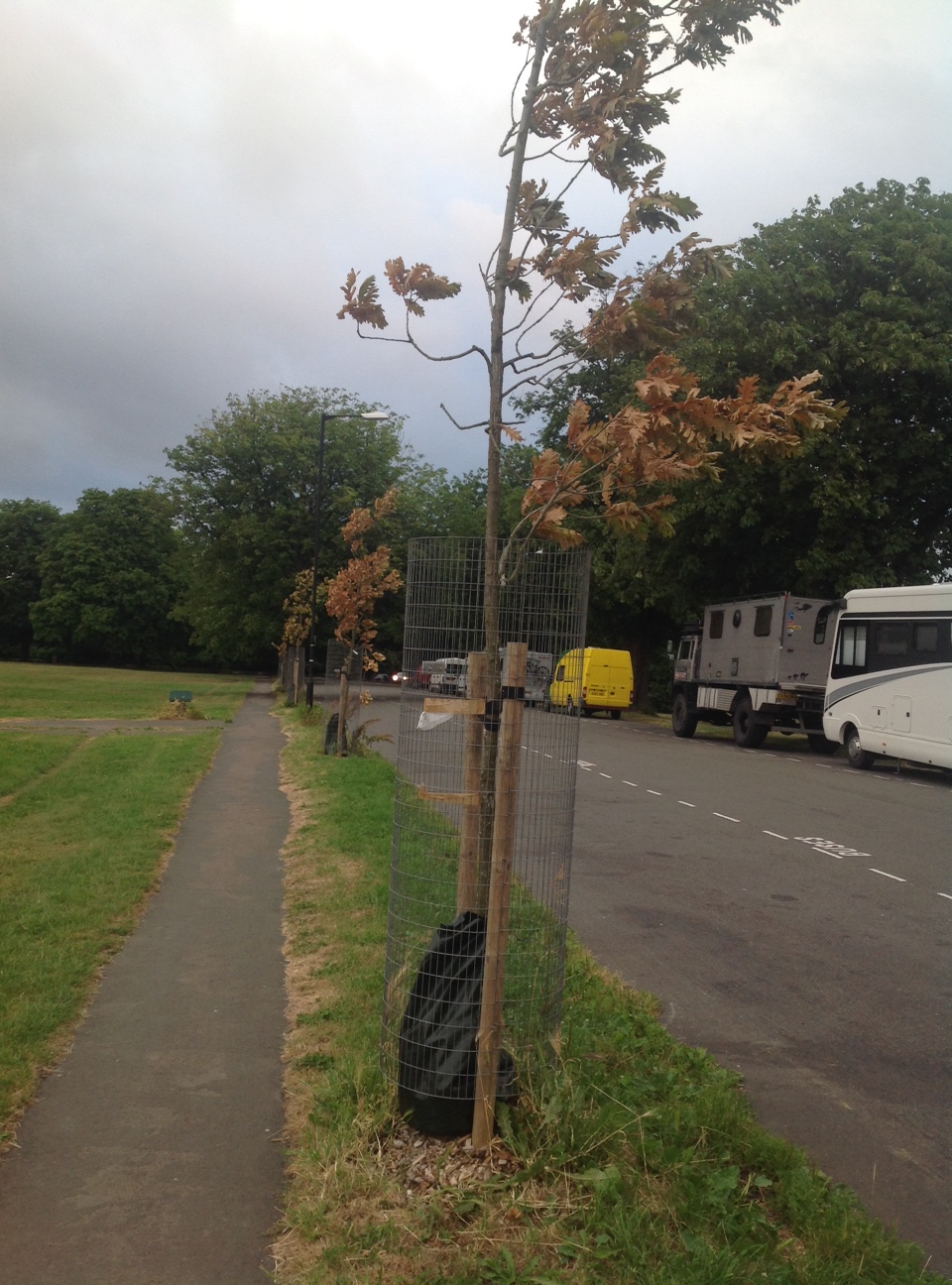
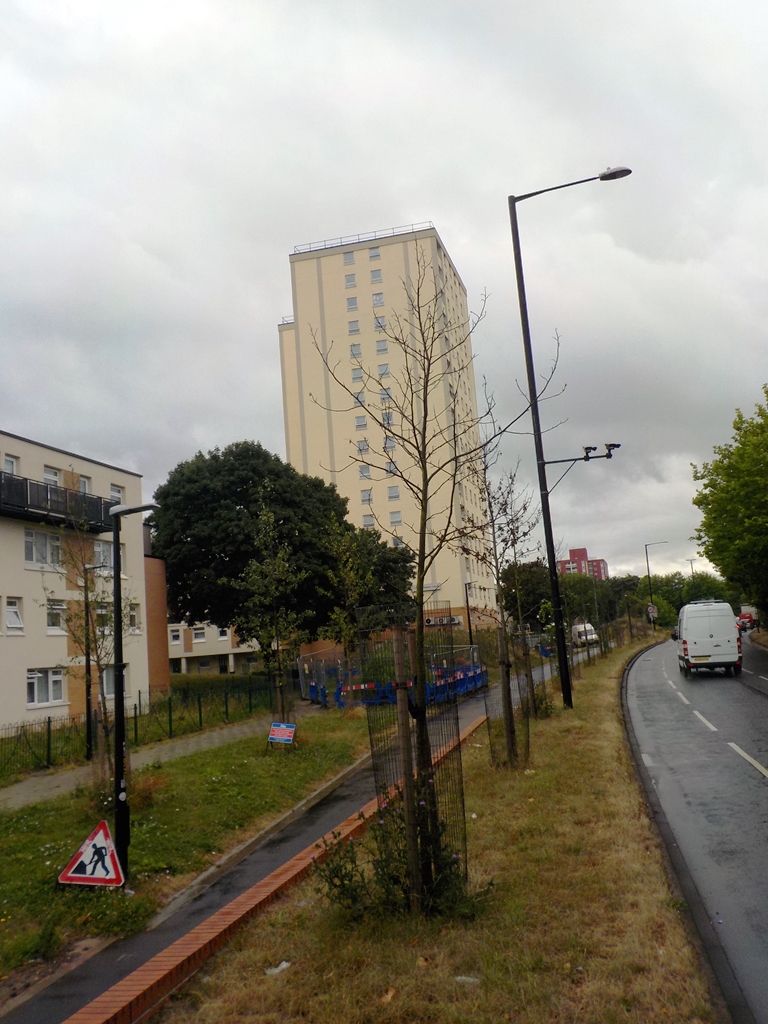
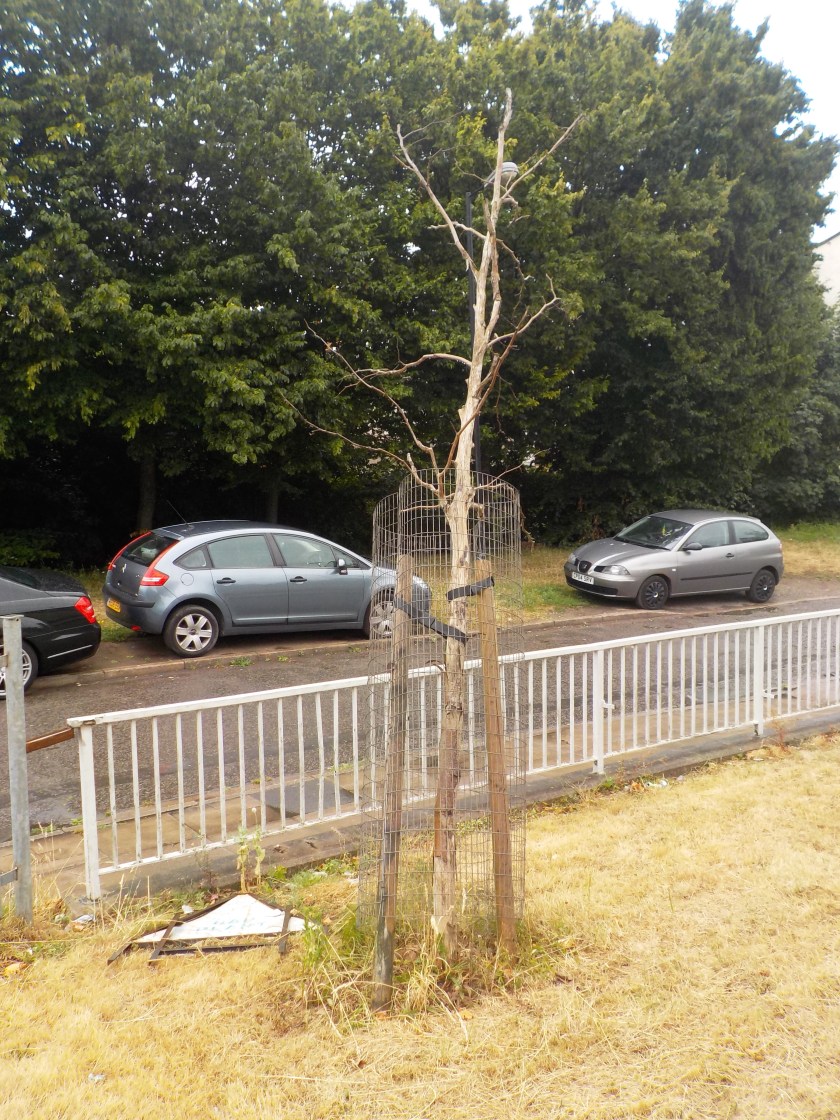
We hear from @averagearborist that there is a whole row of newly planted trees on Easton Way that have died, despite having only been planted only last year.  I went to have a look and they really are in sorry state.

DSCN3076


It was a great idea to plant these trees but so sad that they are now dead or dying.  It sends a poor message to the people who live in this area.

We are told that it should be OK because the Council has said that it will replace newly planted, sponsored trees that die before they are successfully established.  Here on Easton Way is a very dead tree. 

Already dead in Google streeview 2014

A quick examination of Google Streetview shows that it was already dead by June 2014.  When, we wonder, will it be replaced?

Vassili Papastavrou

Bristol Trees in Crisis – Conservatives’ Press release

Conservative Councillor, John Goulandris, is challenging the controversial decision to slash the Authority’s annual funding for street tree maintenance.

Earlier this year, news broke that Council spending on the upkeep of roadside trees was being cut drastically by £187k (from £240k to £53k) as part of wider savings planned for the highways budgets.

Critics have argued that this draconian measure was brought in without proper consultation and without taking  any advice from professionals like the Council’s own in-housearboriculturalists and important advisory local bodies such as the Bristol Tree Forum.

Furthermore, they suggest that this apparent cost saving measure could well prove to be counter-productive in the long term, as poorly maintained trees represent a risk to public safety and may result in an increase in compensation claims for personal injury or damage to property. Short term savings are likely to be more than offset by higher future maintenance costs.

Now, Cllrs  Goulandris and Weston have tabled questions on this issue to the Mayor (and a formal resolution) for the next Members’ Forum and Full Council, to be held on Tuesday, 18th July.

Cllr Goulandris (Stoke Bishop) said:

“The level of public concern over this appalling decision is quite extraordinary.

Equally shocking has been the total lack of transparency in arriving at this saving. Specific details of the proposal – passed by the Mayor’s Labour colleagues in February – appear to have been hidden under a very broad heading of planned reductions in the Highways maintenance budget.

The lack of consultation over the efficacy of this move is also extremely worrying. Not consulting even the Council’s in house tree experts beggars belief and casts serious doubt on the credibility of the proposed savings.

Many residents have approached us to say that, if the Highways Department has to make savings, this should come from cutting back on expensive, over-engineered traffic schemes and installations rather than the essential upkeep of our street trees.

Slashing funding on tree management sends out a strange, contradictory message from this Administration, especially when Bristol only recently handed over its mantle of European Green Capital.

Therefore, we intend to urge the Mayor to rethink this daft idea and reinstate the funding, until a proper analysis of this proposal has been undertaken and a sensible new street tree policy adopted.”

Questions from Councillor John Goulandris:

Street Tree Budget 

Q1.         At a meeting of the Bristol Tree Forum on 4th July, held at City Hall, senior highways officers admitted that they had not consulted the Council’s in-house arboriculturalists, when setting the budget for street tree maintenance. They also admitted that they had no expertise in tree management or tree maintenance budgeting.  Is the Mayor comfortable that this approach to setting the reduced street tree budget is reasonable, rational and prudent?

Q2.         Tree professionals have opined that, if street trees are not subject to regular maintenance e.g. pollarding, this short term approach stores up costly problems for the future.

Is the Mayor fully satisfied that the short term savings identified by reducing the street tree budget will not be more than offset by rising costs in future years?

——————————————————————————————————————————-

Questions from Councillor Mark Weston

Street Trees and the environment

Q1.         Mature trees absorb a huge amount of CO2 and mature street trees in particular help to combat air pollution in our cities.  Does the Mayor agree that Bristol’s street trees play an important role in improving our environment and helping air quality?

Q2.         If mature street trees are not maintained responsibly, their uncontrolled growth can cause problems, given their proximity to houses and the highway. As a result of the reduction in the street tree budget, a ‘simple’ solution to future street tree management may be the felling of mature street trees as has happened in Sheffield. This has a devastating impact on both the street scene and air pollution.  It would also send out a very curious, contradictory environmental message from a recent European Green Capital City. Will the Mayor give his commitment not to fell Bristol’s street trees?

Motion to be moved by Councillor John Goulandris

SAVING BRISTOL’S STREET TREES

“Council is extremely concerned about the hasty decision by Highways drastically to reduce – by 78% – departmental spending on the Street Tree Management Programme.

This move is said to be part of wider savings to be achieved within the highways maintenance budget. However, there seems to have been no prior consultation either within the Council with tree officers or externally with residents and other stakeholders. It would appear that no proper consideration has been given to the efficacy of such action or whether such savings are sustainable.  For example, the relevant line in the Mayor’s budget last February simple states ‘reduce revenue funding by £1.7m’.  This clearly does not articulate sufficiently how such a saving proposal was to be made or the likely impact it could have on the city’s treescape.

Council seriously questions the wisdom of such a sudden and massive spending cut on essential tree maintenance, which raises issues over public safety, increased pollution, damage to roads, pavements and property, as well as leading to a potential rise in compensatory insurance claims and payments. Short term savings in year 1 could well be outweighed by long term costs in future years.

Savings do, of course, have to be found by Bristol City Council. At a recent public meeting to discuss future street tree maintenance, residents stated that they would much prefer available money being redirected from over engineered traffic management/highways projects e.g.  unnecessary traffic light installations and instead put towards helping to maintain our tree canopy, which is environmentally invaluable in helping to absorb CO2 and maintain air quality.

Accordingly, Council calls on the Mayor to reinstate street tree maintenance funding, until such time as a proper evaluation of the implications of this cut has been undertaken and a new street tree policy – formulated with the help of experienced bodies like the Bristol Tree Forum and the Council’s in house tree officers – is adopted.”
Bristol Trees in Crisis – some personal thoughts…

Having spent 3 years as a climber in Bristol on the Council contract undertaking much of the pollarding work and as a current resident of the city I not only find this situation shocking but also very worrying.

At last night’s Bristol tree forum meeting it was finally officially announced by the deputy mayor that due to budget cuts, which now only leaves £53,000 per annum for tree management, the council will be no longer be undertaking any pollarding on the city’s population of street trees. There will also be a termination of epicormic removal which will now only be removed when reported on the grounds of Health and Safety. Later in the meeting the Highways manager when questioned several times finally admitted that this decision had been taken without any consultation or advice from the City’s Arboricultural team, which to me beggars belief.

These trees which are predominantly London Planes and Limes have levels of decay which you would expect to find but are no real cause for concern due to them being on 3/5 year pollarding cycles. There are many however that due to their proximity to commercial buildings and houses are on 2-year cycles as in the photograph below. The photograph below is in fact taken in my old road and by the time the 2 years was up the regrowth was practically touching our bedroom windows and gutters.

Pollarding Needed
Ready for pollarding…

The suspension of the pollarding program as was pointed out to the deputy mayor comes with many potential problems in the future. It was pointed out that there would be an escalation of claims to the Council for damage to property either through over grown crowns or root damage. There is the potential for an increase in limb failure due to excessive weight and god forbid serious injury to pedestrians from falling debris. One of the positives of the pollarding cycles was that the cities Tree stock was getting a full aerial tree inspection every few years with any defects monitored and managed. This will no longer be the case. One concerned resident stated that his house insurance policy is dependent on the tree outside his house being pollarded every 3 years.

As the meeting went on there was a call from Councillors for everybody to get their heads together and discuss a way forward and to come up with solutions to this big problem. Amongst other things suggested was the possibility of residents raising money and having trees pollarded themselves by fully qualified and insured arborists.
It’s all a bit of a mess and who knows where this will all end up but I am very interested in all your thoughts/ideas. Thanks in advance.

Sean Harding – A Bristol tree climber

Comments

‘That is one of the most short-sighted least thought through council decision ever… It will lead to a costly mess, unless they are planning the Sheffield fell everything strategy…’

‘Out of interest is there Massaria on the plane trees in Bristol? If there is, I suspect it’s possibly quite low in occurrence due to the previous regular pollarding, but that would change significantly if the trees become lapsed and develop larger older wood canopies where Massaria thrives. The potential risk of dead Massaria branches not being picked up via inspection and dropping on to target areas would likely increase significantly. What’s the geology in Bristol? Is there much clay around the streets? If there is, the council will not just get an increase in claims due to direct root damage to property but there will be an increase in claims due to subsidence. of course there would be a small positive in the increase of shade due to larger canopies (particularly in terms of urban heat island effect) but doesn’t sound like the tree stock could sustain that benefit for long. Frustrating to hear of the shortsightedness of this decision.’

‘This is some middle managers and some upper managers in the public sector doing what they do best: being absolutely diabolical at doing anything remotely useful.’

‘The public should not be or considering funding any council tree work. Even if it’s to maintain the pollarding cycle or tree health. As soon as they do the council will jump on this, appeal to the community spirit to get money’

‘How u meant to see decay fruiting bodies on base of a lime tree without the epicormic growth being removed.?’

‘So who owns the trees? Are they strictly municipal street trees? If so, seems to me the municipal government has a legal duty to keep the trees pruned so as to promote public safety. The trees are in the shape they are in due to past municipal pruning. If not, pruning them will knowingly increase risk. wouldn’t a pre-emptive lawsuit be called for in order to force continued pollarding? In the long run, injury suits could blast that budget number you stated right out of the water.’

‘There’s a blind spot in all councils at this level: they can hold a ballot on increasing Council Tax for specific things such as this.’

‘Sounds like we are going to have to come up with some kind of crowdfund/localised taxation system if you can afford it, messed up, leave the poor peoples’ trees to fall apart until someone is injured before any pollarding will take place.’