Calculating tree habitat area

A key factor in calculating the value of a habitat under the new Statutory Biodiversity Metric is to work out its size. In the case of trees, their habitat size can be of critical importance to the calculation of their biodiversity valuation which will, in turn, help to preserve our precious tree habitats.

As a result, individual trees in an urban setting are often the most important habitat present.

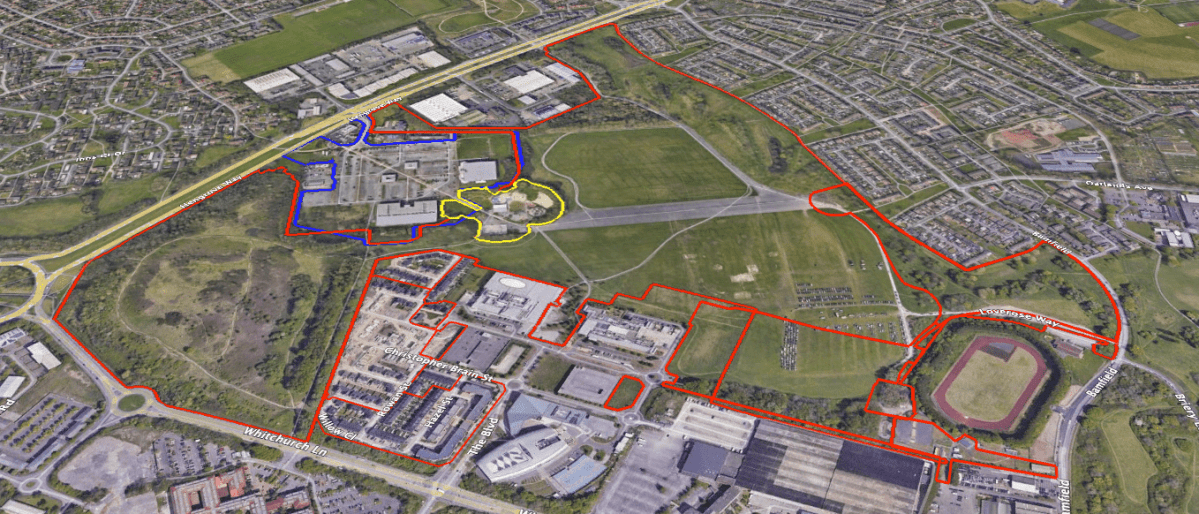
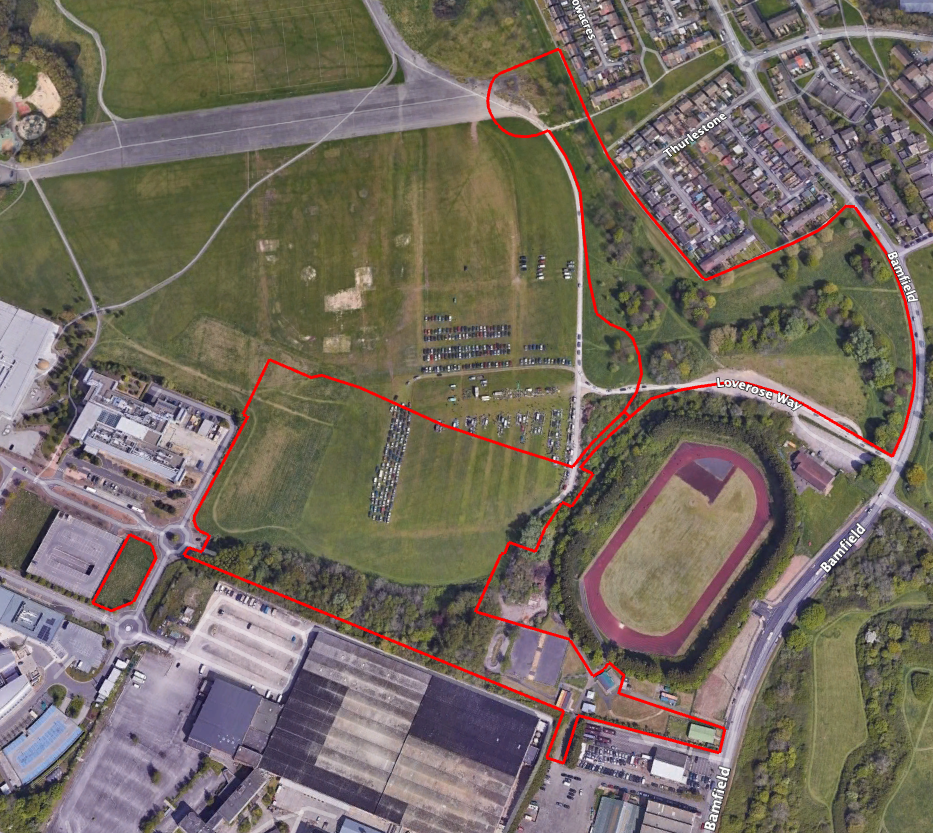
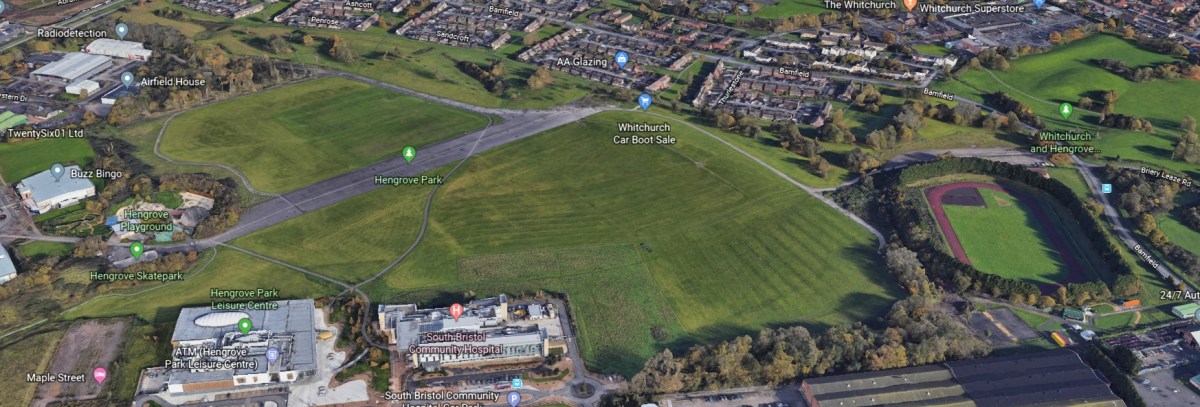
Unfortunately, developers may be tempted to allocate all trees on their planned development site (especially those in groups) to Woodland and forest habitats rather than to Individual trees habitat, because this gives the trees and the site a lower biodiversity value. An example of this is the proposed development by Goram Homes of Hengrove Park in Bristol, as shown in the image above and discussed below. The whole site was granted outline planning permission in October 2019.

Unfortunately, the Statutory Biodiversity Metric User Guide (the Metric) definitions of these habitats are ambiguous and can make such allocations hard to counter, even in settings that are clearly urban.

The User Guide defines two broad tree habitats types whose areas are measured in hectares (ha):

  • Woodland and forest
  • Individual trees

Defining woodland and forest habitat

There are conflicting definitions of ‘woodland’. The Metric User Guide does not define Woodland and forest habitat.

However, the UK Habitat Classification, UKHab, upon which the Metric is based, defines it as ‘Land with 25% or more cover of trees that are five metres or more in height.’ This definition doesn’t mention the minimum land area required.

The UK National Forest Inventory 2015 (NFI) defines woodland as:

a minimum area of 0.5 hectares under stands of trees with, or with the potential to achieve, tree crown cover of more than 20% of the ground. Areas of young trees, which have the potential to achieve a canopy cover of more than 20%, will also be interpreted as woodland and mapped. The minimum width for woodland is 20 m, although where woodlands are connected by a narrow neck of woodland less than 20 m wide, the break may be disregarded if less than 20 m in extent.

Bristol City Council also uses area to define woodland in its 2008 Biodiversity Action Plan (Chapter 5, page 65), which states that ‘this action plan covers all woodlands over 0.5 hectares in extent found in Bristol.‘ As this is a local policy, and aligned with the NFI definition, we have adopted it.

The habitat area of Woodland and forest habitats is based on its total measured canopy area.

Defining individual trees habitat

The Metric User Guide (page 53) advises when to record Individual trees habitat:

Individual trees are classed as ‘urban’ or ‘rural’. You should consider the degree of ‘urbanisation’ of habitats around the tree and assign the best fit for the location. 

Use the broad habitat type ‘Individual trees’ to record: 

  • individual rural trees 
  • individual urban trees 
  • lines, blocks or groups of trees found within and around the perimeter of urban land.

In all circumstances ‘Individual trees’ should be used to record ancient and veteran trees, regardless of location. This could include ancient and veteran trees within hedgerows, ‘rural’ lines of trees and woodlands. 

Other clarifications

Do not use the hedgerow module classifications ‘line of trees’ and ‘ecologically valuable line of trees’ to record linear formations of trees in the urban environment.

These classifications should only be used for rural lines of trees.
Trees within overgrown non-native and ornamental hedges (for example, leylandii) should not be classified as individual trees, or as lines of trees. Record these as nonnative ornamental hedges within the hedgerow module.

Trees recorded as individual trees that will be removed for any purpose, including development, disease, or safety must be recorded in your baseline and recorded as lost.

Do not otherwise record individual trees if they occur within a habitat type characterised by the presence of trees, unless specified within the section on ‘recording individual trees at baseline’, which covers: 

  • trees within private gardens 
  • removal of trees within hedgerows 
  • removal of trees within rural lines of trees 
  • removal of trees within orchards and wood-pasture and parkland 

Recording individual trees at baseline 

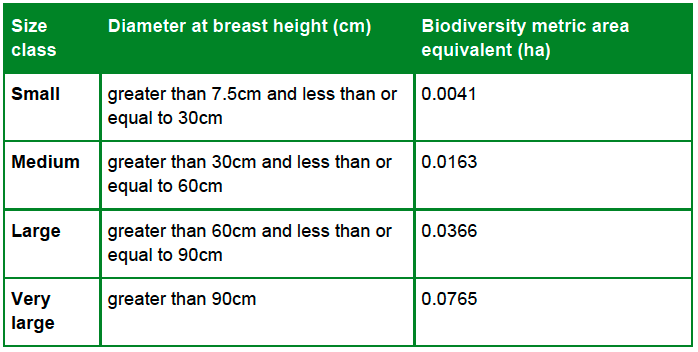
The biodiversity metric uses set values to represent the area of individual trees depending on their diameter at breast height. 

This value is a representation of canopy biomass, and is based on the root protection area formula, derived from BS 5837:2012. 

Table 14 sets out class sizes of trees and their area equivalent. 
The User Guide then deals with specific instances where individual tree habitats also need to be recorded:

Recording baseline trees within private gardens

A private garden is a garden within the curtilage of a privately owned or tenanted dwelling house. Private gardens can contain important features for biodiversity, including mature trees and hedgerows. 

record all medium, large and very large trees within private gardens as individual trees 

Recording baseline trees within hedgerows and lines of trees 

  • if any medium, large or very large trees within a hedgerow or ‘rural’ line of trees are being removed, record these in the area baseline as individual trees 
  • the removal of trees may influence the linear value of hedgerows and ‘rural’ lines of trees within the hedgerow module 

Recording baseline trees within orchards and wood-pasture and parkland 

  • if any medium, large and very large trees within these habitats are being removed, record these in the area baseline as individual trees 
  • this does not change the way in which you would record the area of orchard or wood-pasture and parkland area habitat (see ‘Recording habitat mosaics’ section) 

Calculating the number of post-development trees required

Post-development size classes 

When planting trees post-development size class is determined by the size of the tree at site-planting. When using the tree helper: 

  • record newly planted individual trees as ‘small’, unless ‘medium’ size or above at the time of site-planting 
  • record trees planted with a DBH less than 7.5 cm as ‘small’ 

You should not: 

  • record natural size increases of retained trees within post-development sheets 
  • record natural size increases of planted trees within post-development sheets 

The post-development private garden has no public access, and biodiversity net gains cannot be legally secured. As these gains cannot be secured you should only record created private gardens as either: 

  • ‘urban – vegetated garden’; or 
  • ‘urban – unvegetated garden’ 

You should not: 

  • record the creation of any other new habitats within private gardens 
  • record enhancement of any habitat within private gardens 

However, habitats which are recorded in the baseline and remain within a private garden may be recorded as retained. 

A garden within the curtilage of a privately owned or tenanted dwelling house.  The post-development private garden has no public access, and biodiversity net gains cannot be legally secured. 

How these rules affect the tree habitat area calculation

As a result, this approach places a higher value on the areas of all but the largest Individual trees habitats than those that form part of a Woodland and forest habitat. The following graph shows this, with RPA, derived from DBH, representing the canopy biomass of both broad habitats.
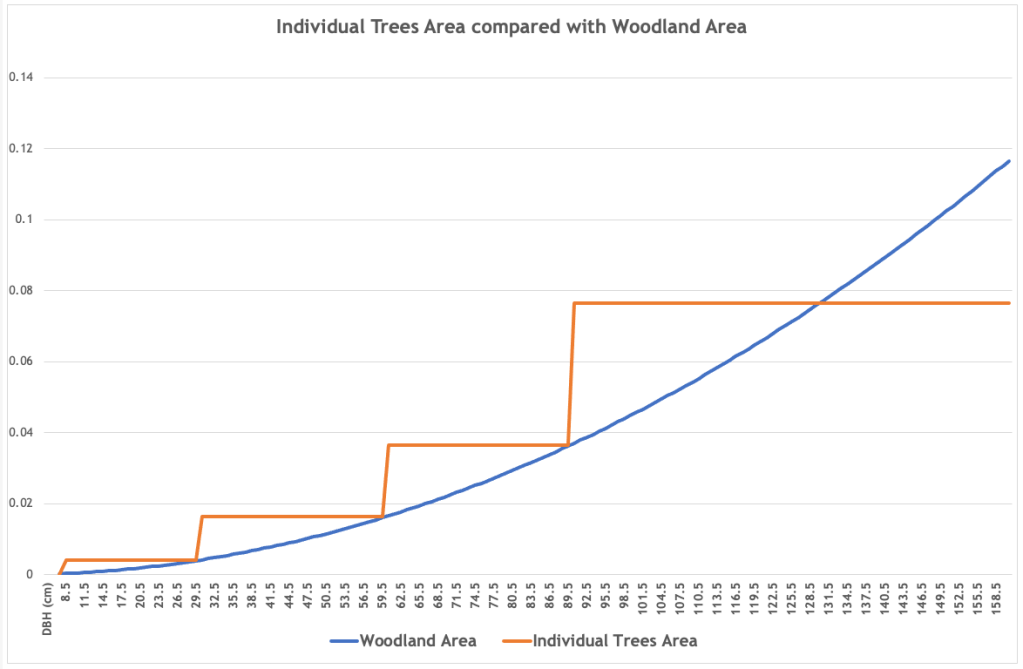
We analysed 12 recent planning applications involving 2,116 trees, 612 (29%) of which were identified for removal. Using the Metric User Guide, they have a combined habitat area of 20.2 ha. If they are measured by canopy area it would only be 8.3 ha (41% of their habitat size). If their combined Root Protection Areas (RPA) were used, they would cover only 8.6 ha (43% of their habitat size).

On the basis that all these trees are in poor condition and have no strategic significance, we calculate that, with the minimum 10% biodiversity net gain now required, a total of 1,925 new trees would need to be planted to replace the habitat lost by the removal of these 612 tree – a ratio of just over 3:1.

To illustrate how this can affect actual applications, here’s a pending application by Goram Homes at Hengrove Park in Bristol. The area edged in red is the development site.
This next image shows how the applicant’s ecologists have defined each habitat: the woodland and forest habitats are shown as a diamond pattern on a dark green background. They cover 2.44 ha.
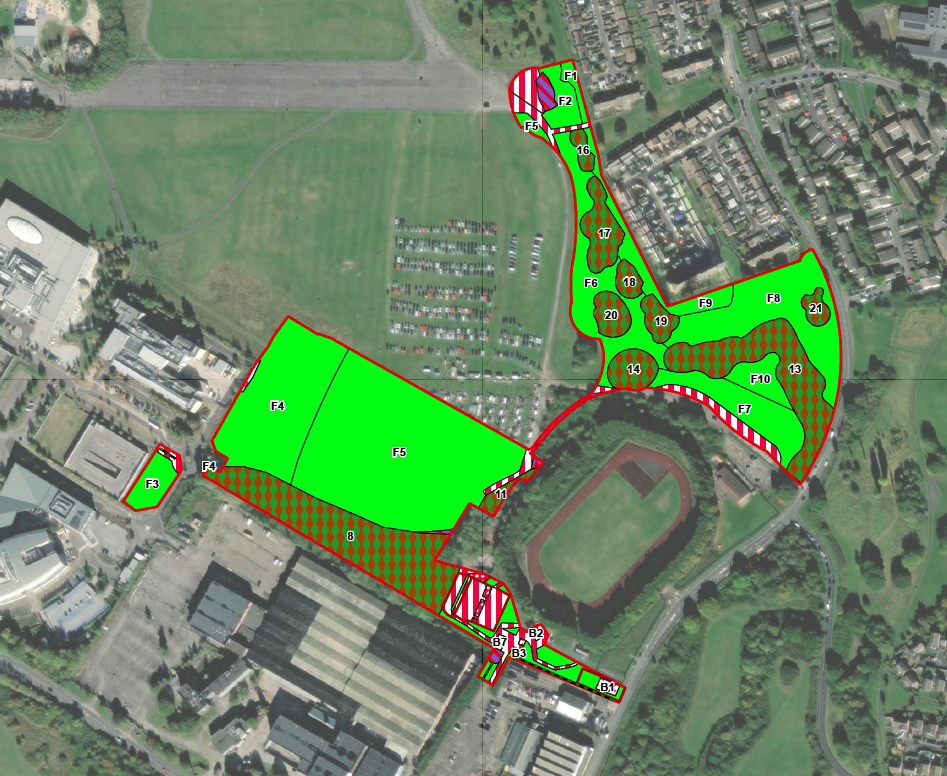
They’ve also identified 0.19 ha of Individual trees habitat, that is, trees not growing within the woodland and forest habitats.

Area 8 in the south of the site (0.99 ha) might legitimately be designated Woodland and forest habitat, but, given that all the remaining trees are growing separately and in groups in an urban park, they should be designated Urban Individual tree habitat.

The site is complex, with many trees growing in groups but, by excluding the trees in area 8 and treating all the other onsite trees as Urban Individual tree habitat, we calculate that their habitat area is 6.42 ha. This is 4.78 ha more than the applicant’s calculation. This difference will clearly have a significant impact on the final biodiversity net gain calculation, valuing these habitats at 34.07 area habitat units (or 2,989 Small size trees) as opposed to the applicant’s 12.11 (or 1,063 Small size trees).

To give the applicant their due, they at least attempted to calculate the tree habitat area. We have seen other applications where the trees were simply ignored, or were classified as another habitat – bramble scrub in one case, or the method by which the Individual trees habitat area was calculated bore no relationship to the evidence submitted. We must remain ever vigilant against such tricks.


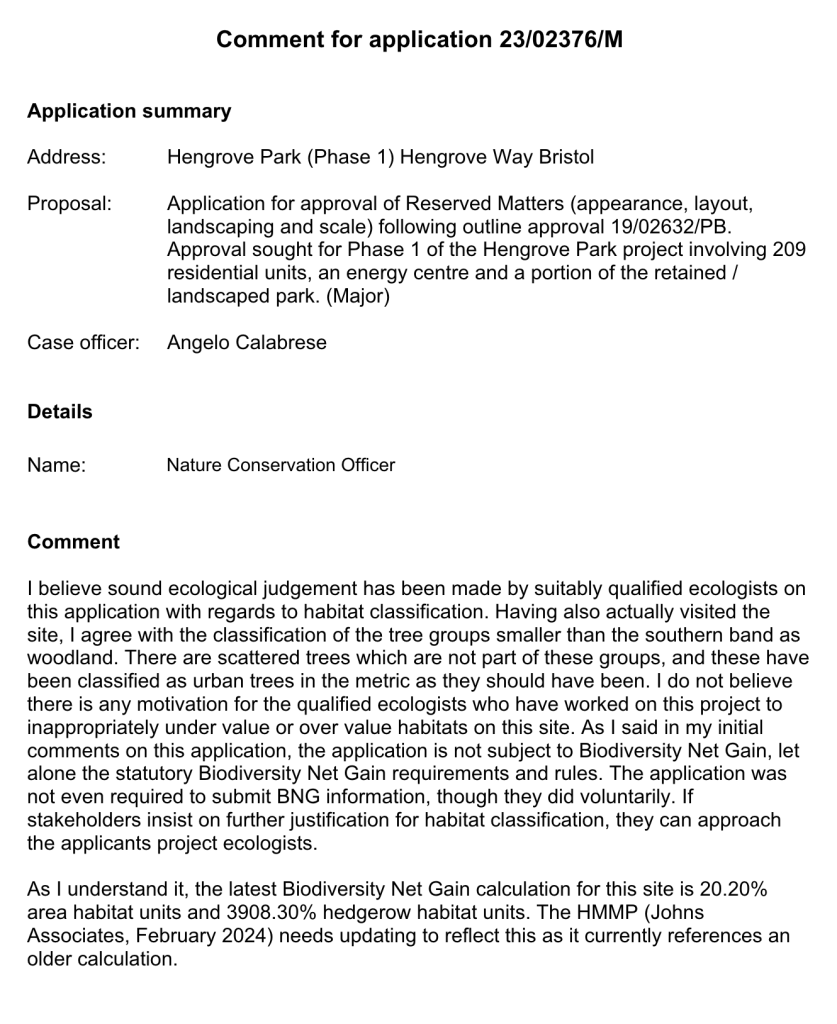
This blog was amended on 09 May 2024 to include the comments of the Nature Conservation Officer dated 03 May 2024 about whether the trees on the Hengrove Park development site are Individual trees habitat or Woodland and forest habitat. The officer writes:
This blog was amended on 14 February 2024 following the obligation for most planning applications to achieve at least 10% biodiversity gain becoming obligatory on 12 February 2024.

Further changes have been made following updates published in July and August 2024, in particular the clarification of the application of BNG in private gardens.


Other Blogs in the series
Calculating habitat units

The trading rules explained


Hundreds of trees threatened at Hengrove Park

The Council’s Development Control A Committee will meet at 6 pm on Wednesday, 16th October at The City Hall to decide the fate of more than 850 parkland trees. We have submitted this statement:

Hengrove Park is just under 51.5 hectares in area and contains 545 mapped trees comprising 37 species. There are many more unmapped trees also growing there.

These trees have a Capital Asset Valuation of Amenity Trees (CAVAT) (One of a range of tools recommended by The Trees and Design Action Group (TDAG) for valuing trees and green infrastructure ) value of at least £5.2 million, a valuation which is based on measurements of the tree diameters made at least 10 years ago. In the meantime, the trees will have continued to grow, making the current CAVAT value even greater.

The Bristol Tree Forum (BTF) was not consulted about the proposed development of this site, which will result in the removal of hundreds of these trees. Many local residents have submitted comments expressing concern about this aspect of the development.

BTF’s starting position is that trees should not be felled if at all possible, and that everything that can reasonably be done to avoid this should always be considered before a felling decision is made. If trees must be felled, then compensatory planting should be undertaken in such a way that there is no net environmental loss.

In order to implement the Council’s recent declaration of a climate emergency, increase net biodiversity and help double tree canopy cover, this development needs to be redesigned to fit around the existing trees, not remove them.

The current documents make various assertions as to the numbers of trees to be lost and the calculations for replacements required under the Bristol Tree Replacement Standard. This can be addressed by the imposition of our proposed planning conditions (see below).

Implementing Bristol’s declaration of a climate emergency

Bristol City Council was the first UK local authority to declare a climate emergency. As Professor Corinne Le Quéré FRS has said, “Actions to tackle climate change have to penetrate all the decisions that we take in society.”

The Government’s 25-year environment plan states that it will strengthen existing requirements for net gain for biodiversity in national planning policy. As it is, we have calculated (appendix 1) that this scheme, if permitted, will result in a net environmental loss of just over £3.65 million – Our CAVAT valuation of the trees potentially lost to this development is nearly £3.8 million (point 8 of Appendix 1). If the figures for tree felling relied on by the Council are accepted, then the figure will be much higher.

Bristol also has ambitious plans to double its tree canopy by 2046. If it is to implement this, and is serious about its declaration of a climate emergency, and wishes to achieve a net gain in biodiversity, then developments like this need to be radically rethought so that we build houses around existing trees rather than felling them, thereby avoiding or at least minimising the loss of our precious existing tree stock.

In addition, we note that the plan is also to remove a row of black poplar trees, a key landscape feature of the site. This is contrary to Policy BCS9 of the Bristol Core Strategy.

Conflicting figures for the calculation of replacement trees under the Bristol Tree Replacement Standard

The figures for the number of trees to be felled differ within the various planning documents and the BTRS calculations are confusing. We address this in detail at Appendix 1.

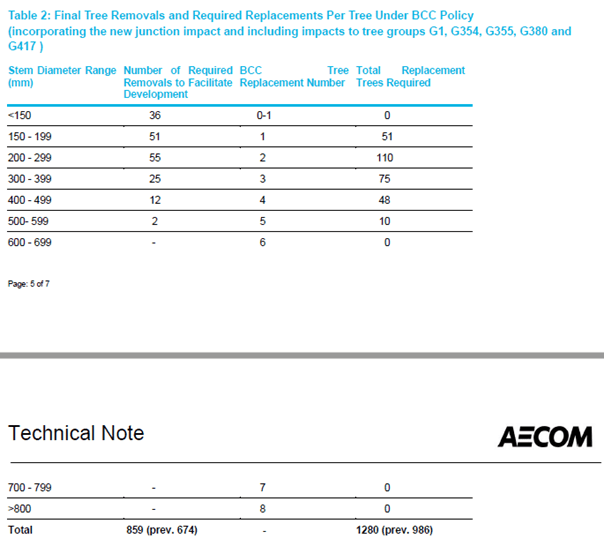
A technical note (23rd September 2019) identifies 859 trees to be felled, to be replaced by 1,280 new trees.  Elsewhere in the note, a table lists the values given for each BTRS category, which come to a total of 181 trees to be felled with 294 replacements. The table produced at paragraph 5.5.17 of the Environmental Statement Addendum gives different values again – 674 trees to be felled with 986 replacements.

These serious discrepancies need to be resolved before the Committee can form any clear idea of the impact of this development on the park’s trees. We propose a number of planning conditions, set out below, to ensure that the BTRS calculations are correctly made.

We are also concerned to read the Tree Officer’s report which states “As a number of the proposed trees are extra heavy standards it is considered that these can count as three new trees and overall the BTRS is met”.  This is simply wrong. The BTRS contains no such protocol.

The care of replacement trees after planting

Many trees that have been planted as a result of large schemes like this fail because they are not properly looked after.  A recent example is the Metrobus scheme, in which large numbers of trees were planted but have failed, probably due to lack of watering or, in some cases, vandalism. As far as we are aware, Metrobus (the developer) has not given any indication that it will replace these lost trees.

In our view, any replacement planting must be done under British Standard BS8545:2104 (Trees: from nursery to independence in the landscape) with a detailed specification in these terms being made a condition of the development. This should include a clear obligation placed on the developer to replace trees which fail within, say, five years of planting.

Planning conditions requested by BTF

The information that has been used to undertake the BTRS calculation is both incorrect and two years out of date.

If the Committee allows this proposal to proceed despite this, we request that the following planning conditions be imposed:  

  • No felling and replacement of any of the trees on the site should take place unless and until an updated survey is undertaken and the actual numbers and DBH values of all the trees (both individually and in groups) identified for felling are ascertained.
  • The BTRS replacements required are agreed with the Bristol Tree Forum and a Planning Arboricultural Officer.
  • All tree planting conforms with British Standard BS8545:2104 (Trees: from nursery to independence in the landscape).
  • A condition of the development includes a clear obligation on the developer to replace trees which fail within, say, five years of planting.

Here is the full statement we have submitted – BTF Full Statement, plus the one page summary that we have been asked to submit for the committee meeting – BTF Summary Statement.

We also link to the Statement submitted by Treespect which we wholly endorse.

You can link to the Council’s application here, via our BTF Planning Portal – 19/02632/PB.

Appendix 1

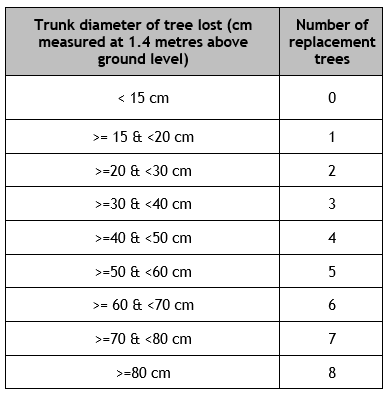
The application of BTRS requires that the trunk diameter (called Diameter at Breast Height, or DBH) of each tree identified for felling be measured. This measurement is then used to calculate the number of trees to be planted as replacements for the felled tree using this table:

This planning application is based on a tree survey that was undertaken some time in November 2017 and set out in an Arboricultural Impact Assessment dated May 2019. Part of this survey was updated in Appendix C of an Environmental Statement Addendum dated 4th September 2019. However, the DBH values have not been changed, so these values are now two years out of date. The trees will have grown in the meantime.

There is also a technical note dated 23rd September 2019 which identifies 859 trees to be felled, to be replaced by 1280 new trees. The following table is produced on page 5 of this note:

However, the values given for each BTRS category come to a total of 181 trees to be felled with 294 replacements, not the totals shown above.

The table produced at paragraph 5.5.17 of the Environmental Statement Addendum gives different values again: 674 trees to be felled with 986 replacements. However, this excludes the number of individual trees within groups G1, G354, G355, G380 and G417, so it is impossible to make any like-for-like comparison.

Having collated the two surveys published in the Arboricultural Impact Assessment and in Appendix C of the Environmental Statement Addendum into a spreadsheet (click here to download), we note the following:

  1. 533 individual trees have been identified and their DBH values recorded. Of these, 167 are identified for felling.
  2. 43 tree groups have also been identified, 13 of which are listed for removal or part removal.
  3. Save for groups G347, G347b and G347c (which have 5, 24 and 7 trees respectively in them) the number of trees in each group (or the number of trees to be removed) is not given.
  4. Save for groups G347, G347b and G347c (which have 5, 22 and 7 DBH values respectively listed), only one DBH value is given for each group.
  5. If we assume one tree per species listed for each unnumbered group,[1] then 228 trees in total are identified for felling.
  6. This produces a BTRS value of 294 replacement trees (again, if we assume one tree per species for each unnumbered group and that all these trees have the same DBH[2] as that given).
  7. Of the trees surveyed, 176 are given an ‘Estimated Remaining Contribution’ (life expectancy) of 10+ years; 46 have a life expectancy of 20+ years; and the remaining six have <10 years of life left. These 10+ and 20+ values are meaningless as they give no upper range. The CAVAT approach is to set life expectancy within these bands:
    • <5 years.
    • >=5 & <10 years.
    • >=10 & <20 years.
    • >=20 & <40 years.
    • >=40 & <80 years.
    • >=80 years.
  8. Applying a life expectancy of between 40 and 80 years and a CTI factor for Bristol of 150,[3] we calculate that the 228 trees we have identified for felling have a CAVAT value of £3,784,282. Using the same factors, the 294 BTRS trees (assuming standards with a DBH of 5 cm) would have a CAVAT value of £134,184, a net environmental loss of £3,653,652.

[1] We accept that each group probably contains more trees than our working assumption.

[2] We accept that the DBH values will vary from tree to tree.

[3] A CTI factor is applied to the base CAVAT value to account for population density. Bristol has a population of 459,300 and a land area of 10,970 hectares. This gives a population density per hectare of 41.9 and so a CTI Index of 150.