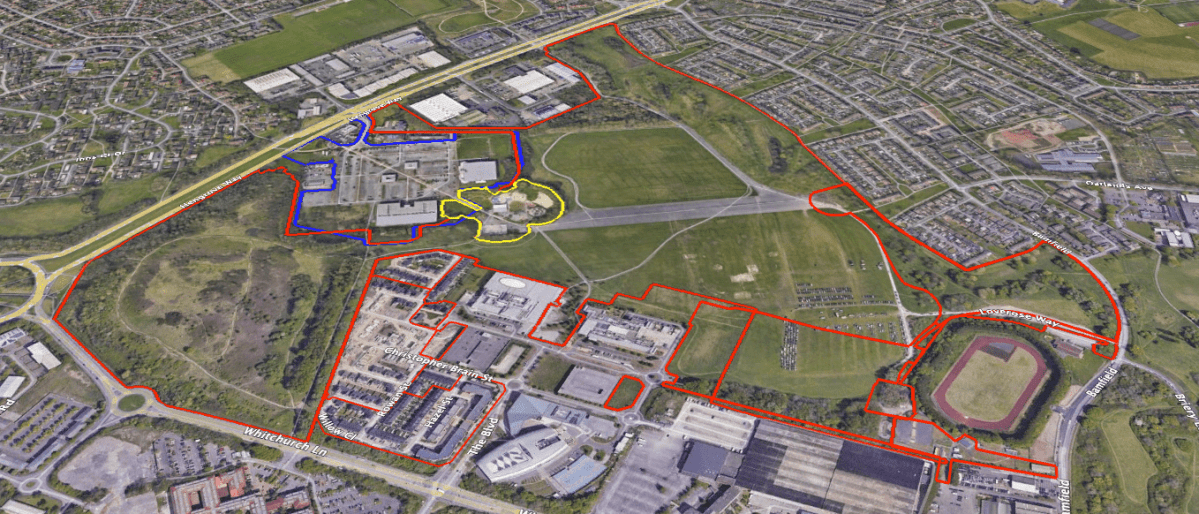
Unfortunately, developers may be tempted to allocate all trees on their planned development site (especially those in groups) to Woodland and forest habitats rather than to Individual trees habitat, because this gives the trees and the site a lower biodiversity value. An example of this is the proposed development by Goram Homes of Hengrove Park in Bristol, as shown in the image above and discussed below. The whole site was granted outline planning permission in October 2019.
Unfortunately, the Statutory Biodiversity Metric User Guide (the Metric) definitions of these habitats are ambiguous and can make such allocations hard to counter, even in settings that are clearly urban.
The User Guide defines two broad tree habitats types whose areas are measured in hectares (ha):
- Woodland and forest
- Individual trees
Defining woodland and forest habitat
There are conflicting definitions of ‘woodland’. The Metric User Guide does not define Woodland and forest habitat.
However, the UK Habitat Classification, UKHab, upon which the Metric is based, defines it as ‘Land with 25% or more cover of trees that are five metres or more in height.’ This definition doesn’t mention the minimum land area required.
The UK National Forest Inventory 2015 (NFI) defines woodland as:
‘a minimum area of 0.5 hectares under stands of trees with, or with the potential to achieve, tree crown cover of more than 20% of the ground. Areas of young trees, which have the potential to achieve a canopy cover of more than 20%, will also be interpreted as woodland and mapped. The minimum width for woodland is 20 m, although where woodlands are connected by a narrow neck of woodland less than 20 m wide, the break may be disregarded if less than 20 m in extent.‘
Bristol City Council also uses area to define woodland in its 2008 Biodiversity Action Plan (Chapter 5, page 65), which states that ‘this action plan covers all woodlands over 0.5 hectares in extent found in Bristol.‘ As this is a local policy, and aligned with the NFI definition, we have adopted it.
The habitat area of Woodland and forest habitats is based on its total measured canopy area.
Defining individual trees habitat
The Metric User Guide (page 53) advises when to record Individual trees habitat:
Individual trees are classed as ‘urban’ or ‘rural’. You should consider the degree of ‘urbanisation’ of habitats around the tree and assign the best fit for the location.
Use the broad habitat type ‘Individual trees’ to record:
- individual rural trees
- individual urban trees
- lines, blocks or groups of trees found within and around the perimeter of urban land.
In all circumstances ‘Individual trees’ should be used to record ancient and veteran trees, regardless of location. This could include ancient and veteran trees within hedgerows, ‘rural’ lines of trees and woodlands.
Other clarifications
Do not use the hedgerow module classifications ‘line of trees’ and ‘ecologically valuable line of trees’ to record linear formations of trees in the urban environment.
These classifications should only be used for rural lines of trees.
Trees within overgrown non-native and ornamental hedges (for example, leylandii) should not be classified as individual trees, or as lines of trees. Record these as nonnative ornamental hedges within the hedgerow module.
Trees recorded as individual trees that will be removed for any purpose, including development, disease, or safety must be recorded in your baseline and recorded as lost.
Do not otherwise record individual trees if they occur within a habitat type characterised by the presence of trees, unless specified within the section on ‘recording individual trees at baseline’, which covers:
- trees within private gardens
- removal of trees within hedgerows
- removal of trees within rural lines of trees
- removal of trees within orchards and wood-pasture and parkland
Recording individual trees at baseline
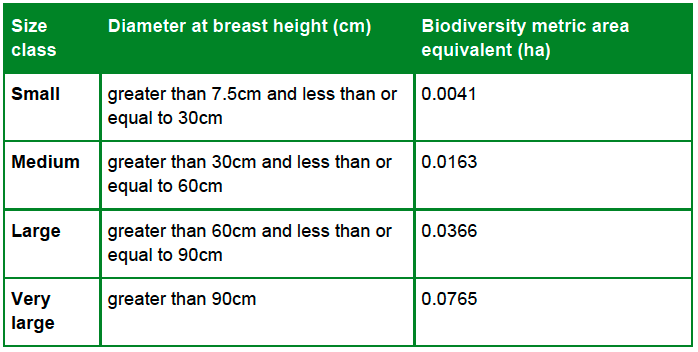
The biodiversity metric uses set values to represent the area of individual trees depending on their diameter at breast height.
This value is a representation of canopy biomass, and is based on the root protection area formula, derived from BS 5837:2012.
Table 14 sets out class sizes of trees and their area equivalent.
The User Guide then deals with specific instances where individual tree habitats also need to be recorded:
Recording baseline trees within private gardens
A private garden is a garden within the curtilage of a privately owned or tenanted dwelling house. Private gardens can contain important features for biodiversity, including mature trees and hedgerows.
record all medium, large and very large trees within private gardens as individual trees
Recording baseline trees within hedgerows and lines of trees
- if any medium, large or very large trees within a hedgerow or ‘rural’ line of trees are being removed, record these in the area baseline as individual trees
- the removal of trees may influence the linear value of hedgerows and ‘rural’ lines of trees within the hedgerow module
Recording baseline trees within orchards and wood-pasture and parkland
- if any medium, large and very large trees within these habitats are being removed, record these in the area baseline as individual trees
- this does not change the way in which you would record the area of orchard or wood-pasture and parkland area habitat (see ‘Recording habitat mosaics’ section)
Calculating the number of post-development trees required
Post-development size classes
When planting trees post-development size class is determined by the size of the tree at site-planting. When using the tree helper:
- record newly planted individual trees as ‘small’, unless ‘medium’ size or above at the time of site-planting
- record trees planted with a DBH less than 7.5 cm as ‘small’
You should not:
- record natural size increases of retained trees within post-development sheets
- record natural size increases of planted trees within post-development sheets
The post-development private garden has no public access, and biodiversity net gains cannot be legally secured. As these gains cannot be secured you should only record created private gardens as either:
- ‘urban – vegetated garden’; or
- ‘urban – unvegetated garden’
You should not:
- record the creation of any other new habitats within private gardens
- record enhancement of any habitat within private gardens
However, habitats which are recorded in the baseline and remain within a private garden may be recorded as retained.
A garden within the curtilage of a privately owned or tenanted dwelling house. The post-development private garden has no public access, and biodiversity net gains cannot be legally secured.
How these rules affect the tree habitat area calculation
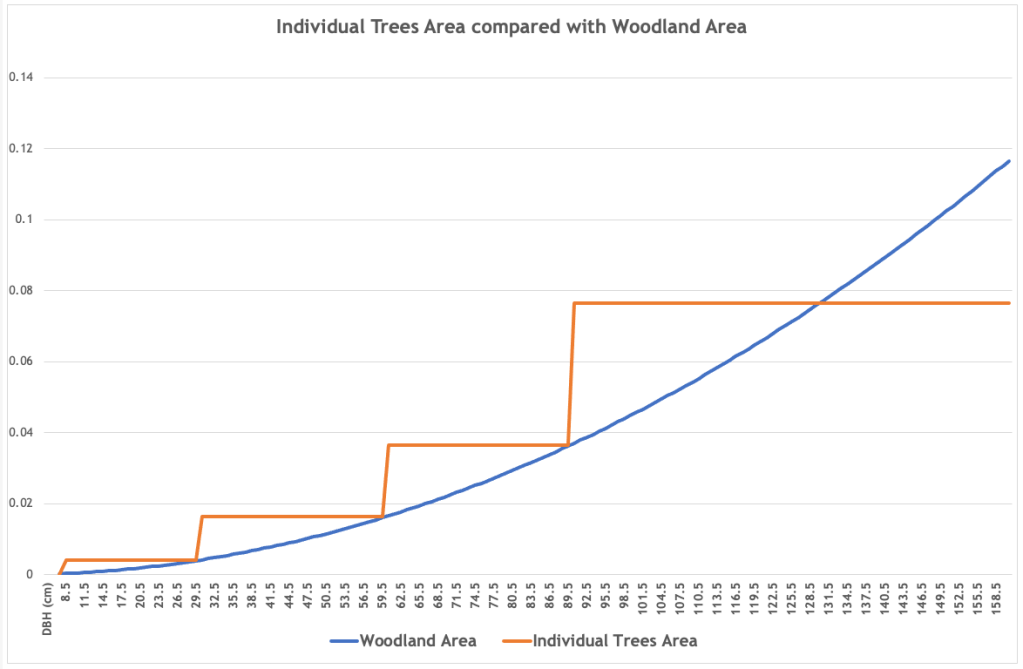
As a result, this approach places a higher value on the areas of all but the largest Individual trees habitats than those that form part of a Woodland and forest habitat. The following graph shows this, with RPA, derived from DBH, representing the canopy biomass of both broad habitats.
We analysed 12 recent planning applications involving 2,116 trees, 612 (29%) of which were identified for removal. Using the Metric User Guide, they have a combined habitat area of 20.2 ha. If they are measured by canopy area it would only be 8.3 ha (41% of their habitat size). If their combined Root Protection Areas (RPA) were used, they would cover only 8.6 ha (43% of their habitat size).
On the basis that all these trees are in poor condition and have no strategic significance, we calculate that, with the minimum 10% biodiversity net gain now required, a total of 1,925 new trees would need to be planted to replace the habitat lost by the removal of these 612 tree – a ratio of just over 3:1.
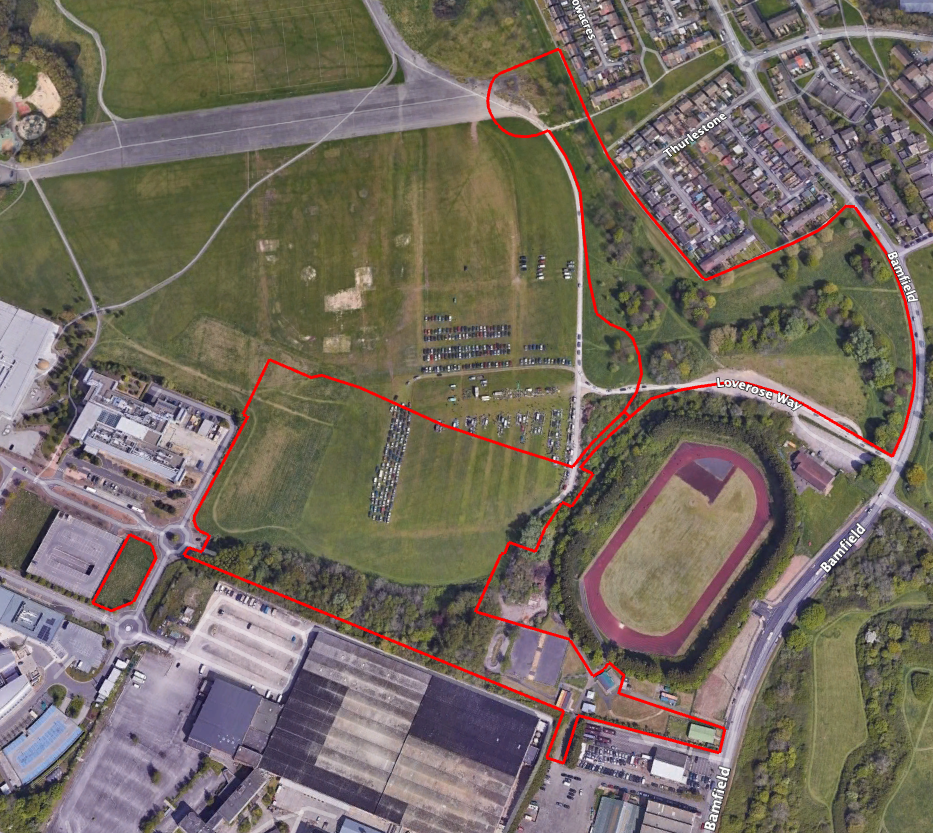
To illustrate how this can affect actual applications, here’s a pending application by Goram Homes at Hengrove Park in Bristol. The area edged in red is the development site.
This next image shows how the applicant’s ecologists have defined each habitat: the woodland and forest habitats are shown as a diamond pattern on a dark green background. They cover 2.44 ha.
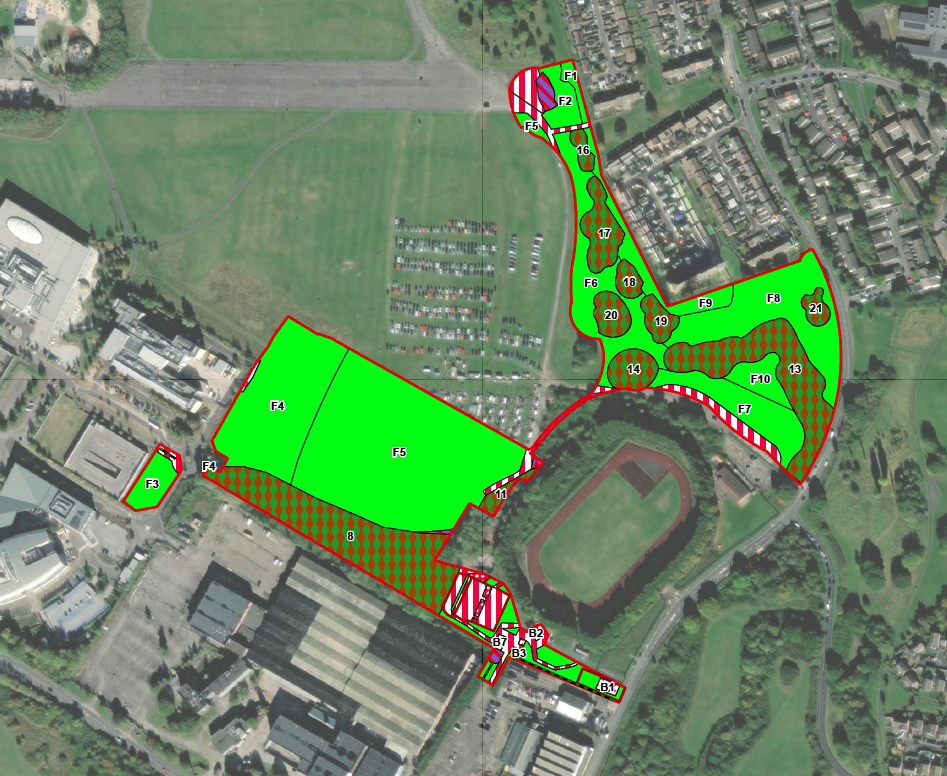
They’ve also identified 0.19 ha of Individual trees habitat, that is, trees not growing within the woodland and forest habitats.
Area 8 in the south of the site (0.99 ha) might legitimately be designated Woodland and forest habitat, but, given that all the remaining trees are growing separately and in groups in an urban park, they should be designated Urban Individual tree habitat.
The site is complex, with many trees growing in groups but, by excluding the trees in area 8 and treating all the other onsite trees as Urban Individual tree habitat, we calculate that their habitat area is 6.42 ha. This is 4.78 ha more than the applicant’s calculation. This difference will clearly have a significant impact on the final biodiversity net gain calculation, valuing these habitats at 34.07 area habitat units (or 2,989 Small size trees) as opposed to the applicant’s 12.11 (or 1,063 Small size trees).
To give the applicant their due, they at least attempted to calculate the tree habitat area. We have seen other applications where the trees were simply ignored, or were classified as another habitat – bramble scrub in one case, or the method by which the Individual trees habitat area was calculated bore no relationship to the evidence submitted. We must remain ever vigilant against such tricks.
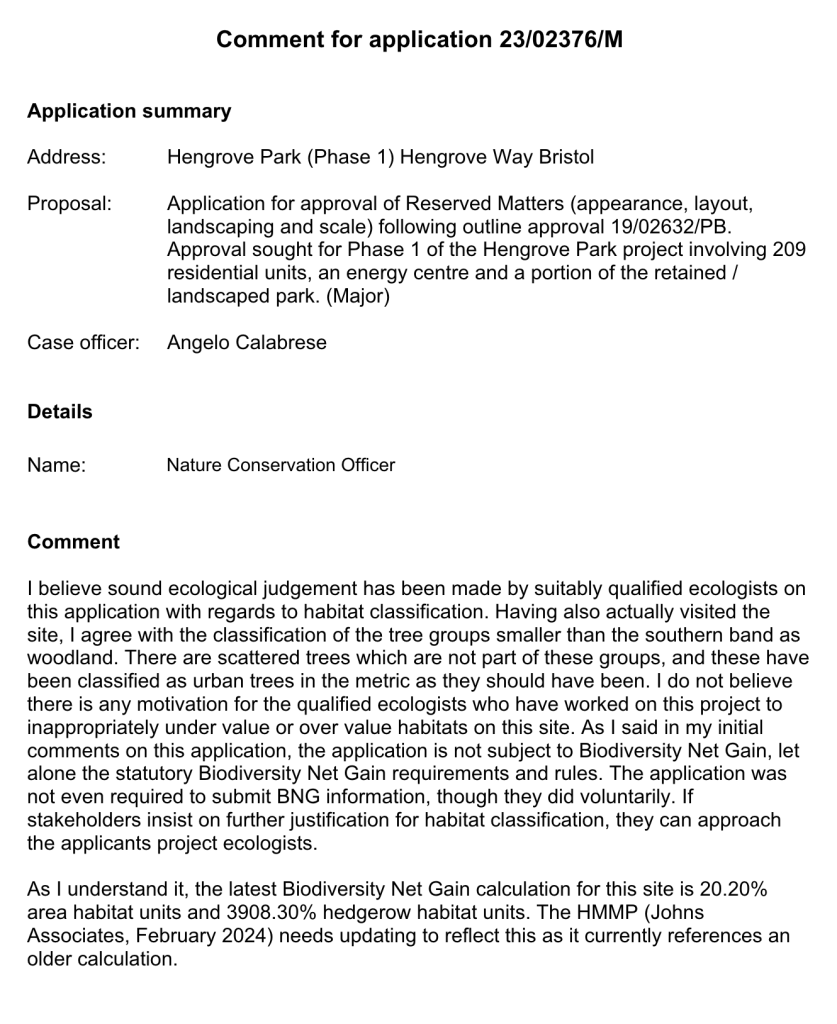
This blog was amended on 09 May 2024 to include the comments of the Nature Conservation Officer dated 03 May 2024 about whether the trees on the Hengrove Park development site are Individual trees habitat or Woodland and forest habitat. The officer writes:
This blog was amended on 14 February 2024 following the obligation for most planning applications to achieve at least 10% biodiversity gain becoming obligatory on 12 February 2024.
Further changes have been made following updates published in July and August 2024, in particular the clarification of the application of BNG in private gardens.
Other Blogs in the series
 bristoltreeforum.org