Bristol Trees in Crisis – Conservatives’ Press release

Conservative Councillor, John Goulandris, is challenging the controversial decision to slash the Authority’s annual funding for street tree maintenance.

Earlier this year, news broke that Council spending on the upkeep of roadside trees was being cut drastically by £187k (from £240k to £53k) as part of wider savings planned for the highways budgets.

Critics have argued that this draconian measure was brought in without proper consultation and without taking  any advice from professionals like the Council’s own in-housearboriculturalists and important advisory local bodies such as the Bristol Tree Forum.

Furthermore, they suggest that this apparent cost saving measure could well prove to be counter-productive in the long term, as poorly maintained trees represent a risk to public safety and may result in an increase in compensation claims for personal injury or damage to property. Short term savings are likely to be more than offset by higher future maintenance costs.

Now, Cllrs  Goulandris and Weston have tabled questions on this issue to the Mayor (and a formal resolution) for the next Members’ Forum and Full Council, to be held on Tuesday, 18th July.

Cllr Goulandris (Stoke Bishop) said:

“The level of public concern over this appalling decision is quite extraordinary.

Equally shocking has been the total lack of transparency in arriving at this saving. Specific details of the proposal – passed by the Mayor’s Labour colleagues in February – appear to have been hidden under a very broad heading of planned reductions in the Highways maintenance budget.

The lack of consultation over the efficacy of this move is also extremely worrying. Not consulting even the Council’s in house tree experts beggars belief and casts serious doubt on the credibility of the proposed savings.

Many residents have approached us to say that, if the Highways Department has to make savings, this should come from cutting back on expensive, over-engineered traffic schemes and installations rather than the essential upkeep of our street trees.

Slashing funding on tree management sends out a strange, contradictory message from this Administration, especially when Bristol only recently handed over its mantle of European Green Capital.

Therefore, we intend to urge the Mayor to rethink this daft idea and reinstate the funding, until a proper analysis of this proposal has been undertaken and a sensible new street tree policy adopted.”

Questions from Councillor John Goulandris:

Street Tree Budget 

Q1.         At a meeting of the Bristol Tree Forum on 4th July, held at City Hall, senior highways officers admitted that they had not consulted the Council’s in-house arboriculturalists, when setting the budget for street tree maintenance. They also admitted that they had no expertise in tree management or tree maintenance budgeting.  Is the Mayor comfortable that this approach to setting the reduced street tree budget is reasonable, rational and prudent?

Q2.         Tree professionals have opined that, if street trees are not subject to regular maintenance e.g. pollarding, this short term approach stores up costly problems for the future.

Is the Mayor fully satisfied that the short term savings identified by reducing the street tree budget will not be more than offset by rising costs in future years?

——————————————————————————————————————————-

Questions from Councillor Mark Weston

Street Trees and the environment

Q1.         Mature trees absorb a huge amount of CO2 and mature street trees in particular help to combat air pollution in our cities.  Does the Mayor agree that Bristol’s street trees play an important role in improving our environment and helping air quality?

Q2.         If mature street trees are not maintained responsibly, their uncontrolled growth can cause problems, given their proximity to houses and the highway. As a result of the reduction in the street tree budget, a ‘simple’ solution to future street tree management may be the felling of mature street trees as has happened in Sheffield. This has a devastating impact on both the street scene and air pollution.  It would also send out a very curious, contradictory environmental message from a recent European Green Capital City. Will the Mayor give his commitment not to fell Bristol’s street trees?

Motion to be moved by Councillor John Goulandris

SAVING BRISTOL’S STREET TREES

“Council is extremely concerned about the hasty decision by Highways drastically to reduce – by 78% – departmental spending on the Street Tree Management Programme.

This move is said to be part of wider savings to be achieved within the highways maintenance budget. However, there seems to have been no prior consultation either within the Council with tree officers or externally with residents and other stakeholders. It would appear that no proper consideration has been given to the efficacy of such action or whether such savings are sustainable.  For example, the relevant line in the Mayor’s budget last February simple states ‘reduce revenue funding by £1.7m’.  This clearly does not articulate sufficiently how such a saving proposal was to be made or the likely impact it could have on the city’s treescape.

Council seriously questions the wisdom of such a sudden and massive spending cut on essential tree maintenance, which raises issues over public safety, increased pollution, damage to roads, pavements and property, as well as leading to a potential rise in compensatory insurance claims and payments. Short term savings in year 1 could well be outweighed by long term costs in future years.

Savings do, of course, have to be found by Bristol City Council. At a recent public meeting to discuss future street tree maintenance, residents stated that they would much prefer available money being redirected from over engineered traffic management/highways projects e.g.  unnecessary traffic light installations and instead put towards helping to maintain our tree canopy, which is environmentally invaluable in helping to absorb CO2 and maintain air quality.

Accordingly, Council calls on the Mayor to reinstate street tree maintenance funding, until such time as a proper evaluation of the implications of this cut has been undertaken and a new street tree policy – formulated with the help of experienced bodies like the Bristol Tree Forum and the Council’s in house tree officers – is adopted.”

Bristol Trees in Crisis – some personal thoughts…

Having spent 3 years as a climber in Bristol on the Council contract undertaking much of the pollarding work and as a current resident of the city I not only find this situation shocking but also very worrying.

At last night’s Bristol tree forum meeting it was finally officially announced by the deputy mayor that due to budget cuts, which now only leaves £53,000 per annum for tree management, the council will be no longer be undertaking any pollarding on the city’s population of street trees. There will also be a termination of epicormic removal which will now only be removed when reported on the grounds of Health and Safety. Later in the meeting the Highways manager when questioned several times finally admitted that this decision had been taken without any consultation or advice from the City’s Arboricultural team, which to me beggars belief.

These trees which are predominantly London Planes and Limes have levels of decay which you would expect to find but are no real cause for concern due to them being on 3/5 year pollarding cycles. There are many however that due to their proximity to commercial buildings and houses are on 2-year cycles as in the photograph below. The photograph below is in fact taken in my old road and by the time the 2 years was up the regrowth was practically touching our bedroom windows and gutters.

Pollarding Needed
Ready for pollarding…

The suspension of the pollarding program as was pointed out to the deputy mayor comes with many potential problems in the future. It was pointed out that there would be an escalation of claims to the Council for damage to property either through over grown crowns or root damage. There is the potential for an increase in limb failure due to excessive weight and god forbid serious injury to pedestrians from falling debris. One of the positives of the pollarding cycles was that the cities Tree stock was getting a full aerial tree inspection every few years with any defects monitored and managed. This will no longer be the case. One concerned resident stated that his house insurance policy is dependent on the tree outside his house being pollarded every 3 years.

As the meeting went on there was a call from Councillors for everybody to get their heads together and discuss a way forward and to come up with solutions to this big problem. Amongst other things suggested was the possibility of residents raising money and having trees pollarded themselves by fully qualified and insured arborists.
It’s all a bit of a mess and who knows where this will all end up but I am very interested in all your thoughts/ideas. Thanks in advance.

Sean Harding – A Bristol tree climber

Comments

‘That is one of the most short-sighted least thought through council decision ever… It will lead to a costly mess, unless they are planning the Sheffield fell everything strategy…’

‘Out of interest is there Massaria on the plane trees in Bristol? If there is, I suspect it’s possibly quite low in occurrence due to the previous regular pollarding, but that would change significantly if the trees become lapsed and develop larger older wood canopies where Massaria thrives. The potential risk of dead Massaria branches not being picked up via inspection and dropping on to target areas would likely increase significantly. What’s the geology in Bristol? Is there much clay around the streets? If there is, the council will not just get an increase in claims due to direct root damage to property but there will be an increase in claims due to subsidence. of course there would be a small positive in the increase of shade due to larger canopies (particularly in terms of urban heat island effect) but doesn’t sound like the tree stock could sustain that benefit for long. Frustrating to hear of the shortsightedness of this decision.’

‘This is some middle managers and some upper managers in the public sector doing what they do best: being absolutely diabolical at doing anything remotely useful.’

‘The public should not be or considering funding any council tree work. Even if it’s to maintain the pollarding cycle or tree health. As soon as they do the council will jump on this, appeal to the community spirit to get money’

‘How u meant to see decay fruiting bodies on base of a lime tree without the epicormic growth being removed.?’

‘So who owns the trees? Are they strictly municipal street trees? If so, seems to me the municipal government has a legal duty to keep the trees pruned so as to promote public safety. The trees are in the shape they are in due to past municipal pruning. If not, pruning them will knowingly increase risk. wouldn’t a pre-emptive lawsuit be called for in order to force continued pollarding? In the long run, injury suits could blast that budget number you stated right out of the water.’

‘There’s a blind spot in all councils at this level: they can hold a ballot on increasing Council Tax for specific things such as this.’

‘Sounds like we are going to have to come up with some kind of crowdfund/localised taxation system if you can afford it, messed up, leave the poor peoples’ trees to fall apart until someone is injured before any pollarding will take place.’


Bristol Trees in Crisis – Notes of 04 July public meeting

Notes of a public meeting of the Bristol Tree Forum held in the City Hall, Bristol on July 4, 2017 

Bristol City Council Attendees: Deputy Mayor Asher Craig, Cllrs. John Goulandris, Liz Radford, Mike Davies, Olly Mead, Clive Stevens and many senior officers. 

At 6.00 pm The Chair, Peter Harnett, moved the meeting into the main Conference Room, as some 80 people had gathered. He read out a short statement from Cllr. Anthony Negus, Chair of Neighbourhoods Scrutiny (see below) who could not be present. He argued that the cuts to street tree maintenance would create long-term problems.

He then called on Cllr. Clive Stevens, who argued that the Tree Forum since 2008 had built up trust between the public and the council, and that the recent cuts had destroyed that relationship.  Trust is very important to the Council, especially where they aspire to commercialise services and so need a trusted brand name people can buy into.  BCC had, with BTF, been deeply involved in the creation of the Bristol Tree Replacement Policy, which had helped to ensure that where trees were felled they were replaced. Of around 16,000 street trees, 4,000 are pollarded and there are some 1,200 stumps awaiting replacement.

Note: – Trees of Bristol has logged just over 66,000 trees – some 67,300 when stumps are counted – of which some 16,000 are street trees, covering 1,062 species, varieties and cultivars in 2,310 sites.

The Chair then read out the statement of Margrit & John Waldron (see below).

The Chair then asked Vassili Papastavrou to read a statement from Prof. John Tarlton (see below), who had persuaded the University to put substantial sums into new tree planting. He suggested that the increase in the price of new trees from £295 to £765 would simply ensure that all private sponsorship would dry up, and that as a result tree stump sites would be permanently lost.

Graham Turnbull from the Sheffield Trees Action Group then spoke about the way in which the Council had handed over responsibility for road maintenance to a private firm under a PFI initiative, who had then begun a massive tree felling programme on the grounds that trees damaged pavements. A council attempt at a public survey had been grossly mishandled, and the Sheffield Trees Action group was set up via Facebook with 6,600 members across the city who began direct action to protect trees, which led to arrests, and nationwide adverse publicity. He made the point that a PFI contract ends democratic accountability, and that the entire city Tree department had been outsourced.

After questions the Chair invited the deputy Mayor, Asher Craig to respond. She stated categorically that that Bristol is not looking at any PFI contract that would include street tree maintenance. The financial crisis had forced an immediate cut in the budget, and the need for longer term change. A cut in the Highways budget of £1.66 million had resulted in the reduction of the street tree management budget from £187,000 to £53,000.  She emphasised that the risks from street trees would continue to be assessed and action taken if needed. For example, where epicormic growth becomes a health & safety issue, the council will act. Only dead or dangerous trees should be felled. She wanted to rebuild the trust, to work with communities, and set up some kind of charitable trust scheme, perhaps involving the Woodland Trust, the Civic Society and the Forest of Avon, which would be able to tap into funds not available to the Council. A meeting of interested parties should be held as soon as possible.

During questions from the floor a number of issues were raised including the problems of epicormic growth, and whether voluntary action could help; pollarding is a skilled, technical job which should be done by experts; the house insurance issue when a policy issued to an individual owner would depend on the pollarding regime; whether Bristol City Council would be able to defend itself from subsidence, flooding or tripping claims in the future without a reasonable pollarding regime in place (just one or two successful claims could wipe out any savings made by cutting the budget); the need for continued climbing inspections of street trees, rather than street level judgement, as an end to pollarding would create dangers which would start to manifest themselves within two to three years, but which might not be visible from the pavement; the need to increase tree inspections has not been costed; and the need to put Bristol’s problems into a global perspective, with the need to increase local and national tree canopy cover. For example, one mature tree can sequester some two and a half tonnes of carbon.

The Chair then called on Peter Mann and Shaun Taylor of the BCC Highways department, who stressed that statutory and health & safety obligations will be met. They were challenged on the issue that short-term measures would lead to long-term problems, and, in response to a question from the floor, stated that the BCC Tree Officers were not asked prior to the decision to cut the budget what the effects of the reduced maintenance budget would be.

Finally, the chair sought suggestions from the floor for possible solutions. There were contributions from the Woodland Trust, Forest of Avon, Birmingham Trees for Life Trust amongst many others, and a suggestion that Trees in Cities could be involved. The Deputy Mayor drew attention to a meeting on July 20th of the Community Network.

Possible solutions discussed were:

  • Partnering with other like-minded organisations to set up a charitable trust to take over the management of street and other public trees.
  • raising funds through accessing grants from other charities, lottery or other public money or crowd funding. It was noted that raising funds for revenue expenditure (annual maintenance costs) can be very difficult.
  • Encouraging local volunteers to help care for and manage local trees – a bit like the snow warden schemes set up across the city.
  • Copying other solutions around the country – such as Manchester City of Trees or Birmingham Trees for Life.
  • Install rain catchers in parks and other public spaces with trees and encourage local groups to use them to water newly planted trees.

The meeting closed at 8.10 pm.

Statement of Councillor Anthony Negus

I’m sorry I can’t be with you today but have been active in highlighting and supporting this cause since it became apparent.

This Administration passed swingeing budget cuts to services earlier this year. I was one who persistently warned of the unforeseen or even foreseen consequences when these headline numbers became defined losses in service. Some of these are not easy to track but when part of the highways savings morphed into reduction of the maintenance of our street trees by 78% the immediate effects were plain and stark.

Bristol is wonderfully endowed with street trees. Quite apart from the well-being and environmental richness they support, mocked by some, they are sunshades and regulate drainage and pollution.  But they grow, and in an urban setting this needs to be controlled. Without this, branches reach windows and fall on people and vehicles, and roots can damage structures and footpaths, increasing the risk of personal injury. This will lead to more expensive insurance claims and the offending mature trees, and probably others, will be cut down though perfectly healthy, adding to the total of stumps in the city. Increased planting charges will make their replacement with saplings much less likely.

This policy, seeking savings, will not secure them. If followed-through the loss to our city’s appearance, the environmental benefits and our reputation as a green capital will be immense and last for at least a generation. It is possible for councils to accommodate long term necessity, even in this period of austerity. I urge the Bristol Tree Forum and the wider population who appreciate the real value of trees to strongly and actively support efforts to stop this short-term vandalism.

Please help. Thanks.

Statement of Margrit & John Waldron

We feel privileged by the foresight of previous generations in leaving such a legacy of street trees in our City and are committed to leaving to maintaining this heritage for our successors.

Street trees are a ‘common good’ that should be paid for the community at large, however in the light of the current financial emergency facing the City we propose that those who enjoy them and have the means to do so should make a nominal contribution of £10 per person towards an emergency tree fund to help maintain and enhance this heritage.  This could possibly raise a fund of up to £1m to be spent in consultation with local communities.  We enclose our initial contribution of £20.

Statement of Prof. John Tarlton

Alongside concerns regarding the cut in the maintenance budget which will inevitably lead to a loss of existing trees, it is also proposed that the cost of tree replacement will be more than doubled from £295 to £765 to cover maintenance costs to 15 years.

The financial argument for this is unsound. The current cost of £295 includes an amount for the additional 2 years of watering. Beyond this, the maintenance of the new tree is covered by the existing maintenance budget for the earlier tree.

By increasing charges prohibitively, it is likely that potential sponsorship offers will dry up. Also, by delaying planting at an “existing” tree site (at a cost of £295), later planting would incur the full cost of a new tree, at £3000. If the council ultimately aim to recover these lost sites, the cost to them will be many times what they are trying to save with this short-sighted policy.

Hilary Green, who attended the meeting but had to leave early, has asked for her planned contribution to be added. Here it is:

Isn’t it about time Bristol looked at a congestion, or perhaps more pointedly, a pollution charge?  This would at least help to pay for some of this – and perhaps also contribute towards an environmental fund, which could help fund street trees and more.

I was in Ljubljana on business this year – Green Capital in 2016.  They had closed off the whole of the city centre to traffic (except for early morning deliveries).  People walked, cycled, or used the (free!) electric mini-buses, leaving the streets safe for people and free from traffic fumes and noise.  It was also bustling with street life and the shops and restaurants were doing great business.

I appreciate that different cities have different configurations and pressures, however I am sure there is something we could learn from Ljubljana, if only that we need to find a way to deter traffic from unnecessarily entering the city centre, and find a way to provide clean, cheap public transport.

Bristol Trees in Crisis – Agenda for tonight’s emergency meeting

Meeting of the Bristol Tree Forum – 6.00 pm to 8.pm Tuesday 4th July, The Writing Room, City Hall, Bristol

6.00 Introduction. (Peter Harnett, Chair, Bristol Tree Forum)

6.10 Written summary from Anthony Negus, Chair of Neighbourhoods Scrutiny

6.15 Concerns over the BCC decision (Cllr Clive Stevens)

6.25. Peter Harnett. Concerns.

6.30 The situation in Sheffield. Graham Turnbull: Sheffield Tree Action Group

6.45 Questions to Graham Turnbull

6.55 The Council’s response to concerns. Cllr Asher Craig.

7.00 Questions to Asher Craig.

7.15 Responses from the Highways Department

7.20 Questions to Highways Department

7.30 Finding solutions: Questions to members of related organisations

7.55 Close

Peter Harnett

Chair, Bristol Tree Forum


Urgent help needed to water new trees

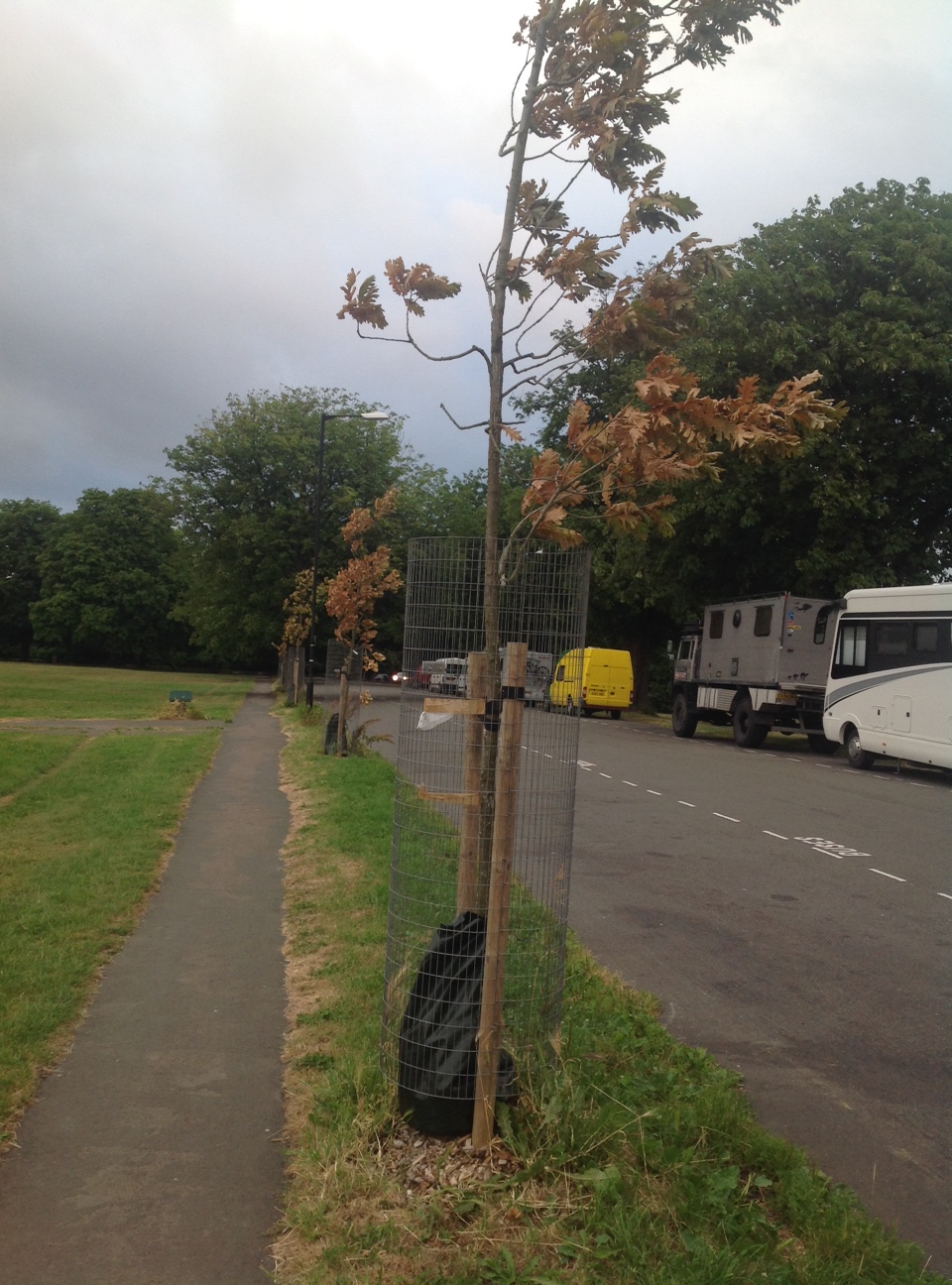
Lots of newly-planted trees on The Downs and elsewhere are suffering from lack of water in this unusually dry weather.  Many trees are dying.

The soil around the roots of each tree was so dry that (despite the recent rain) it would now take a lot of water to become hydrated.  Your help is urgently needed to water any of these trees that you see.  Even if they look nearly dead, with a lot of water they may come back to life.  These trees were paid for by members of the public and local organisations.

A number of people have raised concerns and Bristol City Council has said that it will now water each tree twice a week.  Some are in good shape – one sponsor has been watering her own tree.

IMG_0446
Just about hanging on…

Last year, the same thing happened and after six months of raising concerns with Bristol City Council, they said that last year’s problems would not happen again and watering would be sorted out for this year.  Much of the cost of planting a new tree is to cover sufficient watering for the first couple of years.

Clearly, it is a terrible waste of trees, time and effort and upsetting for the sponsors for the trees to die.  The Bristol Tree Forum  will keep raising this problem so that future sponsors can be sure that their trees thrive and that dead trees from this year and last year’s plantings are replaced.  A proper guarantee needs to be obtained for the future.

IMG_0454
Too late – these trees on Redland Green are dead

If you know anyone who sponsored one of these trees alert them and encourage them to water their own tree.  If you see a new tree that is dead or dying please email us a location and photo.

Vassili Papastavrou

Bristol Trees in Crisis III – BTF Emergency Meeting – 6.00 to 8.00 pm, Tuesday 4th July, Bristol City Hall

You are invited to a meeting at Bristol City Hall on Tuesday, 04 July 2017 between 6 and 8 pm.

The meeting will discuss and consider:

  • The Council’s consultation on its recent decision to stop maintaining street trees in the city.
  • The consequences of this should the decision not be reversed.
  • What solutions to this threat to Bristol’s street trees we can to offer.
  • To plan a way ahead.

We hope to hear from speakers from Sheffield, where the Council’s careless decision to outsource highway maintenance without considering the impact on its urban tree cover has and continues to result in the destruction of Sheffield’s magnificent street trees.

We also hope to hear from Birmingham Trees for Life, where, despite a similar decision ten years ago, they are still able to protect, maintain and plant trees in public open spaces.
More information to follow, but make it a date now!
In the meantime, please make your thoughts known by contacting your local Councillor and emailing the Mayor.
You can also Contact us here at Bristol Tree Forum to register your support and offer to help defend Bristol’s public tree spaces.
Please spread the word and forward this blog to others interested in saving Bristol’s trees.
AND FINALLY – Sign our petition!

Trees under threat at the Eastgate Centre – Comments so far…

Many thanks to all of you who have lodged comments on this application (nine so far). Here is one great example:

  1. This proposal flies in the face of the objective of the city council to double tree canopy cover in a generation.
  2. There is clear evidence that climate change is in part being driven by the city heat island effect. Bristol is already two degrees warmer than the surrounding area. A mitigation of this is to ensure that all car parking areas are shaded by trees- and not simply by a perimeter screen, but the use of suitable trees 20 metres apart to cover the entire area. This particular complex already has huge areas of unshaded car parking, and the proposal would only increase this.
  1. The Frome Valley is a key feature of the city’s biodiversity. It is one of a series of wildlife corridors that form a key feature of the attractiveness of the city to humans. This corridor is increasingly being eroded by development. As the River Frome has a huge water catchment area, which is increasingly being developed, creating much greater and faster run off, it floods rapidly and frequently. The fact that flood water is now diverted at the site of the Eastgate shopping centre into the northern stormwater interceptor will not prevent future floods upstream.
  1. Visually this remnant woodland of the Frome Valley is crucial it counteracting the utter ugliness and dreariness of the developed site. This of course originates from the original use of the site as a football and greyhound racing stadium. Bristol deserves better.
  1. What is desperately needed throughout this site is more trees being planted on the land owned by the various firms in the area, and not the destruction of the trees that by happy chance have survived.
  1. The wonderful veteran oak in particular, probably 300 years old, should become the centrepiece of a revival of this dreary area.

This is our earlier blog. Time is running out to lodge your objections. If you want to do so, please lodge your objections here in the Planning application comments section.

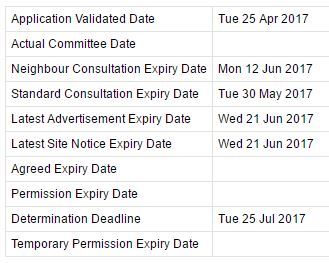
These are the Important dates:

Eastgate Trees3

Trees under threat at the Eastgate Centre!

Bristol’s trees are constantly under threat from development, especially when the commercial value of the land they grow on is so great and the public amenity value they offer is not thought worthy of consideration.

Here is (yet) another example.

An outline planning application – Number 17/01580/P – has been made to at the Eastgate Centre on Eastgate Road  for the demolition of the existing drive-thru restaurant. It will be replaced by new retail units with a health and fitness club above and a replacement drive-thru restaurant.

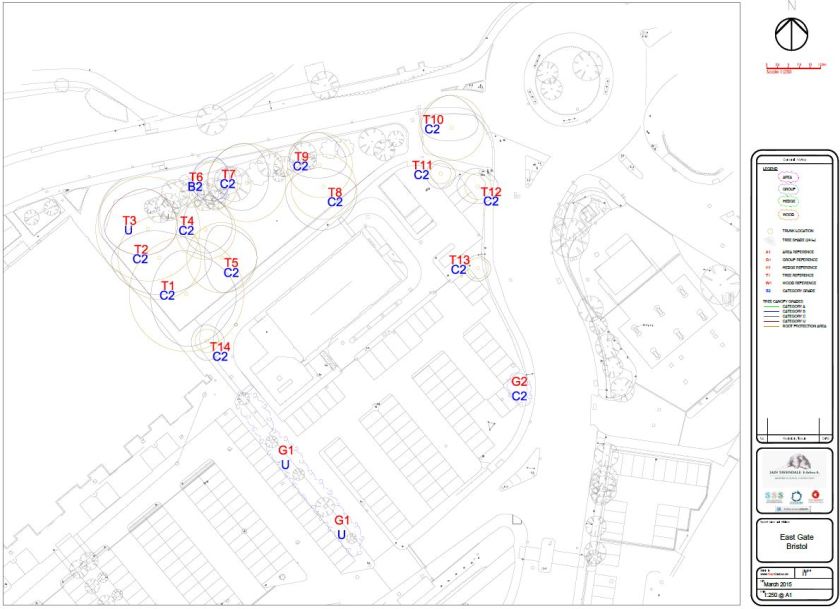
Part of this application will require the destruction and removal of a delightful stand of trees that grow on a triangle of land between the roundabout on Eastgate Road and the existing retail park. This is so that larger retail units can be built and goods vehicles can more easily gain access to the rear of the site. This is a plan of the trees affected.

Eastgate Trees

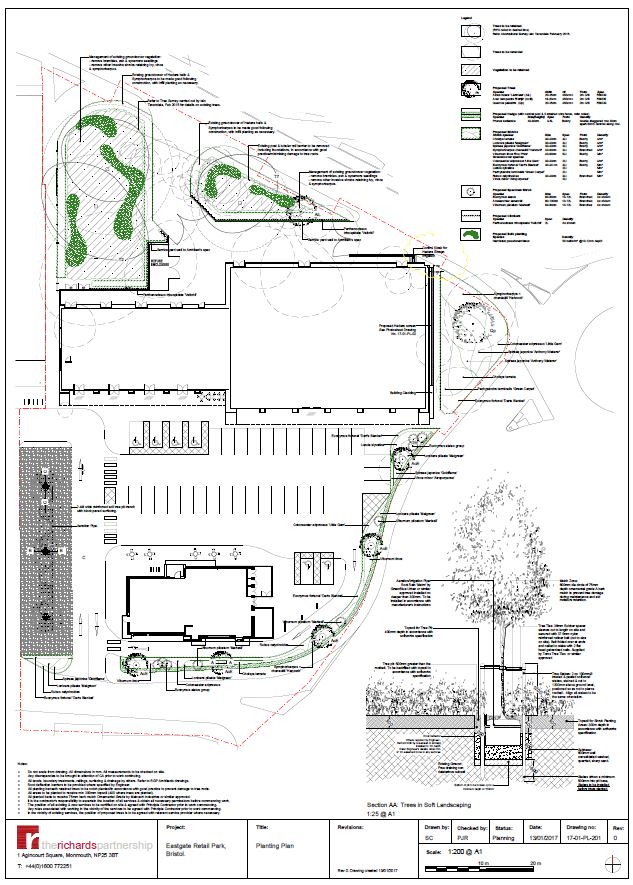
This is the proposal for what will be planted in their place – a souless echo of what is already there:

Eastgate Trees2

The Council’s own arboricultural officer has objected to the proposal. He advises:

“I have conducted a site visit and reviewed the supporting arboricultural documentation. The trees on site are located on the edge of the proposed development area and provide a significant screen to the already extensive retail development. The group of trees fall within 2 distinct age ranges, a mature group of ash, oak and poplar and a young understorey of secondary infill planting.

The mature trees are protected by TPO 282. The ash and oak are a historic remnant of a landscaped garden (Circa 1900) from the former gas works that occupied the site, the ash appear to of been managed as old pollards which have now grown out. They are historic trees with potential veteran tree characteristics that warrant the TPO status and must be retained. Due to poor management or lack of management the trees have a number of less than satisfactory defects associated with them that have in part been identified within the supporting tree survey from February 2015. The understorey planting appears to date back to the original development of the retail park, this understorey now has a more complex relationship with the larger TPO trees. They reduce the target area of people and property by the restriction of movement within this area and they also provide shade to the lower portions of the main stems which when considering the potential veteran tree characteristics offer significant ecological benefits. The management of this area for the benefit of the mature TPO’d trees would need careful consideration.

The supporting arboricultural survey is out of date and only provides basic survey detail that does not consider age and historic relevance of the TPO’d trees. The survey in not a full BS5387 report as required with DM17: Development Involving Existing Green Infrastructure.

The proposal seeks to redevelop the current Burger King site to increase the number of commercial units with associated HGV delivery bays to the rear.

This proposal would remove the vast majority of the historic TPO’s trees and associated understorey, This would be detrimental to the TPO status of the trees. The final design would be in constant conflict with the trees identified for retention leading to further applications to remove the tree following occupation of the individual units.

The Mature Oak T10 is a key amenity feature located in an elevated position over the roundabout at the gateway of the Eastgate centre; this is a TPO’d tree and no evidence has been provide to justify its removal.

I object to the proposed and would recommend refusal of the application on the grounds of a detrimental impact to the only green infrastructure on site and historic environment. Insufficient detail has been presented in accordance with BCS9, DM15 & DM17. There has been no consideration of the TPO status of the trees or their current or future management.

The arboricultural documentation is poor, out of date and insufficient to support an application, the tree planting plan produced to mitigate the loss of such significant trees has not considered the “Planning obligation SPD, Tree.” (Bristol tree replacement standard (BTRS). I hope you find these comments of use.

Matt Bennett Arboricultural Officer (Planning) City Design Group – Place Directorate City Hall.”

We agree with Matthew! We shall be lodging our objections.

If you also agree, please lodge your objections here in the Planning application comments section. These are the Important dates:

Eastgate Trees3

Bristol Trees in Crisis II

Bristol’s street trees saved?

We heard last night at the Mayor’s Cabinet Committee that the Council has agreed to consult about its decision the stop maintaining Bristol’s street trees. This will take place after the General Election has been held. Hopefully this means that the decision will then be reversed, though this is not certain.
As for tree planting, this can continue but it must now be ‘fully funded’. This means that the sponsorship cost will rise from £295 to £765. We are told that this is so that the tree can also be cared for over the next 15 years. If a tree is being planted at a new site (i.e. is not replacing another tree lost), then, if a specially constructed tree pit is required, the cost of this will also need to be funded. This could easily add another £2,000 to £3,000 to the planting cost.
This is good news, but it is likely that many residents are going to find the new cost prohibitive. It also raises the prospect that some street trees are being cared for while all the others are not, which seems rather ridiculous when you think about it!
If you agree, or want to be consulted, please make your thoughts known by contacting your local Councillor and emailing the Mayor.
You can also Contact us here at Bristol Tree Forum to register your support and offer to help defend Bristol’s public tree spaces.
Please spread the word and forward this blog to others interested in saving Bristol’s trees.

Bristol’s trees in crisis!

With Bristol City Council’s budget cuts, two decisions have been made regarding the management of Bristol’s treescape that make no economic sense, and threaten the reputation of the City as a Green and pleasant place to live and locate a business.

With Bristol City Council’s budget cuts, two decisions have been made regarding the management of Bristol’s treescape that make no economic sense, and threaten the reputation of the City as a Green and pleasant place to live and locate a business.

Decision 1: Slashing of street tree management budget

  • The budget for managing street trees has been cut by nearly 78% from £240,000 to £53,000.
  • As a result there will be no pollarding of street trees or removal of epicormic growth around the tree.
  • Emergency cover outside normal working hours is no longer being provided through the tree management contract, despite having no cost benefit.
  • Tree management will be limited to felling to address safety risks, despite greater initial costs and the long term consequent loss of tree sites – felling costs the same as 16 years of maintenance.  As a result, Bristol’s street tree population will rapidly fall into decline as they are steadily removed, never to be replaced.

Decision 2: No planting of street trees, either replacement or new, even when cost neutral

  • Bristol City Council has operated a number of innovative schemes allowing residents or community groups to sponsor replacement or new street trees. Despite fully funding the planting, and maintenance for two years, such planting will no longer be permitted.
  • At the moment, when a tree is replaced in an existing tree pit it costs £295. This covers regular watering until the tree is established and two years maintenance. If the trees dies whilst establishing itself, it is replaced at no extra cost.
  • If the Council can be persuaded to change its mind about not planting new trees, then this cost could to increase to the £765 that developers are required to pay – the overall costs of planting a tree and maintaining it during its lifetime. Planting a tree at a brand new site could add around £2,000-£2,500 if a special tree pit needs to be installed.
  • Currently there is huge support from the community for replacing lost trees. Around £200,000 of developers’ money is set aside for this purpose, Metrobus is committed to planting 200-300 trees as part of their planning condition, and Bristol University has donated funds to plant 60-100 public street trees.
  • It makes little sense, in times of budget constraints, to renounce external funding sources that fully cover planting and maintenance costs.

These decisions are a false economy for Bristol City Council

  • With no pollarding of street trees, increased tree growth will lead to more subsidence claims against the Council, and create more highway damage, pavement trip hazards, and infrastructure damage.
  • New tree growth from previous pollarding points will become unstable, increasing the probability of personal injury and property damage claims against the Council.
  • Just a couple of additional subsidence or injury claims could negate the Council’s entire “cost saving”.
  • This short-term decision makes no sense – if a tree can be maintained for some 16 years – the one-off cost of felling it, then surely it makes better economic sense to spread this inevitable cost and maintain the tree rather than fell it as a short-term ‘solution’ – a ‘solution’ which loads all the costs up front and will lead to greatly increased and unavoidable expenditure in not very many years time?

These decisions will threaten Bristol’s reputation as a Green City

These decisions were taken with no consultation with stakeholders

There has been no consultation regarding these decisions with other Departments within Bristol City Council, who will have to deal with the foreseeable consequences, with insurers, who will face additional damage claims, Avon and Somerset Police, who will have to address public order consequences of mass felling, or Bristol Tree Forum, with its wide-reaching understanding of tree issues.

What you can do

  • Contact your Councillor and email the Mayor and demand that these decisions be overturned.
  • Contact us here at Bristol Tree Forum to register your support and offer to help defend Bristol’s public tree spaces.
  • Spread the word and forward this blog to others interested in saving trees.