Biodiversity gain: will urban nature become hollowed out?

In a boost for the environment, new legislation now obliges most developers to set out how they will achieve at least 10% more biodiversity than already exists on their proposed development sites.

Developers must now show how they will improve the biodiversity of their development site as a result of their works. Developers must record the (baseline) on-site habitats that exist before development starts and show how they will either enhance or replace these on site. If their proposals fail to reach the 10% threshold, the developer may provide the shortfall elsewhere. This post-development mitigation should be done as closely as possible to the development site, or at least within the Local Authority. However, if this isn’t possible, they can use approved sites anywhere in England.

This approach is called the Biodiversity Gain Hierarchy (found in Schedule 7A of the Town and Country Planning Act 1990 at section 37A). The Hierarchy says it’s a priority to avoid the ‘adverse effects’ to ‘onsite habitat with a habitat distinctiveness score … equal to or higher than four.’ If this can’t be avoided, only then is mitigation permitted. In our experience, nearly all developers ignore the requirement to avoid adverse effects and move straight on to mitigation.

Since the introduction of the Bristol Tree Replacement Standard in 2013, developers (and planners) have ignored the policy requirement to avoid tree removal where at all possible. Instead, they’ve moved straight on to providing compensation for the trees lost to the development. As a result, the money set aside for replacement tree planting was not spent (on occasion reaching nearly £1 million) and many of the lost trees were never replaced.

Under the Hierarchy, habitats that score four are designated as having medium distinctiveness. While many habitats have medium distinctiveness, many don’t. For example, managed grassed areas (called ‘modified grassland’) are often found on urban sites but have a low distinctiveness score. So, too, do many other urban habitats such as allotments and gardens. Developers are not required to avoid harming these, though losses to these habitats must still be mitigated.

There’s no definition of what an ‘adverse effect’ is or any guidance on how it is assessed. However, recent advice from the Bristol’s Chief Planner about the meaning of ‘harm’ suggests that this could be interpreted very broadly or simply ignored because some sort of mitigation will always be available.

In the last extreme, developers may purchase biodiversity credits. We wait to see how this and the offsite biodiversity mitigation market evolves, but a 2012 paper published in the Harvard Environmental Law Review suggests that such environmental markets are prisoners of their own geography because the space available is always constrained:

Markets for water quality, biodiversity, endangered species, fisheries, air quality, and aquatic resources, to name a few, must recognize that the commodities they trade exist at particular geographic scales, and set appropriate spatial limits on the redistribution of environmental quality. The size of geographic trading areas has significant implications for the economic viability of markets and the ecological quality of their offsets.

This will be a particular challenge when providing biodiversity mitigation in urban areas.

The squeeze on green spaces

Land use in Bristol is subject to intense competition by many stakeholders. This is especially true for our green and open spaces, which offer many ‘services’ beyond just habitat provision. There is very little, if any, space available for new biodiversity to be created. At best, some green spaces might be enhanced, but opportunities to do this are likely to be very limited.

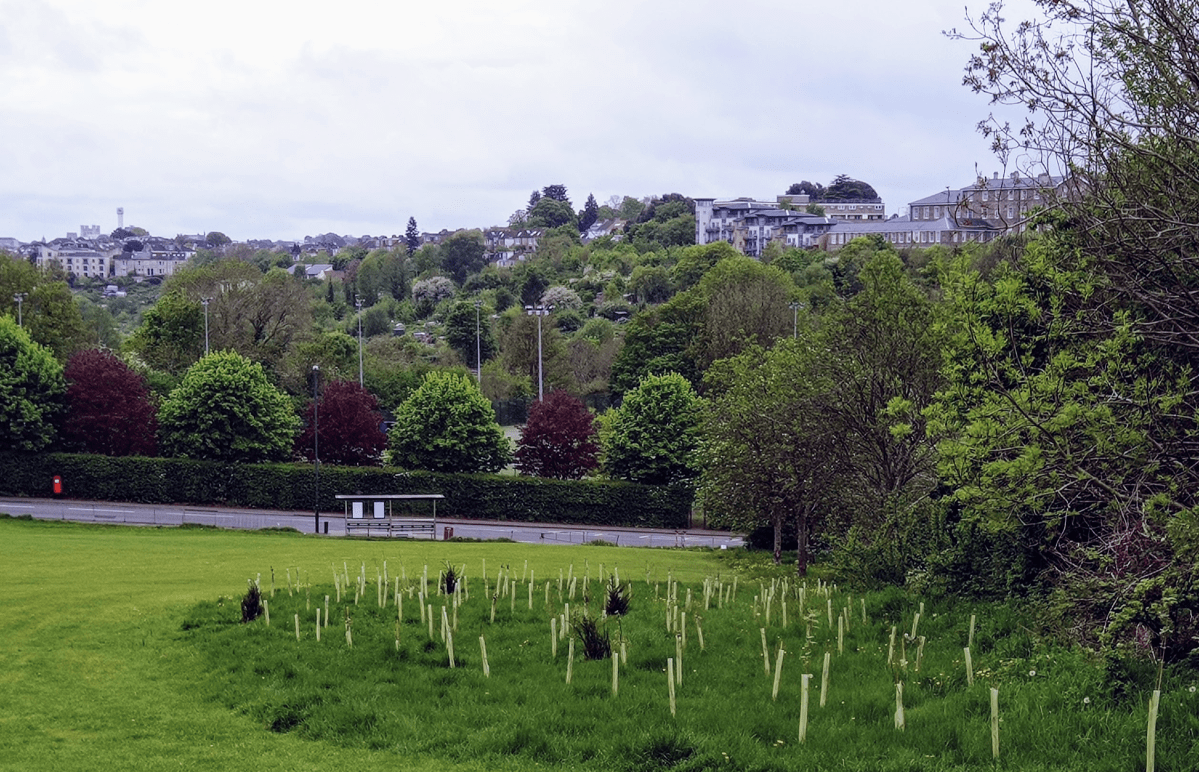
For example, Bristol Tree Forum’s examination of the three proposals to develop Bedminster Green shows that, if these proposals are allowed, then nearly 400 new trees will need to be planted to compensate for the lost tree habitat – a medium distinctiveness habitat. There’s no room to plant these trees on site, so offsite provision will be needed. There are very few opportunities for doing any new tree planting (as opposed to replacing lost trees) in the surrounding wards or even across Bristol, let alone, as is usually required, within a mile of a development site.
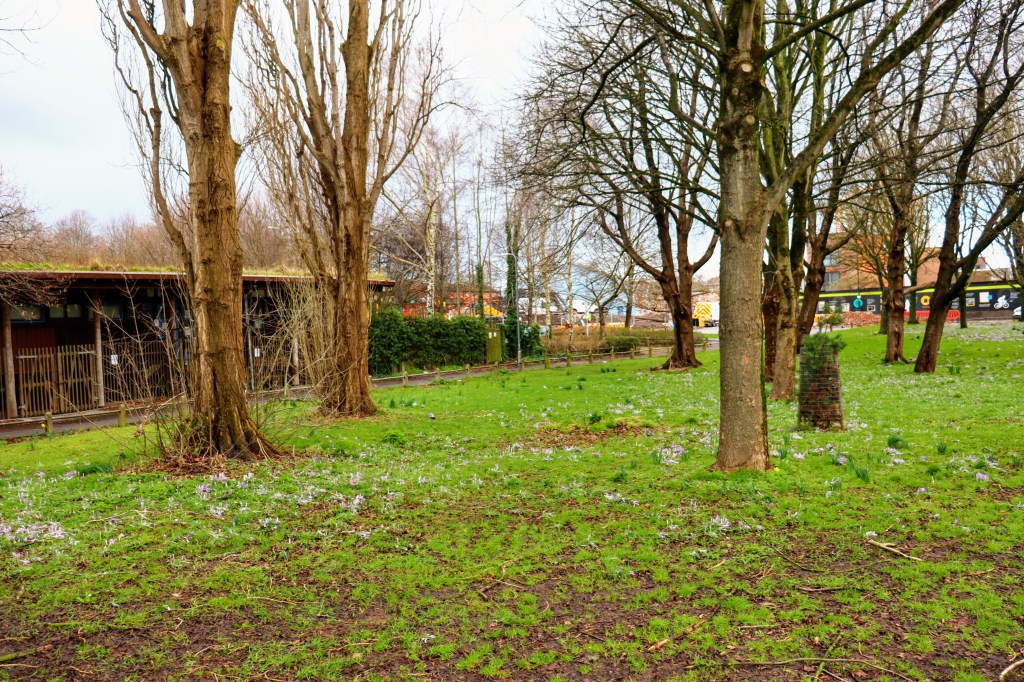
Instead, these replacement trees will have to be planted somewhere else: ‘in some foreign field that is forever Bristol’. This will inevitably lead to a net loss of biodiversity across the city as nature is ‘hollowed out’. This is unacceptable. The whole purpose of the new biodiversity gain regime is to improve overall local biodiversity, but it seems inevitable that Bristol will instead see a steady, inexorable decline.

We are disappointed that the current draft of the new Local Plan addresses none of these issues and have said so in our responses to the latest consultation:

Bristol Tree Forum representations in relation to the Bristol Local Plan 2023 Publication Version consultation & BTF Representations on the Bristol Local Plan 2023 publication version – Addendum.

A shorter version of this article was published by 24/7 as:

‘It seems inevitable Bristol will see a steady, inexorable biodiversity decline’

Why we need a new Bristol Tree Replacement Standard

We believe the time has come to revise the Bristol Tree Replacement Standard (BTRS), to reflect our changing understanding of the vital importance of urban trees to Bristol and how they contribute to biodiversity gain.

The current BTRS Standard, adopted nearly a decade ago in July 2014, provides a mechanism for calculating the number of replacements needed for any trees that are removed for developments. It was ground-breaking in its time as it, typically, required more than 1:1 replacement of trees lost to development.

Since then, Defra has published the statutory version of the Biodiversity Metric (SM) (on 29 November 2023), which became mandatory on 12 February 2024. In addition, Bristol has adopted Climate and Ecological Emergency Declarations, so an updated BTRS would be an important part of implementing these declarations. It would require all new developments, subject to some exceptions, to achieve a Biodiversity Net Gain (BNG) of at least 10%. Where deveelopments are exempt, BTRS will still apply.

Although Councillors rejected our proposals for a new Standard at their meeting on 31 October last, we’ve revisited our July 2023 proposals and recast our calculations. These proposals, set out below, provide a mechanism for complying with the new requirements and align the BTRS with the BNG provisions of the EA 2021.

The purpose of the BTRS is that it should only ever be a last resort and not the default choice – which, unfortunately, it has become. When considering any development involving established trees, the presumption should always be that trees will be retained. If this is not possible, then the impact of the proposed development must be mitigated. Only if this is impossible, should compensation for their loss be considered. This is the meaning of the Mitigation Hierarchy, as set out in paragraph 180 a) of the National Planning Policy Framework, which states:

If significant harm to biodiversity resulting from a development cannot be avoided (through locating on an alternative site with less harmful impacts), adequately mitigated, or, as a last resort, compensated for, then planning permission should be refused.

This is reflected in the Bristol Core Strategy, policy BCS9 (page 29),which states that:

Individual green assets should be retained wherever possible and integrated into new developments.

This is repeated in the proposed replacement for BCS9 – Policy BG1: Green infrastructure and biodiversity in new development (page 124) – which ‘aims to ensure that green and blue infrastructure and provision for nature is incorporated into new development’ so that, among other things:

The provision of green infrastructure in new development should … Retain and incorporate important existing green infrastructure such as trees (Policy BG4 ‘Trees’), hedgerows and water features …

It is a shame that the requirement is only an aspiration, not an obligation.

Background

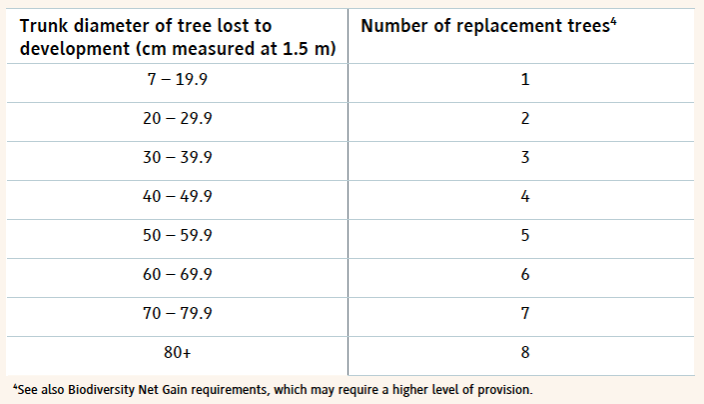
Under the new proposed policy – BG4: Trees (page 131) – trees lost to development will be replaced using this table:

Table 1 The proposed BG4 tree replacement table.

However, when the balance of EA 2021 takes effect, the current version of the BTRS will not, in most cases, be enough to achieve the 10% BNG minimum required for nearly all developments. A new Section 90A and Schedule 7A will be added to the Town and Country Planning Act 1990 and will set out the level of BNG required.

Paragraph: 001 Reference ID: 74-001-20240214 of the Biodiversity net gain guidance states:

Under the statutory framework for biodiversity net gain, subject to some exceptions, every grant of planning permission is deemed to have been granted subject to the condition that the biodiversity gain objective is met (“the biodiversity gain condition”). This objective is for development to deliver at least a 10% increase in biodiversity value relative to the pre-development biodiversity value of the onsite habitat.

Many development proposals will aim to achieve more than the minimum 10% gain voluntarily. Others may not but will still need to achieve much more in order to comply with the SM trading rules (page 140). This is based on the habitat type lost and its distinctiveness. In the case of Individual tree habitats – Urban or Rural –­ losses must be replaced within the same broad habitat (i.e. more Individual trees) or with a habitat of a higher distinctiveness.

However, for the sake of certainty, we propose only using the minimum 10% BNG required.

Our proposed new BG4 (BTRS) model

We propose that the table in BG4 be amended to reflect the requirements of the EA 2021 and SM and that the BG4 table (Table 1 above) be replaced with Table 2 below:

Table 2 Our proposed BG4 tree replacement requirement

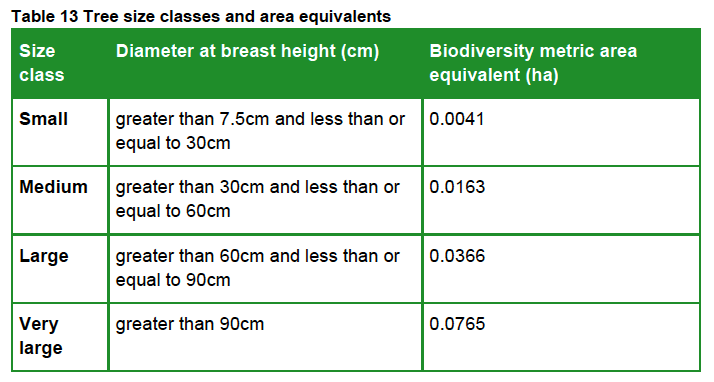
The Replacement Trees Required number is based on the habitat area of each of the four SM tree category sizes (Table 13 below), divided by the area habitat of one BNG 4.0 Small category tree (see section 3 below) plus a 10% net gain. This is rounded up to the nearest whole number (since you can’t plant a fraction of a tree).

The reasoning for our proposal is set out below:

1. Applying the Biodiversity Metric to Urban trees

The most recent Statutory Biodiversity Metric User Guide defines trees as Individual trees habitats as follows:

When to record individual trees

Use the broad habitat type ‘Individual trees’ to record trees where:

  • they are found as an individual or as part of a group;
  • are over 7.5cm in diameter at breast height (DBH).

Individual trees should also be recorded where they meet the definition of an irreplaceable habitat but would not otherwise be recorded.

Do not otherwise record individual trees if they occur within an area habitat type characterised by the presence of trees, examples of these are:

  • woodlands
  • orchards
  • wood-pasture and parkland

Individual trees are classed as ‘urban’ or ‘rural’. You should consider the degree of ‘urbanisation’ of habitats around the tree and assign the best fit for the location.

2. Calculating Individual trees habitat

Table 13 in the SM User Guide is used to calculate the ‘area equivalent’ of individual trees:

The biodiversity metric uses set values to represent the area of trees depending on their diameter at breast height. This value is a representation of canopy biomass, and is based on the root protection area formula, derived from BS 5837:2012.

You should report the number of individual trees within your project and input tree count into the ‘tree helper’ within the biodiversity metric tool to generate area values for data input. For multi-stemmed trees, use the DBH of the largest stem. You should:

  • account for each individual tree within a group or block of trees.
  • record the habitat underneath the tree canopy separately.
  • not reduce any area generated by the tree helper.
  • not deduct the area of individual trees from other habitats.
  • make clear in the user comments how many trees contribute towards the total area.

Recording trees within private gardens

You should assess most individual trees that are recorded in private gardens. You should record:

  • any medium, large and very large trees as individual trees
  • any small trees that are ancient or veteran

Recording trees within hedgerows

You should assess most individual trees that are recorded within hedgerows. You should record:

  • any medium, large and very large trees as individual trees
  • any small trees unless they are ancient or veteran.

You must assess the linear value of hedgerows within the hedgerow module separately.

Individual Tree habitats have medium distinctiveness and so, under Rule 1 of SBNG, ‘Losses must be replaced by area habitat units of either medium band habitats within the same broad habitat type or, any habitat from a higher band from any broad habitat type.

3. Forecasting the post-development area of Individual trees

The SBNG User Guide provides this guidance:

You should use the tree helper to calculate the area for created trees.

You should categorise most newly planted individual trees as ‘small’, unless the tree is medium sized or above at the time of planting.

You should not factor in the age of nursery stock when using the ‘creation in advance’ function. The ‘creation in advance’ function should only be used where trees are planted in advance of the development (for example, as screening or as structural landscaping).

Exceptions

You cannot count:

  • newly planted trees within private gardens
  • natural size increases of baseline trees
  • trees planted as part of hedgerow creation or enhancement as individual trees.

Our calculations are based on Small category replacement trees being planted as per the SM guidance.

4. The likely impact of this policy change

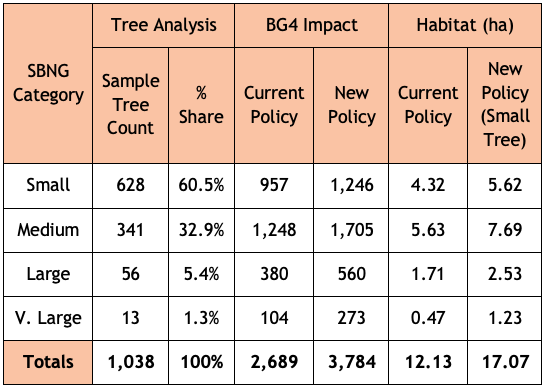
We have analysed tree data for 1,038 surveyed trees taken from a sample of BS:5837 2012 tree surveys submitted in support of previous planning applications. Most of the trees in this sample, 60.5%, fall within the SM Small tree category, 32.9% are within the Medium tree category, 5.4% are in the Large tree category with the balance, 1.3%, being categorised as Very Large.

Table 4 below sets out the likely impact of the proposed changes to BG4. It assumes that all these trees were removed (though that was not the case for all the planning applications we sampled) and replaced with SM Small category trees:

Table 4 Proposed BG4 impact analysis.

The spreadsheet setting out the basis of our calculations can be downloaded here – RPA Table Statutory BNG 13 table Comparison.

The vital role of trees in urban development

There’s a climate emergency and we need to act. With higher temperatures and more severe weather events than just a decade ago, we must take action at the local as well as the global level.

Bristol City Council declared a Climate Emergency in 2018, reflecting the need to reduce the city’s contribution to the causes of climate change, and to adapt and be resilient to further expected climate impacts. For the declaration to be meaningful, it has to result in practical changes, for example the protection of existing trees on development sites. With important urban trees being routinely felled, there is no evidence that this is the case. If Bristol continues in this way, the city will become unliveable in the climate crisis.

The Council is now drafting a tree strategy for the city, which we hope will become a key element of the forthcoming revised Local Plan. We hope that the strategy will protect existing trees and prioritise the planting of replacement and new trees across the city. We have asked for 18 principles to be included in the strategy.

If our urban environment is going to be liveable in the long term, we need to create new developments that can cope with the changes in the local climate expected in the future. The benefits of trees in the fight against climate change are now well understood: trees lock up carbon, reducing pollution and flooding. They are also the best way of reducing the urban heat island effect, decreasing the temperatures of heatwaves by up to 10°C . It’s therefore vital that green infrastructure forms part of any proposed development. This is particularly crucial in the city centre.

On every occasion that trees are felled, we’re told it will be all right, as they will be replaced. Often these replacement trees are never planted because there is nowhere to plant them, or if planted, they die and are not replaced. At any rate, we need tree canopy and shade now, not in 50 years’ time when any new trees that might survive will replace the canopy lost. This is why we must protect existing trees, and if trees must be lost, local tree replacements must be planted and not just promised.

A warmer climate increases the risk of overheating and heat-related illness, even death. In the heat wave of 2003, around 70,000 people died across Europe due to the extreme heat, with older people and children particularly vulnerable. However, we can reduce much of the risk without the need for active cooling, by incorporating effective measures into development proposals from the earliest design stage. New buildings and external spaces must be designed to provide year-round comfort and support well-being. On-site tree planting for shade will contribute to this by minimising the amount of heat entering buildings. All new developments will be expected to demonstrate through ‘sustainability statements’ how they would incorporate such measures into their design from the outset.

How green (and blue) infrastructure reduces climate impacts

Developers must take into account that changes in the local climate are likely to: increase flood risk and water stress; change the shrink-swell characteristics of clay soils affecting foundations and pipework; affect slope stability; and affect the durability of building materials. Incorporating green and blue infrastructure, such as trees and water features, in developments will help to reduce all these effects. Green and blue infrastructure should be multifunctional, that is, provide ecology and biodiversity benefits as well as climate adaptation in developments. Where appropriate, this should include the use of living roofs with a sufficient substrate depth to maximise cooling benefits. However, the cooling effect of green roofs is a fraction of that afforded by trees.

Long-term thinking

As we build more homes, businesses and communities, it’s essential that we retain and integrate important existing trees within any new development. We must also consider carefully the size, species and placement of new trees provided as part of any planned landscape treatment, for example in terms of:

  • ensuring that any new streets are tree-lined
  • focusing once again on large-form trees that will be long-lived and provide substantial shade, rather than small, short-lived trees such as Rowan or Amelanchier
  • reducing or mitigating run-off and flood risk on the site
  • increasing on-site canopy cover and providing shade and shelter
  • ensuring that newly planted trees will be maintained in the long term and replaced if necessary.

Where tree loss or damage is unavoidable, and not merely expedient, within a development site, new replacement trees of an appropriate species must be provided either on or off site and their long-term management and maintenance secured.


We have submitted our proposals for how trees lost to development should be replaced as for of the Local Plan Review – Our proposal for a new Bristol Tree Replacement Standard using Biodiversity Metric 4.0