Calculating tree habitat area

A key factor in calculating the value of a habitat under the new Statutory Biodiversity Metric is to work out its size. In the case of trees, their habitat size can be of critical importance to the calculation of their biodiversity valuation which will, in turn, help to preserve our precious tree habitats.

As a result, individual trees in an urban setting are often the most important habitat present.

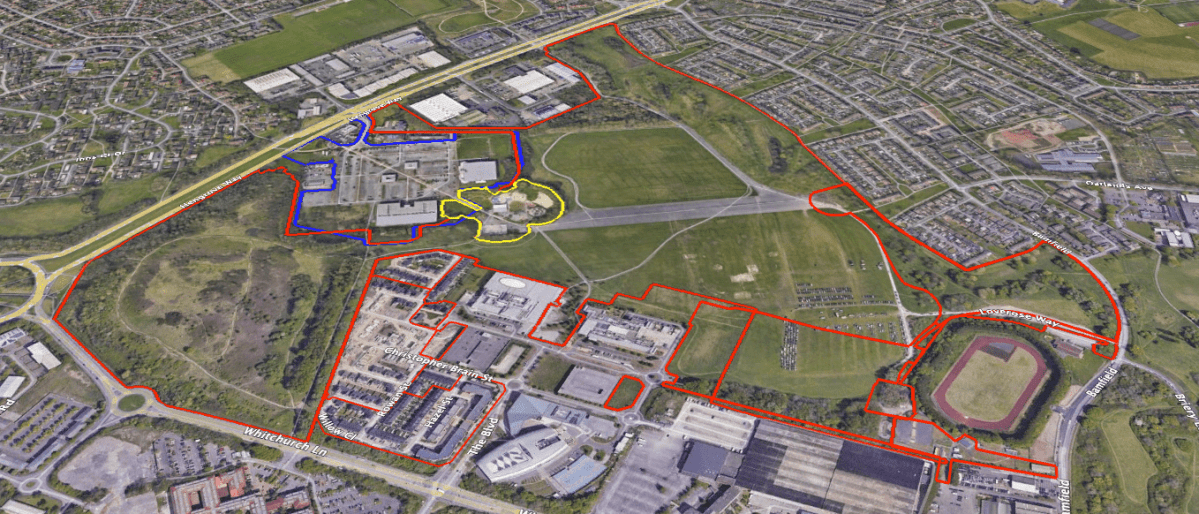
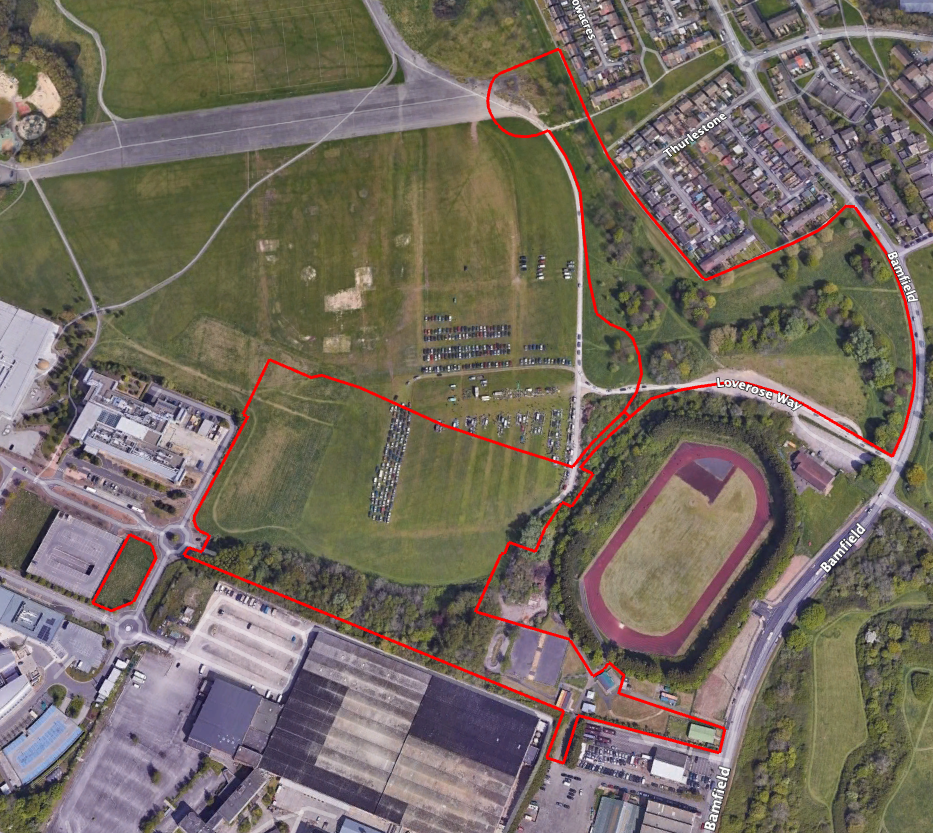
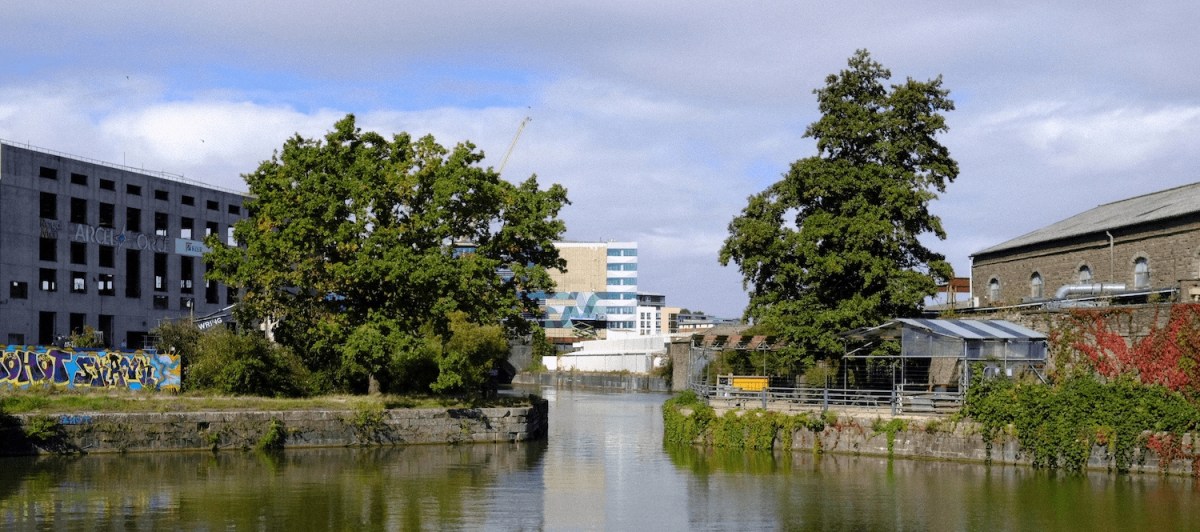
Unfortunately, developers may be tempted to allocate all trees on their planned development site (especially those in groups) to Woodland and forest habitats rather than to Individual trees habitat, because this gives the trees and the site a lower biodiversity value. An example of this is the proposed development by Goram Homes of Hengrove Park in Bristol, as shown in the image above and discussed below. The whole site was granted outline planning permission in October 2019.

Unfortunately, the Statutory Biodiversity Metric User Guide (the Metric) definitions of these habitats are ambiguous and can make such allocations hard to counter, even in settings that are clearly urban.

The User Guide defines two broad tree habitats types whose areas are measured in hectares (ha):

  • Woodland and forest
  • Individual trees

Defining woodland and forest habitat

There are conflicting definitions of ‘woodland’. The Metric User Guide does not define Woodland and forest habitat.

However, the UK Habitat Classification, UKHab, upon which the Metric is based, defines it as ‘Land with 25% or more cover of trees that are five metres or more in height.’ This definition doesn’t mention the minimum land area required.

The UK National Forest Inventory 2015 (NFI) defines woodland as:

a minimum area of 0.5 hectares under stands of trees with, or with the potential to achieve, tree crown cover of more than 20% of the ground. Areas of young trees, which have the potential to achieve a canopy cover of more than 20%, will also be interpreted as woodland and mapped. The minimum width for woodland is 20 m, although where woodlands are connected by a narrow neck of woodland less than 20 m wide, the break may be disregarded if less than 20 m in extent.

Bristol City Council also uses area to define woodland in its 2008 Biodiversity Action Plan (Chapter 5, page 65), which states that ‘this action plan covers all woodlands over 0.5 hectares in extent found in Bristol.‘ As this is a local policy, and aligned with the NFI definition, we have adopted it.

The habitat area of Woodland and forest habitats is based on its total measured canopy area.

Defining individual trees habitat

The Metric User Guide (page 53) advises when to record Individual trees habitat:

Individual trees are classed as ‘urban’ or ‘rural’. You should consider the degree of ‘urbanisation’ of habitats around the tree and assign the best fit for the location. 

Use the broad habitat type ‘Individual trees’ to record: 

  • individual rural trees 
  • individual urban trees 
  • lines, blocks or groups of trees found within and around the perimeter of urban land.

In all circumstances ‘Individual trees’ should be used to record ancient and veteran trees, regardless of location. This could include ancient and veteran trees within hedgerows, ‘rural’ lines of trees and woodlands. 

Other clarifications

Do not use the hedgerow module classifications ‘line of trees’ and ‘ecologically valuable line of trees’ to record linear formations of trees in the urban environment.

These classifications should only be used for rural lines of trees.
Trees within overgrown non-native and ornamental hedges (for example, leylandii) should not be classified as individual trees, or as lines of trees. Record these as nonnative ornamental hedges within the hedgerow module.

Trees recorded as individual trees that will be removed for any purpose, including development, disease, or safety must be recorded in your baseline and recorded as lost.

Do not otherwise record individual trees if they occur within a habitat type characterised by the presence of trees, unless specified within the section on ‘recording individual trees at baseline’, which covers: 

  • trees within private gardens 
  • removal of trees within hedgerows 
  • removal of trees within rural lines of trees 
  • removal of trees within orchards and wood-pasture and parkland 

Recording individual trees at baseline 

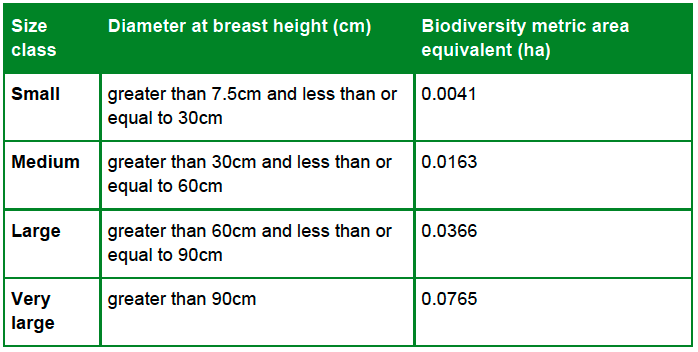
The biodiversity metric uses set values to represent the area of individual trees depending on their diameter at breast height. 

This value is a representation of canopy biomass, and is based on the root protection area formula, derived from BS 5837:2012. 

Table 14 sets out class sizes of trees and their area equivalent. 
The User Guide then deals with specific instances where individual tree habitats also need to be recorded:

Recording baseline trees within private gardens

A private garden is a garden within the curtilage of a privately owned or tenanted dwelling house. Private gardens can contain important features for biodiversity, including mature trees and hedgerows. 

record all medium, large and very large trees within private gardens as individual trees 

Recording baseline trees within hedgerows and lines of trees 

  • if any medium, large or very large trees within a hedgerow or ‘rural’ line of trees are being removed, record these in the area baseline as individual trees 
  • the removal of trees may influence the linear value of hedgerows and ‘rural’ lines of trees within the hedgerow module 

Recording baseline trees within orchards and wood-pasture and parkland 

  • if any medium, large and very large trees within these habitats are being removed, record these in the area baseline as individual trees 
  • this does not change the way in which you would record the area of orchard or wood-pasture and parkland area habitat (see ‘Recording habitat mosaics’ section) 

Calculating the number of post-development trees required

Post-development size classes 

When planting trees post-development size class is determined by the size of the tree at site-planting. When using the tree helper: 

  • record newly planted individual trees as ‘small’, unless ‘medium’ size or above at the time of site-planting 
  • record trees planted with a DBH less than 7.5 cm as ‘small’ 

You should not: 

  • record natural size increases of retained trees within post-development sheets 
  • record natural size increases of planted trees within post-development sheets 

The post-development private garden has no public access, and biodiversity net gains cannot be legally secured. As these gains cannot be secured you should only record created private gardens as either: 

  • ‘urban – vegetated garden’; or 
  • ‘urban – unvegetated garden’ 

You should not: 

  • record the creation of any other new habitats within private gardens 
  • record enhancement of any habitat within private gardens 

However, habitats which are recorded in the baseline and remain within a private garden may be recorded as retained. 

A garden within the curtilage of a privately owned or tenanted dwelling house.  The post-development private garden has no public access, and biodiversity net gains cannot be legally secured. 

How these rules affect the tree habitat area calculation

As a result, this approach places a higher value on the areas of all but the largest Individual trees habitats than those that form part of a Woodland and forest habitat. The following graph shows this, with RPA, derived from DBH, representing the canopy biomass of both broad habitats.
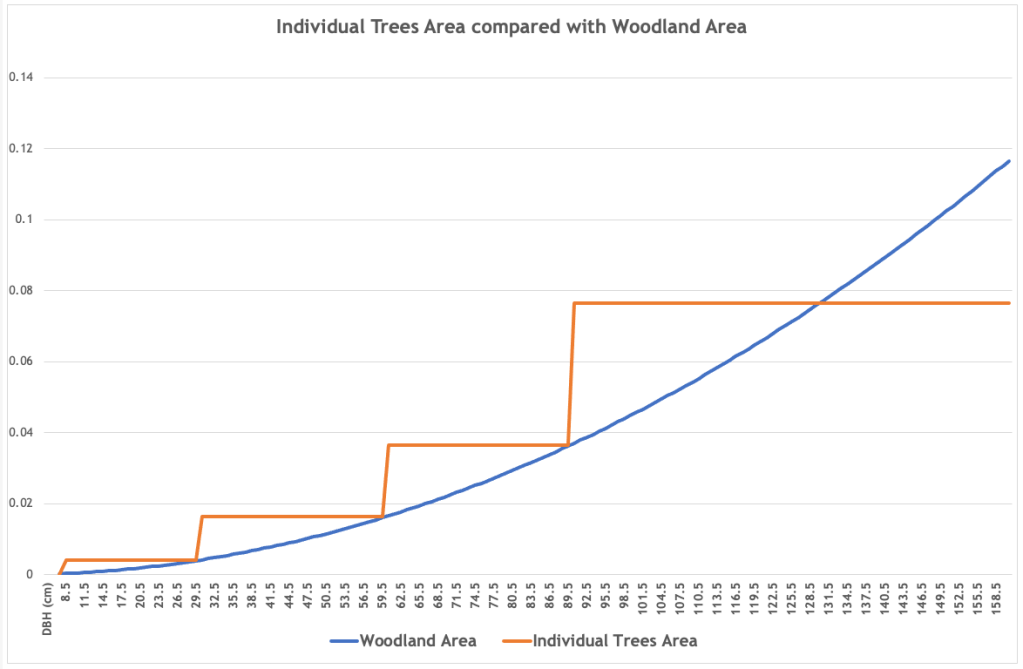
We analysed 12 recent planning applications involving 2,116 trees, 612 (29%) of which were identified for removal. Using the Metric User Guide, they have a combined habitat area of 20.2 ha. If they are measured by canopy area it would only be 8.3 ha (41% of their habitat size). If their combined Root Protection Areas (RPA) were used, they would cover only 8.6 ha (43% of their habitat size).

On the basis that all these trees are in poor condition and have no strategic significance, we calculate that, with the minimum 10% biodiversity net gain now required, a total of 1,925 new trees would need to be planted to replace the habitat lost by the removal of these 612 tree – a ratio of just over 3:1.

To illustrate how this can affect actual applications, here’s a pending application by Goram Homes at Hengrove Park in Bristol. The area edged in red is the development site.
This next image shows how the applicant’s ecologists have defined each habitat: the woodland and forest habitats are shown as a diamond pattern on a dark green background. They cover 2.44 ha.
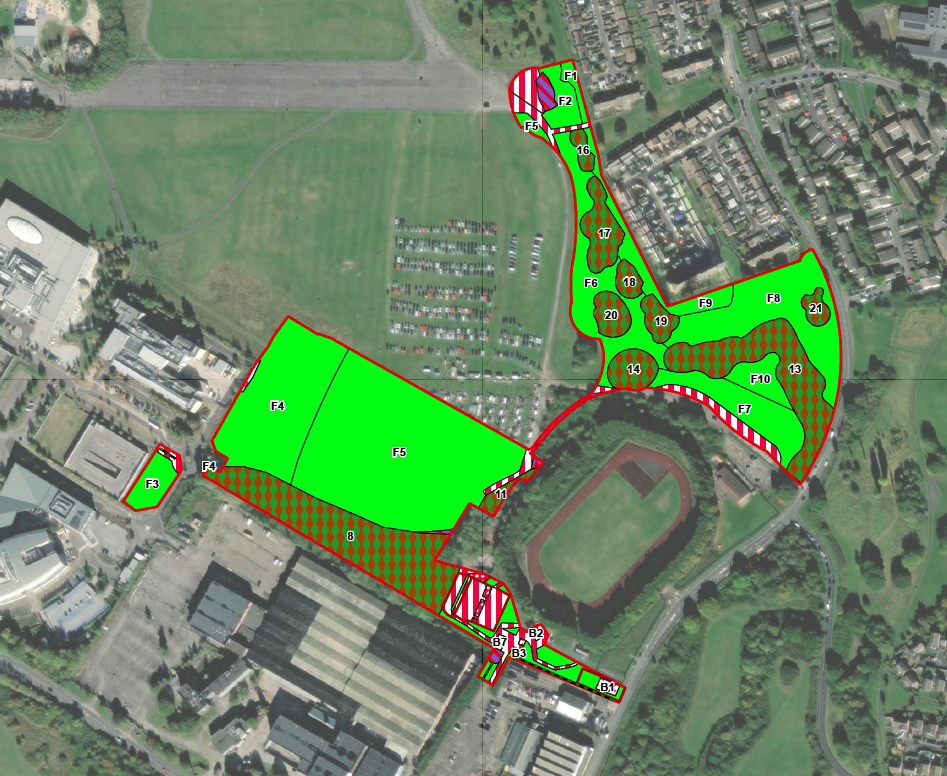
They’ve also identified 0.19 ha of Individual trees habitat, that is, trees not growing within the woodland and forest habitats.

Area 8 in the south of the site (0.99 ha) might legitimately be designated Woodland and forest habitat, but, given that all the remaining trees are growing separately and in groups in an urban park, they should be designated Urban Individual tree habitat.

The site is complex, with many trees growing in groups but, by excluding the trees in area 8 and treating all the other onsite trees as Urban Individual tree habitat, we calculate that their habitat area is 6.42 ha. This is 4.78 ha more than the applicant’s calculation. This difference will clearly have a significant impact on the final biodiversity net gain calculation, valuing these habitats at 34.07 area habitat units (or 2,989 Small size trees) as opposed to the applicant’s 12.11 (or 1,063 Small size trees).

To give the applicant their due, they at least attempted to calculate the tree habitat area. We have seen other applications where the trees were simply ignored, or were classified as another habitat – bramble scrub in one case, or the method by which the Individual trees habitat area was calculated bore no relationship to the evidence submitted. We must remain ever vigilant against such tricks.


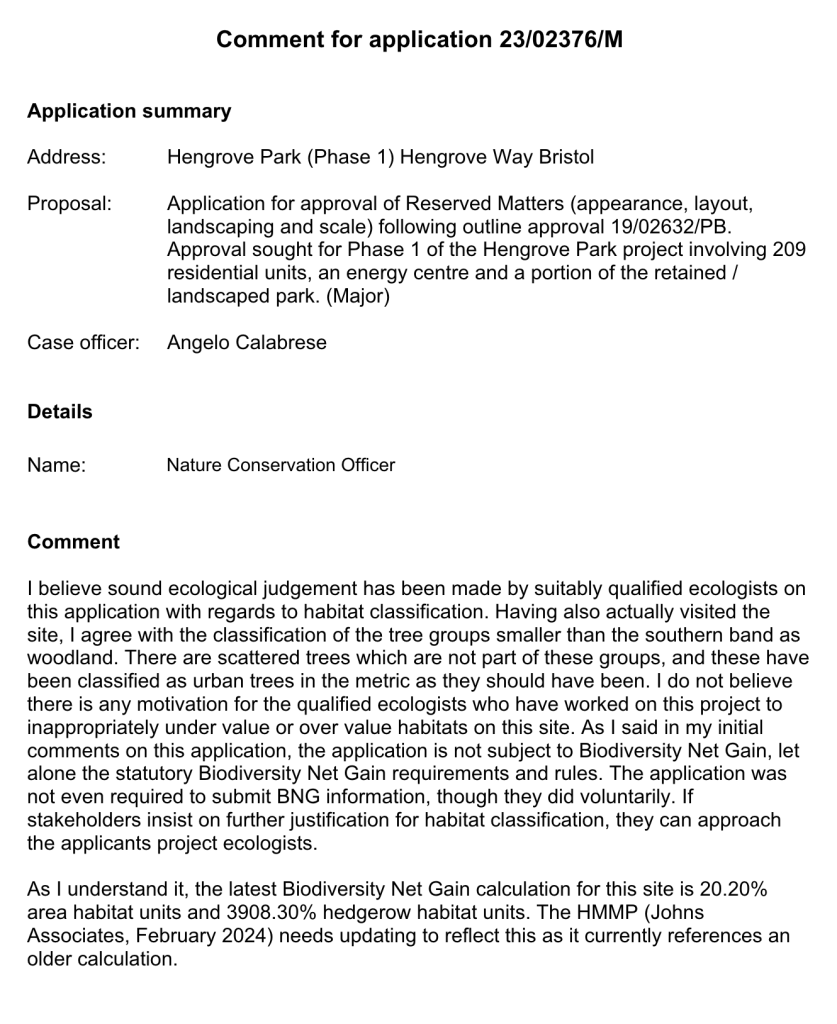
This blog was amended on 09 May 2024 to include the comments of the Nature Conservation Officer dated 03 May 2024 about whether the trees on the Hengrove Park development site are Individual trees habitat or Woodland and forest habitat. The officer writes:
This blog was amended on 14 February 2024 following the obligation for most planning applications to achieve at least 10% biodiversity gain becoming obligatory on 12 February 2024.

Further changes have been made following updates published in July and August 2024, in particular the clarification of the application of BNG in private gardens.


Other Blogs in the series
Calculating habitat units

The trading rules explained


Why we need a new Bristol Tree Replacement Standard

We believe the time has come to revise the Bristol Tree Replacement Standard (BTRS), to reflect our changing understanding of the vital importance of urban trees to Bristol and how they contribute to biodiversity gain.

The current BTRS Standard, adopted nearly a decade ago in July 2014, provides a mechanism for calculating the number of replacements needed for any trees that are removed for developments. It was ground-breaking in its time as it, typically, required more than 1:1 replacement of trees lost to development.

Since then, Defra has published the statutory version of the Biodiversity Metric (SM) (on 29 November 2023), which became mandatory on 12 February 2024. In addition, Bristol has adopted Climate and Ecological Emergency Declarations, so an updated BTRS would be an important part of implementing these declarations. It would require all new developments, subject to some exceptions, to achieve a Biodiversity Net Gain (BNG) of at least 10%. Where deveelopments are exempt, BTRS will still apply.

Although Councillors rejected our proposals for a new Standard at their meeting on 31 October last, we’ve revisited our July 2023 proposals and recast our calculations. These proposals, set out below, provide a mechanism for complying with the new requirements and align the BTRS with the BNG provisions of the EA 2021.

The purpose of the BTRS is that it should only ever be a last resort and not the default choice – which, unfortunately, it has become. When considering any development involving established trees, the presumption should always be that trees will be retained. If this is not possible, then the impact of the proposed development must be mitigated. Only if this is impossible, should compensation for their loss be considered. This is the meaning of the Mitigation Hierarchy, as set out in paragraph 180 a) of the National Planning Policy Framework, which states:

If significant harm to biodiversity resulting from a development cannot be avoided (through locating on an alternative site with less harmful impacts), adequately mitigated, or, as a last resort, compensated for, then planning permission should be refused.

This is reflected in the Bristol Core Strategy, policy BCS9 (page 29),which states that:

Individual green assets should be retained wherever possible and integrated into new developments.

This is repeated in the proposed replacement for BCS9 – Policy BG1: Green infrastructure and biodiversity in new development (page 124) – which ‘aims to ensure that green and blue infrastructure and provision for nature is incorporated into new development’ so that, among other things:

The provision of green infrastructure in new development should … Retain and incorporate important existing green infrastructure such as trees (Policy BG4 ‘Trees’), hedgerows and water features …

It is a shame that the requirement is only an aspiration, not an obligation.

Background

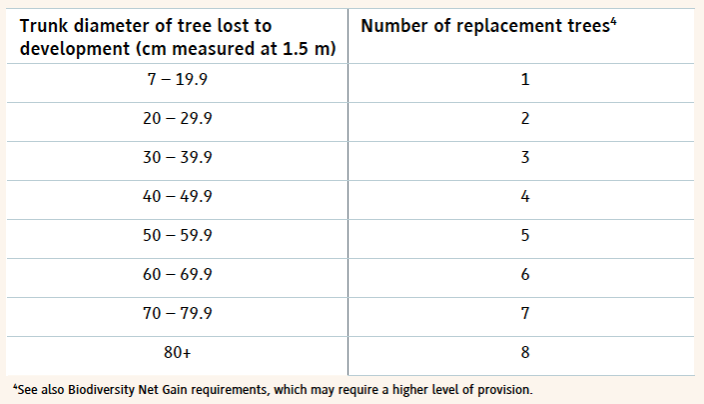
Under the new proposed policy – BG4: Trees (page 131) – trees lost to development will be replaced using this table:

Table 1 The proposed BG4 tree replacement table.

However, when the balance of EA 2021 takes effect, the current version of the BTRS will not, in most cases, be enough to achieve the 10% BNG minimum required for nearly all developments. A new Section 90A and Schedule 7A will be added to the Town and Country Planning Act 1990 and will set out the level of BNG required.

Paragraph: 001 Reference ID: 74-001-20240214 of the Biodiversity net gain guidance states:

Under the statutory framework for biodiversity net gain, subject to some exceptions, every grant of planning permission is deemed to have been granted subject to the condition that the biodiversity gain objective is met (“the biodiversity gain condition”). This objective is for development to deliver at least a 10% increase in biodiversity value relative to the pre-development biodiversity value of the onsite habitat.

Many development proposals will aim to achieve more than the minimum 10% gain voluntarily. Others may not but will still need to achieve much more in order to comply with the SM trading rules (page 140). This is based on the habitat type lost and its distinctiveness. In the case of Individual tree habitats – Urban or Rural –­ losses must be replaced within the same broad habitat (i.e. more Individual trees) or with a habitat of a higher distinctiveness.

However, for the sake of certainty, we propose only using the minimum 10% BNG required.

Our proposed new BG4 (BTRS) model

We propose that the table in BG4 be amended to reflect the requirements of the EA 2021 and SM and that the BG4 table (Table 1 above) be replaced with Table 2 below:

Table 2 Our proposed BG4 tree replacement requirement

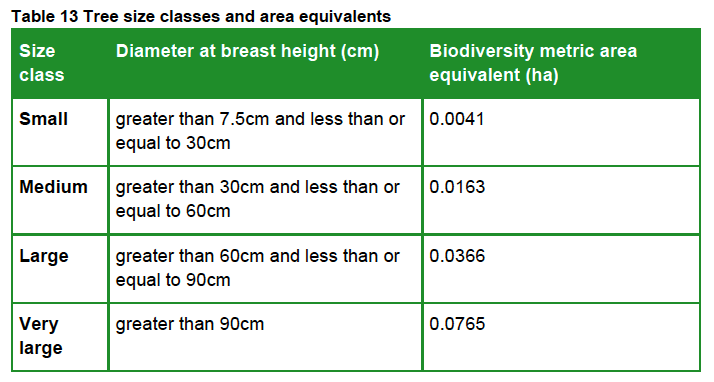
The Replacement Trees Required number is based on the habitat area of each of the four SM tree category sizes (Table 13 below), divided by the area habitat of one BNG 4.0 Small category tree (see section 3 below) plus a 10% net gain. This is rounded up to the nearest whole number (since you can’t plant a fraction of a tree).

The reasoning for our proposal is set out below:

1. Applying the Biodiversity Metric to Urban trees

The most recent Statutory Biodiversity Metric User Guide defines trees as Individual trees habitats as follows:

When to record individual trees

Use the broad habitat type ‘Individual trees’ to record trees where:

  • they are found as an individual or as part of a group;
  • are over 7.5cm in diameter at breast height (DBH).

Individual trees should also be recorded where they meet the definition of an irreplaceable habitat but would not otherwise be recorded.

Do not otherwise record individual trees if they occur within an area habitat type characterised by the presence of trees, examples of these are:

  • woodlands
  • orchards
  • wood-pasture and parkland

Individual trees are classed as ‘urban’ or ‘rural’. You should consider the degree of ‘urbanisation’ of habitats around the tree and assign the best fit for the location.

2. Calculating Individual trees habitat

Table 13 in the SM User Guide is used to calculate the ‘area equivalent’ of individual trees:

The biodiversity metric uses set values to represent the area of trees depending on their diameter at breast height. This value is a representation of canopy biomass, and is based on the root protection area formula, derived from BS 5837:2012.

You should report the number of individual trees within your project and input tree count into the ‘tree helper’ within the biodiversity metric tool to generate area values for data input. For multi-stemmed trees, use the DBH of the largest stem. You should:

  • account for each individual tree within a group or block of trees.
  • record the habitat underneath the tree canopy separately.
  • not reduce any area generated by the tree helper.
  • not deduct the area of individual trees from other habitats.
  • make clear in the user comments how many trees contribute towards the total area.

Recording trees within private gardens

You should assess most individual trees that are recorded in private gardens. You should record:

  • any medium, large and very large trees as individual trees
  • any small trees that are ancient or veteran

Recording trees within hedgerows

You should assess most individual trees that are recorded within hedgerows. You should record:

  • any medium, large and very large trees as individual trees
  • any small trees unless they are ancient or veteran.

You must assess the linear value of hedgerows within the hedgerow module separately.

Individual Tree habitats have medium distinctiveness and so, under Rule 1 of SBNG, ‘Losses must be replaced by area habitat units of either medium band habitats within the same broad habitat type or, any habitat from a higher band from any broad habitat type.

3. Forecasting the post-development area of Individual trees

The SBNG User Guide provides this guidance:

You should use the tree helper to calculate the area for created trees.

You should categorise most newly planted individual trees as ‘small’, unless the tree is medium sized or above at the time of planting.

You should not factor in the age of nursery stock when using the ‘creation in advance’ function. The ‘creation in advance’ function should only be used where trees are planted in advance of the development (for example, as screening or as structural landscaping).

Exceptions

You cannot count:

  • newly planted trees within private gardens
  • natural size increases of baseline trees
  • trees planted as part of hedgerow creation or enhancement as individual trees.

Our calculations are based on Small category replacement trees being planted as per the SM guidance.

4. The likely impact of this policy change

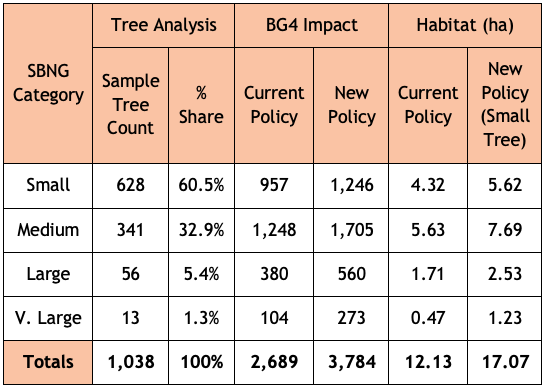
We have analysed tree data for 1,038 surveyed trees taken from a sample of BS:5837 2012 tree surveys submitted in support of previous planning applications. Most of the trees in this sample, 60.5%, fall within the SM Small tree category, 32.9% are within the Medium tree category, 5.4% are in the Large tree category with the balance, 1.3%, being categorised as Very Large.

Table 4 below sets out the likely impact of the proposed changes to BG4. It assumes that all these trees were removed (though that was not the case for all the planning applications we sampled) and replaced with SM Small category trees:

Table 4 Proposed BG4 impact analysis.

The spreadsheet setting out the basis of our calculations can be downloaded here – RPA Table Statutory BNG 13 table Comparison.

The saga of the SNCI at Yew Tree Farm continues

What does ‘harmful impact’ mean?

When the Development Control Committee last met to discuss the Council’s application to extend the cemetery at South Bristol into the SNCI at Yew Tree Farm on 6 September 2023, we were disturbed to hear the Chief Planner’s interpretation of the meaning of ‘harmful impact’, as set out in the Local Plan policy, DM19 – ‘Development which would have a harmful impact on the nature conservation value of a Site of Nature Conservation Interest will not be permitted.’

We even wrote an open letter to the Chief Planner asking them to explain their reasoning. We published this as a blog: It seems that SNCIs are nothing special – an open letter to Bristol’s Chief planner.


Update

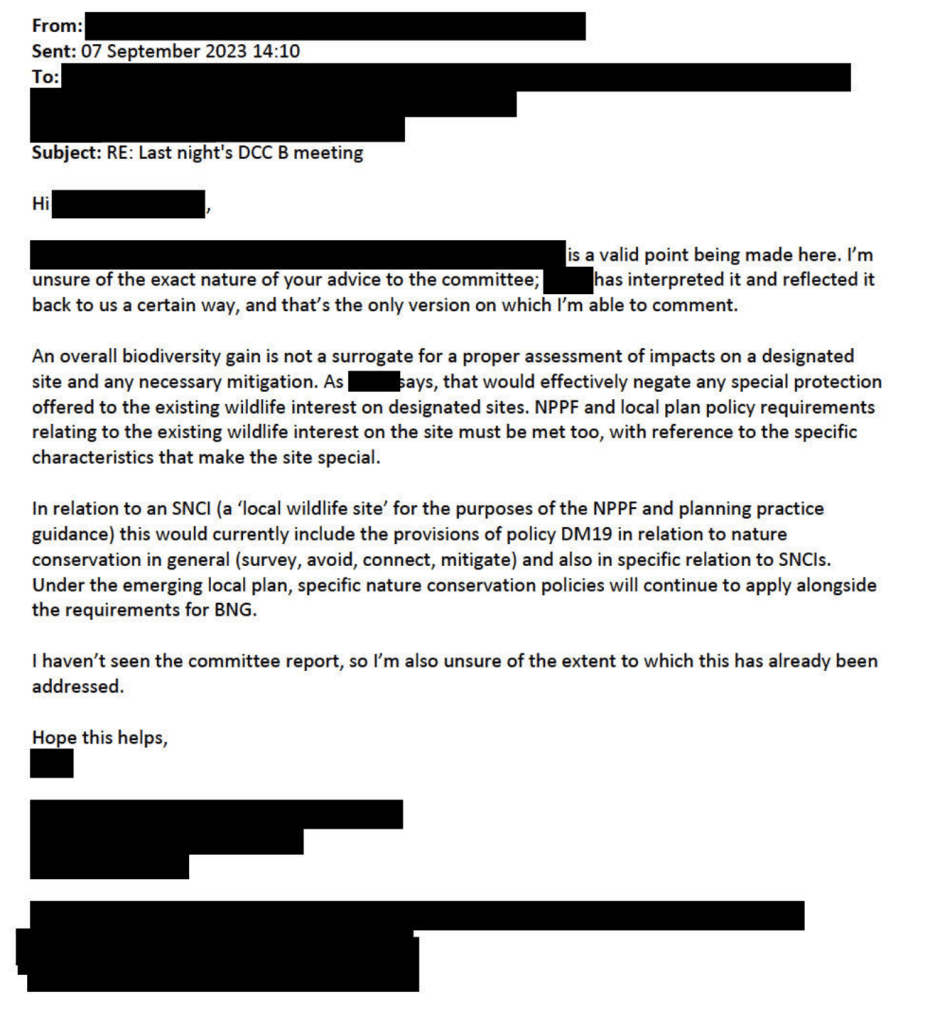
Unbeknown to us, it seems that the Council’s Nature Conservation officer did comment on the Chief Planner’s earlier advice to the Committee:

This document was disclosed on 1 December 2023 as a result of our Freedom of Information request of 01 November 2023. This appears to have formed the basis of the answers given below.

Update Ends


As we received no reply at the time, we took the opportunity to ask again when the Committee reconvened to make its decision on 29 November 2023. We asked two questions – see page 9 of the Public Forum. As the responses still didn’t really satisfy, we asked two supplementary questions:

  1. When you say, ‘the site’, what do you mean? Is it within the redline boundary or something else such as within the SNCI’s boundary?
  2. You say ‘The crucial additional clarification to highlight, is that to be in alignment with this policy it is NOT the overall biodiversity gain that is determinative. There rather needs to be an assessment that establishes whether there is harm with reference to the specific characteristics that make the site special.’

Does this mean that the replacement of one habitat which forms part of the ‘specific characteristics that make the site special’ – such as a replacing the Grassland Habitat that forms part of the current SNCI designation with a Lake Habitat that does not form part of the current SNCI designation, or that the provision of offsite mitigation measures to compensate for onsite habitat losses (in this case -6.44%) – would not be acceptable?

These were the replies:

To question 1

By ‘the site’, it’s the site as set out in the application document, so it’s the SNCI as contained in the application document the area in the redline boundary.

To question 2 (as it is quite complex, we have reproduced it verbatim)

You need to take the application as a whole and where it is demonstrated as that with regard to the features, particularly the grassland, that there is no impact ultimately or, if anything, a slight enhanced impact.

We intervened to ask – So you are saying that the substitution of the grassland habitat for a lake habitat…?

I am not saying that at all, I am saying that the grassland, actually that there is more grassland and that’s what the ecology report also says – more grassland of the type for which the SNCI is designated will be there through this application than before… within the redline boundary.

Here is the recording of this exchange – https://www.youtube.com/watch?v=-8EvqLA8-Lg (08:05 minutes from the start to 11:30 minutes).

What’s a redline boundary?

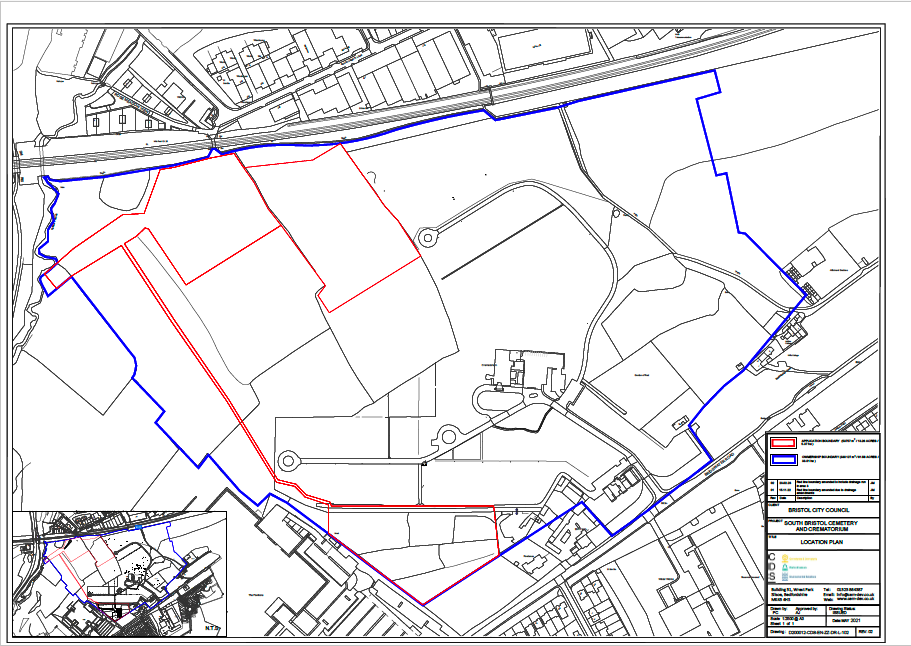
Anyone who wants to develop land must produce a location plan of the area proposed for development, delineated by a red line – the so-called ‘redline boundary’.[1]

When planning permission is granted, only the area within the redline boundary may be developed (though ancillary works may take place elsewhere).

Here is the location plan for the South Bristol Cemetery Extension application:

The South Bristol Cemetery Extension location plan (North is at the top)

The redline boundary here is quite complex because it’s made up of two burial areas, in the north and south, and an attenuation pond to collect runoff from the northern burial ground through a series of drains (the southern burial ground runoff will drain straight into Colliter’s Brook to the west). The area within the blue line is also owned by the Council and so is under their control.

The redline boundary is also important when it comes to calculating the biodiversity value (BNG) of the development site. All the habitats within the redline boundary are treated as ‘onsite’, while those outside the boundary are treated as ‘offsite’.

So, when we are told that ‘… there is more grassland and that’s what the ecology report also says – more grassland of the type for which the SNCI is designated will be there through this application than before… within the redline boundary,’ it’s just the onsite area that’s being referred to. This is important, as we show below.

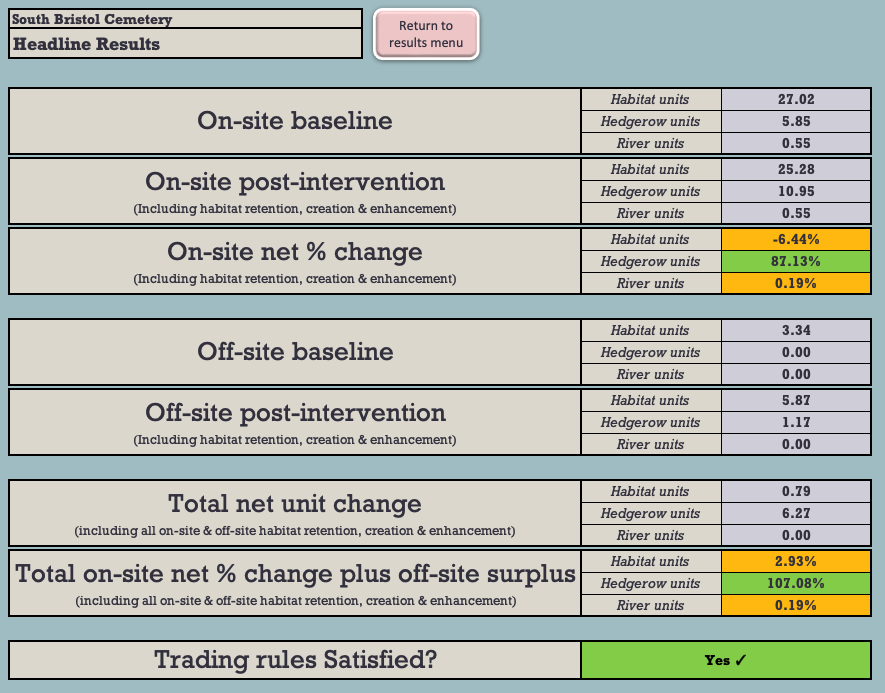
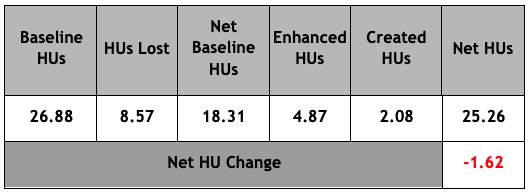
The headline results shown in the most recent BNG 3.1 calculation relied on by the Council[2] show that 6.44% of the baseline onsite area biodiversity will be lost as a result of the development (see Figure 1).

Figure 1: The BNG 3.1 Headline BNG results.

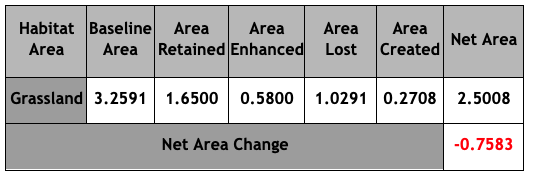
Figure 2 shows the net losses of the onsite grassland habitat:

Figure 2: Grassland Area & Habitat Unit analysis (HUs)

Under the BNG Trading Rules, Medium Distinctiveness grassland habitats may only be replaced with the other Medium Distinctiveness grassland habitats or with habitats of a Higher Distinctiveness. So, in order to achieve the net 2.93% BNG which the Council claims will result from the development, it will be necessary to compensate for these losses by crediting 3.25 Habitat Units of High Distinctiveness Lakes habitat by creating the attenuation pond.

This is not what we are told is happening and it certainly cannot be said that: ‘… there is more grassland … of the type for which the SNCI is designated … within the redline boundary,’ This is plainly untrue and, even on the Chief Planner’s definition (which we do not accept), it is clear that this application will ‘have a harmful impact on the nature conservation value of a Site of Nature Conservation Interest.’ This is contrary to DM19.

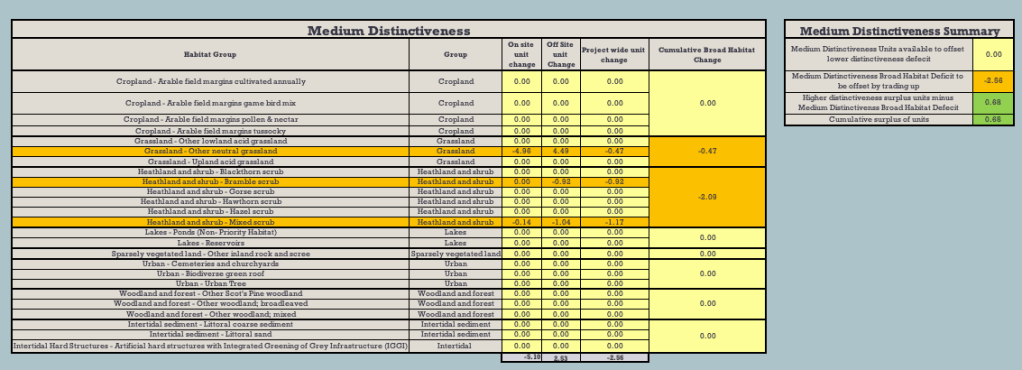
What’s more, even if the proposed offsite habitat mitigations were taken into account, there’d still be a net loss of -0.47 HU of Medium Distinctiveness grassland habitat (see Figure 4 below).

Figure 4: Net Medium Distinctiveness habitat losses

There’s one other serious flaw in the application, which was not brought to the attention of the Development Control Committee at its meeting. There’s a shortfall of -0.11 Habitat Units of the High Distinctiveness habitat, Species-rich native hedgerow with trees. Lost High Distinctiveness habitats may only be replaced like-for-like. This has not happened. As a result, the application is in breach of the BNG Trading Rules and should not have been approved.

We have brought this to the attention of the Council and the LPA.

These are just some of the important reasons why we say that the Development Control Committee was wrong to grant this flawed application.

A copy of this blog can be downloaded here – The saga of the SNCI at Yew Tree Farm continues


[1] It seems that no one thought of those with red/green colour blindness, who might find it difficult to see this red line.

[2] 22_05714_FB-SOUTH_BRISTOL_CEMETERY_BNG__25TH_AUGUST_23_-3540800