The Eastgate woodland copse – Decision time

We have reported on this issue a number of times already – Trees under threat at the Eastgate Centre!Trees under threat at the Eastgate Centre – Comments so far…Eastgate woodland and Eastgate Woodland – Round Three, but the Eastgate Oak and the tree community it lives within is still threatened with destruction.
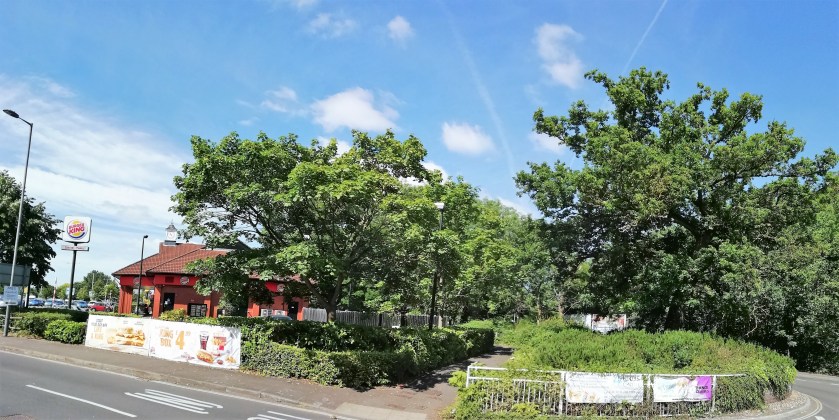
Eastgate Copse_5

The Development Control Committee will be meeting this Thursday – 21 June 2018 at 2 pm to decide whether outline planning permission should be given to remove the last vestige of an older woodland that once connected the Frome & Eastville Park with St Werburgh’s and the heart of Bristol beyond and redevelop this site. Small though the copse is, it still forms part of the green space in which we live and gives pleasure to many to many of those who pass by.

Here is the location plan:
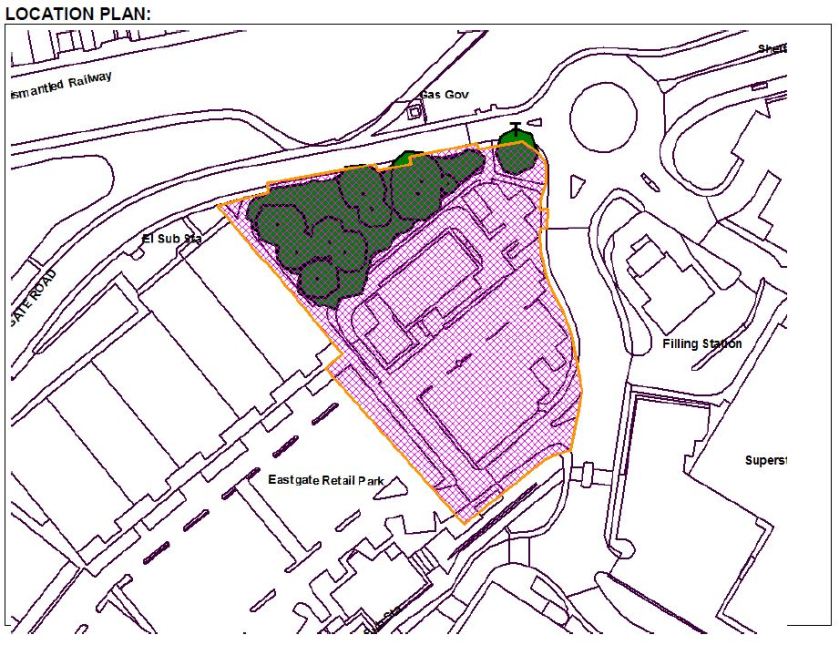
Eastgate Oak Location Plan

This is what is being proposed – the living copse is gone and a few lingering specimens are left standing alone (for how long?) like exhibits in a museum, with new plantings (what species?) dragooned into neat lines like so many extras, but away from the main commercial activity which takes centre stage:
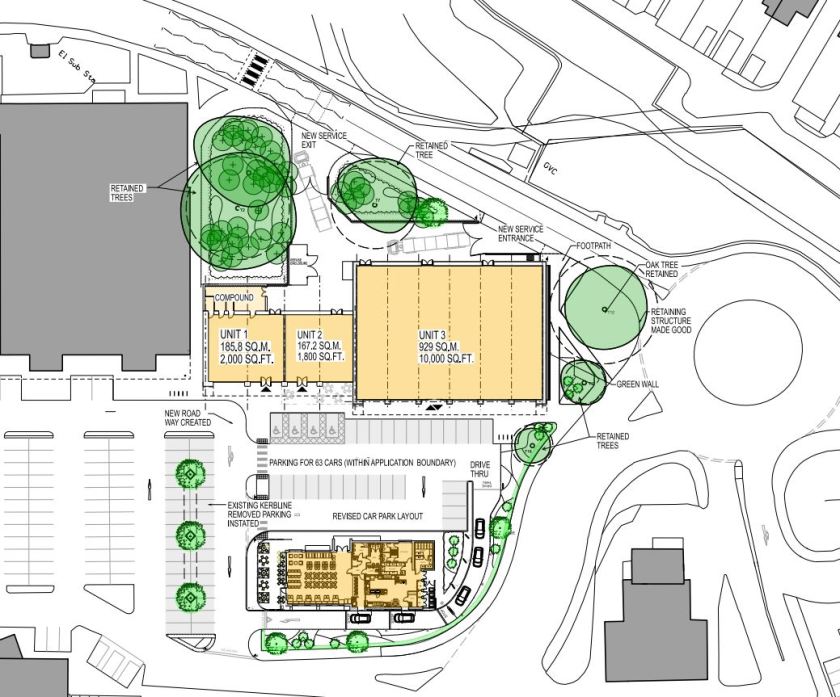
Eastgate Proposed Layout

The paragraph headed ‘TREES’ in Development Control Committee’s summary is instructive and says it all:

‘The application was submitted with insufficient survey detail to cover all the trees on the site including the understorey, and how they would be impacted by the proposed development. However, it is clear that one mature poplar tree would remain (adjacent to the existing retail unit on the western end of the site) and possibly one mature ash tree within the remaining area of landscaping following implementation of the scheme. It should be noted that the chances of this ash tree surviving are slim, as more than 40% of its root area would be removed. In the absence of an Arboricultural Implications Assessment or an Arboricultural Method Statement it is not possible to assess whether what is shown to be retained is in fact feasible. It is highly likely that much of the existing tree cover shown to be retained will be lost. The majority of the understorey would not survive the works proposed and any remaining understorey would be unprotected and more vulnerable to adverse weather. In short, given the proposed layout the conditions suggested will only be certain of protecting one mature tree. All the remaining trees will in all likelihood be lost. In terms of the ecological quality of the trees to be lost, the following additional comments can be added: The area of green infrastructure contains six ash trees that have been identified in particular as locally notable trees of age and are characterised as being ‘transition veterans’. This means that they provide important habitat due to their age and characteristics within a heavily built-up area where habitats are limited and they have the potential to become potentially important veteran trees for biodiversity in time. It should also be noted that this group of trees provides a significantly greater ecological benefit than a single tree as proposed. The group of trees also provides an element of future proofing the site, as if a single tree is lost due to the natural laws and forces of nature others remain that continue to provide ecological benefit.’ We agree!

If Bristol City Council is serious about its long-term goal of doubling tree canopy cover to 30% by 2050, it cannot allow this endless nibbling away of the little we already have, especially in places like the Eastgate Retail Park, already the victim of an older, unenlightened and merciless policy of development ‘desertification’.

Leaving just one or two specimen trees as a token concession to us ‘tree huggers’ really no longer suffices in the face of mounting evidence that the removal of trees, especially in urban environments, is more than just a question of utility and aesthetics, but impacts us and the world we live in immediate and direct ways by damaging our physical and emotional well-being and degrading the environment we depend on.

It is too late to submit questions, but petitions and statements may still be lodged as long as they are received by the Council at the latest by 12 Noon this Wednesday, 20 June.  They can be emailed to democratic.services@bristol.gov.uk.

Statements will not be accepted after 12.00 noon on the working day before the meeting unless they have been submitted in advance to Bristol City Council but were not received by the Democratic Services Section. Anyone submitting a statement for an application will also be allowed to speak in support of it at the meeting.

The Anne Frank Ginkgo

If the end of the world were imminent, I still would plant a tree today.

So wrote Otto Frank, Anne Frank’s father.

Bristol’s Anne Frank tree was planted in her memory on 12 June 2009 on what would have been her 80th birthday. You can visit the tree and remember Anne at Brandon Hill Park near the Charlotte Street entrance. It can be found here.

By Unknown photographer; Collectie Anne Frank Stichting Amsterdam (Website Anne Frank Stichting, Amsterdam) [Public domain], via Wikimedia Commons

The tree, a Ginkgo biloba, was one of many such trees planted in memory of Anne Frank throughout the country. The tree-planting ceremony was held nine years ago to mark the 80th anniversary of her birth and took place after the city had hosted a touring exhibition in the cathedral, which attracted more than 10,000 people and 25 school groups.

Anne Frank and other members of her family were among millions of Jews murdered in Nazi concentration camps during World War II.

Jon House, Deputy Chief Executive of Bristol City Council, who led the event, said ‘Anne Frank has become a symbol of the millions who have suffered persecution throughout the world because of prejudice and hatred and the ongoing fight to challenge it that we all share. Bristol City Council has an important leadership role to play in bringing communities together and building better neighbourhoods, creating equality of opportunity for everyone and defending the most disadvantaged in our city.’

A chestnut tree behind the secret annex in Amsterdam where Anne and her family hid was one of Anne’s only links to the outside world during her years in hiding, but, by 2009 it had become diseased. This tree in Bristol, and many others like it, reminds us of the consolation and pleasure that trees can bring us, and of the tragedy that befell Anne, her family and all those who have suffered persecution. The Anne Frank trees planted throughout Britain were intended to ensure that her story is not forgotten.

If Anne were alive today, she would be 89 years old next Tuesday.

Planting and replacing Bristol’s street trees with Section 106 money

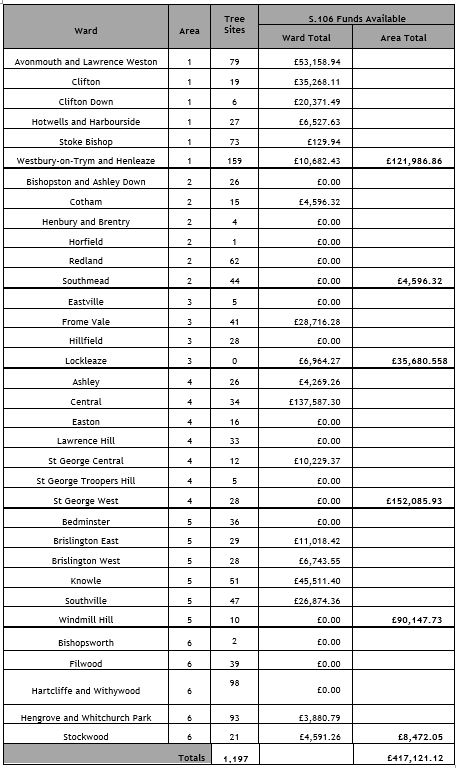
There are some 38 s.106 agreements worth more than £400,000 available just for planting trees in Bristol.

BCC Area 01

Section 106 (of the Town & Country Planning Act 1990) agreements are private agreements made between local authorities and developers. Some Section 106 agreements are specifically made to replace trees lost because of development. In Bristol, these agreements are made under the Bristol Tree Replacement Standard (see pages 20 & 21). They often also require that trees be planted within a one-mile radius of a development site. The current total value of these funds is more than £400,000.

There are also another 27 agreements that relate to ‘Parks & Open Spaces’ valued at more than £450,000, some of which might also be used to plant trees, but subject always to agreement with Bristol Parks Forum and other local ‘green space’ community groups.

Here is a summary of the current tree-specific agreements grouped by Ward and the new BCC Administration Areas:Ward S106 fundsBackground Notes

Of the 52,017public trees and tree sites managed by the council, a third are street trees. Across the city there are 944 vacant tree sites, 542 of which are places where street trees once grew. Bristol Tree Forum is negotiating to have these sites made available for sponsorship. The remainder of these tree sites are in housing estates, parks, cemeteries, amenity areas and many other green spaces.

None of these sites is available to sponsor but there are currently another 707 sponsorship sites, of which 246 are in streets. These figures constantly change as trees felled are added and sites sponsored are removed. Figures for sponsorship sites where a sponsor has come forward, but the tree has not yet been planted are not published.

These sites could also be funded by Section 106 money. This makes 1,651 sites across the city where trees could, potentially, be replanted. Of these some 1,198 lie within one or more of the areas specified by these Section 106 agreements and 417 of them are on streets.

Replacing all Bristol’s lost trees using only Section 106 agreement monies would cost £765.21 per tree. Planting trees in new sites (sites where there was never any tree) may be more expensive: £3,318.88 per site if the pavement must be lifted, services are disturbed, and a specially designed tree pit installed. If all Section 106 agreement funds were used to replace just lost trees, then some 540 trees could be replaced – 45 per cent of the total number of sites available.

Figures available for tree planting on streets show that 608 street trees were planted between 2013 and 2018, an average of 122 per annum (We are happy to provide the reports and data upon which this table is based on request).Trees Planted tableWe have now been able to establish that the Council felled 1,304 trees over the last three years. We have not yet been able to find what sort of trees they were or where they we located, but it is likely that most were located on streets. 363 street trees were planted over the same period.

* This figure constantly changes. As trees are felled, they are removed from the main BCC asset register. The site disappears until a new tree replaces (if it ever does) the one lost. Trees are usually planted during the winter months when most trees are dormant.

Here is a pdf of this blog.

The Bristol Tree of the Year Competition, 2018

The Bristol Tree Forum is hosting its first Bristol Tree of the Year Competition.

The purpose of the competition is to increase public awareness of the arboreal heritage of Bristol and the many benefits that trees bring us. We intend to make this an annual event.

The competition will be in four phases:

1    Submitting your chosen tree

Local Bristol community groups and organisations are invited to submit their candidate tree before 1 September 2018. Just one tree per group or organisation may be submitted. The tree must be within the Bristol City Council boundary and in a public space accessible to everyone.

2    Voting for your favourite tree

Voting opens on 15 October 2018 and will close at midnight, 15 November 2018.

3    Announcing the winner

We will announce the winner and the runner-up during National Tree Week, which will be held between 24 November and 2 December 2018.

To enter the competition, please download and complete this application form and submit it to:

TreeoftheYear2018@bristoltreeforum.org

Alternatively (or as well), you might want to take up the Woodland Trust’s initiative and celebrate the street trees near you. If so, then click here to apply for a Street Trees Celebration Starter Kit.

Here are the entries so far:

Meet the Candidates

Plant a tree for Paul Dirac

The other day, as I wandered around Bristol looking at the delightful, newly planted trees so many generous Bristolians have paid to have planted, I passed No. 13 Monk Road in Bishopston – the house where Paul Dirac, the famous theoretical physicist, was born and lived in as a child. He is regarded as one of the most significant winning physicists of the 20th century.
Sadly, the line of lime and plane trees that grace the road has a prominent gap where a tree is missing. It is just outside No. 13 (which has a blue plaque). There was probably one there once, though.
The Paul Dirac Gap
Wouldn’t it be great if we could get it replaced…and perhaps build on that to plant other Blue Plaque Trees where famous Bristolians once lived and so celebrate their lives.

In Hintock woods…

‘The casual glimpses which the ordinary population bestowed upon that wondrous world of sap and leaves called the Hintock woods had been with these two, Giles and Marty, a clear gaze. They had been possessed of its finer mysteries as of commonplace knowledge; had been able to read its hieroglyphs as ordinary writing; to them the sights and sounds of night, winter, wind, storm, amid those dense boughs, which had to Grace a touch of the uncanny, and even the supernatural, were simple occurrences whose origin, continuance, and laws they foreknew.  They had planted together, and together they had felled; together they had, with the run of the years, mentally collected those remoter signs and symbols which, seen in few, were of runic obscurity, but all together made an alphabet.  From the light lashing of the twigs upon their faces, when brushing through them in the dark, they could pronounce upon the species of the tree whence they stretched; from the quality of the wind’s murmur through a bough they could in like manner name its sort afar off.  They knew by a glance at a trunk if its heart were sound, or tainted with incipient decay, and by the state of its upper twigs, the stratum that had been reached by its roots.  The artifices of the seasons were seen by them from the conjuror’s own point of view, and not from that of the spectator’s.’  

Chapter 44, The Woodlanders by Thomas Hardy

Public Meeting, 4 June 2018

You are invited to a meeting of the Bristol Tree Forum at Bristol City Hall on Monday 4 June 2018 between 6 p.m. and 8 p.m.

BRISTOL TREE FORUM

Supporting Bristol’s Trees & its Urban Forest to ensure a sound future for all our trees, especially our street trees

Our guest speaker will be Dr Kieron J. Doick, Head of the Urban Forest Research Group.

The meeting will also discuss and consider:

  • taking advantage of untapped funds to help plant and look after more trees 
  • wider engagement within the community over tree issues, including the role of tree champions.

Visit bristoltreeforum.org for updates and to contact us.

In the meantime, don’t forget to sign the Tree Charter…

Tree_charter__logo

Help shape Bristol’s Tree Strategy Action Plan – join the iTree Bristol tree survey

Come along and find out about the iTree Project training day between 10 a.m. to 12.30 p.m. at Ashton Court next Sunday 13th May.

iTree Bristol is a new project providing a great opportunity to be personally involved in a campaign to care for the Bristol’s existing trees and woodlands and to plant many more of them all over the city.

The plan is to survey around 200 randomly selected plots across the city. In this way we will have a better understanding of the structure of the city’s urban forest and the many benefits it brings us – reducing air pollution, capturing carbon, reducing rainfall runoff.

Internationally recognised, i-Tree Eco is being used by cities and towns across the UK to help inform their tree strategies. The results of our iTree Bristol survey will inform the forthcoming plans for our Tree Strategy Action Plan, setting out our goals and priorities for increasing our tree canopy cover and developing and funding our urban forest and its trees into the future.

iTree Bristol needs volunteers to help run the survey. You don’t need to be an expert. All you need is an interest in trees and have time to help with a small number of surveys over this summer when our trees are in full leaf and at their best. Forest of Avon Trust will provide training and support.

Come and join in

If you would like to join in, please complete the form below and email it to Forest of Avon Trust to register your interest. They will be in touch with more information about the event.

Complete the iTree Bristol Volunteer Contact form to volunteer!

iTree Bristol  is supported by the Forest of Avon Trust working with Bristol City Council, the Woodland Trust and Bristol Tree Forum. This core group will also be working with organisations and individuals across the city to produce Bristol’s Tree Strategy Action Plan.

As plans develop, more information will be provided through the our web sites and Twitter accounts –  and .

And don’t forget to sign the Tree Charter…


Tree_charter__logo


Eastgate Woodland – Round Three

A new planning application has been lodged – No. 18/00634/P.

Here, for example, is the proposed new layout.

Eastgate Proposed Layout

For those of you who would like to comment, you have until March 26th to do so. The Determination Deadline is 16 May next.

So far there have been five objections and something called a ‘Statement of Community Involvement‘.

Tree Canopy Cover – a strategic solution?

A recent study* has used i-Tree Canopy^ (a free-to-use tool developed by the USDA Forest Service) to survey the tree canopy cover (TCC) of 282 towns and cities in England.

TCC, also called ‘urban canopy cover’ or ‘urban tree cover’, has been defined as the area of leaves, branches, and stems of trees covering the ground when viewed from above. It is an easily accessible measure that can be used to estimate the percentage of tree cover that any urban area enjoys.

It is now internationally accepted that properly managed forests and trees in urban environments make important contributions to the planning, design and management of sustainable, resilient landscapes – they help make cities safer, more pleasant, more diverse and attractive, wealthier and healthier.

Research also suggests that even moderate increases in canopy cover within cities can aid adaptation to the adverse effects projected under a changing climate. However, a baseline TCC value for many of the UK’s towns and cities is unknown.

Nor is it known whether canopy cover is changing and, if it is, whether it is increasing or diminishing. There is also a knowledge gap when it comes to knowing the numbers of trees in towns and cities, or their species, age composition and health. The level of canopy cover required to deliver meaningful benefits in UK towns and cities is also unknown, though there is some evidence to suggest that it is in decline.

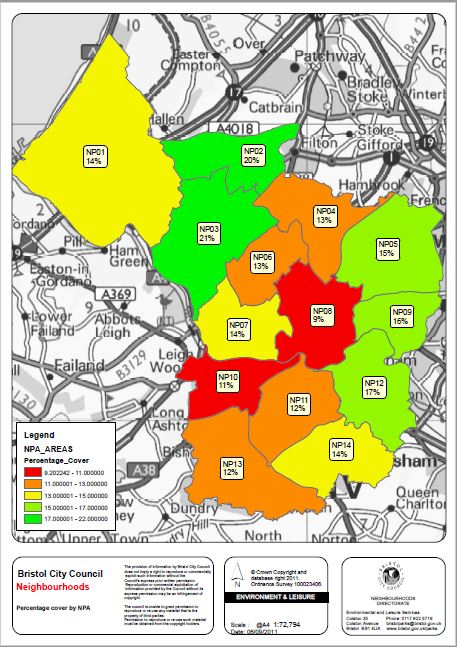
This study* has now gone some considerable way to answering these questions and revealed a wide range of baseline tree canopy cover across the country – from a TCC of 45% in Farnham to just 3.3% in Fleetwood; with a median TCC of 15.8% and only 132 (47%) of sampled areas exceeding this.

Bristol, for example, ranks 176/282 samples if the 14% TCC identified in a study undertaken by Bristol City Council in 2011 is used. If the 18.6% cover estimated in this recent study is used (the study only looked at TCC in the urban land classes, rather than at the whole administrative area covered by BCC), then its TCC is above average and it would rank 83/282 samples. This suggests that “…boundary choice can impact TCC results and should be driven by the overriding question: ‘what is the tree canopy cover in the urban land classes of a given local authority?’, compared to ‘what is the tree canopy cover in a given local government jurisdiction?'”‘.

Doick et al – i-Tree Canopy Assessment urban area mapped

Bristol also has the added benefit of having already surveyed many of its public trees, albeit some eight to ten years ago. This treasure-trove of data has been collated and augmented with other data we have collected to make a dataset of nearly 67,500 individual trees (though just 2.4% of predicted TCC) and made available to all via the Trees of Bristol web site.

Conclusions drawn by the study

A TCC target that is city-wide and not targeted at specific wards or land-uses poses a number of challenges. It can be delivered in such a way that does not optimise or diversify benefit delivery. For towns and cities that have a green belt (or similar designation), planting schemes can be targeted within this land. However, with comparatively lower populations than the urban centres, planting here offers fewer benefits on a per capita basis.

Canopy increase targets could equally be met by preserving the existing tree stock and allowing natural growth. As the canopies increase so will total canopy cover, although such increases will be constrained by tree loss/removals, natural wastage and damage by pests and disease.

Such an approach, however, also fails to address social equity. Targets based on land-use-based assessments or ward are more likely to align the provision of ecosystem services with indicators of social inequity. It will be important that such approaches are underpinned by a robust baseline and a commitment to repeat canopy cover surveys using a consistent approach.

Species diversity and placing the right tree in the right place are important considerations when planting to achieve a TCC increase as these allow resilience to be built into the urban forest. Knowing the composition of the existing urban forest in terms of species and age structure, condition and appropriateness to location (and therefore life expectancy) can inform such decisions. Given that private ownership of trees can be as little as 24-35% in some cities, but as high as 71-75% in others (Introducing England’s urban forests), TCC baselining studies should be complemented by a field study.

With the wide range of considerations and stakeholders involved in urban forest management, TCC targets should be set both within local planning policy and within a formal urban forest management strategy.

Targets should have a target date, an action plan and a commitment to monitor, review and update. The policies should inform on which tree species to plant. They should also prioritise wards and/or land uses and should protect the existing tree canopy by enforcing best practice, codes of practice and statutory controls in the care, maintenance and protection of trees. Given that the average lifespan of a typical urban tree is estimated to be 32 years, changes in the age profile of the urban forest should also be modeled to at least 50 years distant in order to understand and plan for the likely impact on total TCC of tree planting and loss.

Any strategy will need to focus on partnerships with institutions and on guidance advising residents how they can best protect and look after their tree stock, schemes to assist in management and maintenance, and support future tree planting amongst the different ownership groups.

Finally

City-wide tree canopy cover is a useful indicator of the extent of tree presence across a city. Its assessment can be simple, fast and highly reproducible. Repeat observation could be a cost-effective means of monitoring tree populations, setting targets and tracking effectiveness of planting programs.

The results of this study suggest that:

  • an average TCC of 20% should be set as the minimum standard for most UK towns and cities, with a lower target of 15% for coastal towns;
  • towns and cities with at least 20% cover should set targets to increase cover by at least 5% (i.e. above the ±2% tolerance of i-Tree Canopy) within 10 to 20 years (depending on what is achievable against their baseline); and, targets and strategies for increasing tree cover should be set according to the species, size and age composition of the existing urban forest, based upon a ward/district level and land-use assessment.’

We at BTF commend and recommend this very helpful and timely study.

* Doick, K.J., Davies, H.J., Moss, J., Coventry, R., Handley, P., Vaz Monteiro, M., Rogers, K., Simpkin, P. (In Press). The Canopy Cover of England’s Towns and Cities: baselining and setting targets to improve human health and well-being. Conference Proceedings of TPBEIII. Urban Trees Research Conference. 5-6th April 2017. Institute of Chartered Foresters, Edinburgh.

i-Tree Canopy