To calculate the biodiversity value of a habitat, it’s important to assess its strategic significance. A habitat’s strategic significance takes into account both its type and its location. If strategic significance is high, then the habitat’s value will be uplifted by 15%. However, as this article explains, the opportunities for doing this are limited.
A habitat parcel is an area of habitat which is all of the same distinctiveness, condition and strategic significance. Strategic significance refers to the importance of a habitat parcel based on its location and type.
Each habitat parcel needs to be assessed both before, when the baseline habitat is surveyed, and after development, on or off site.
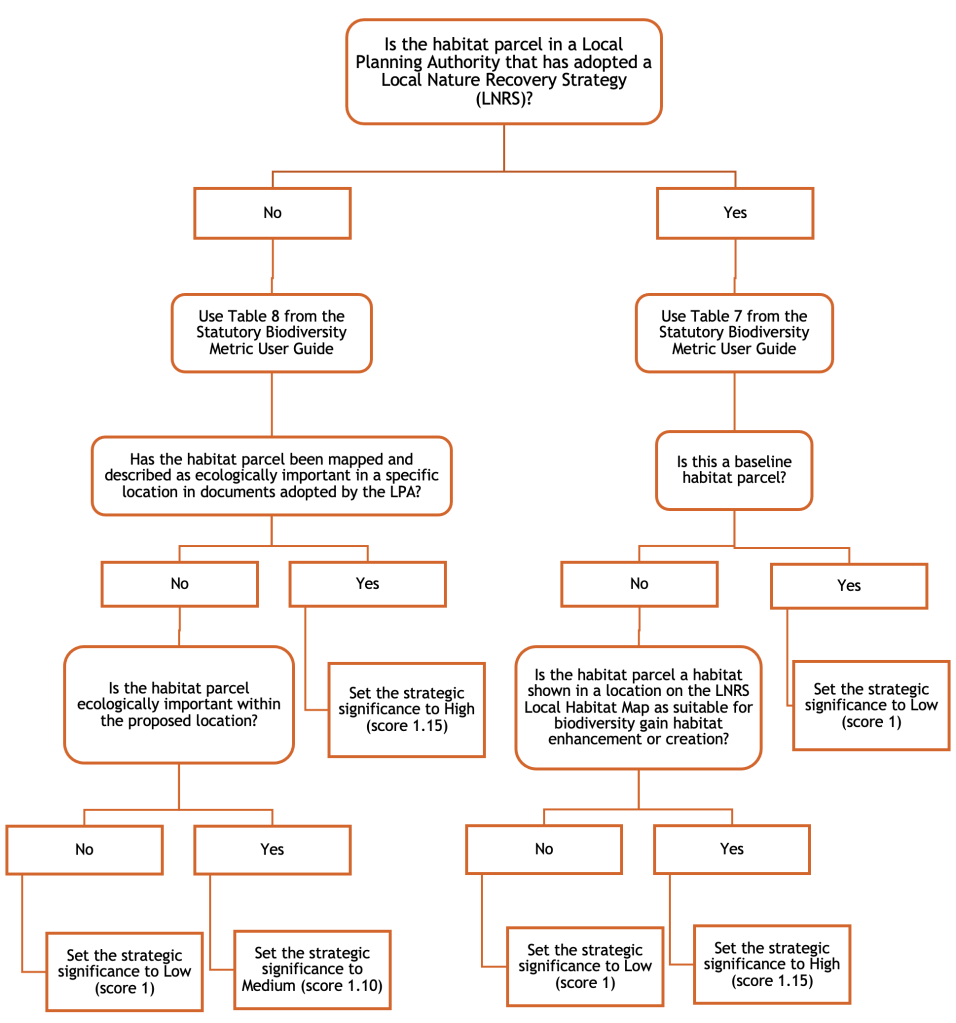
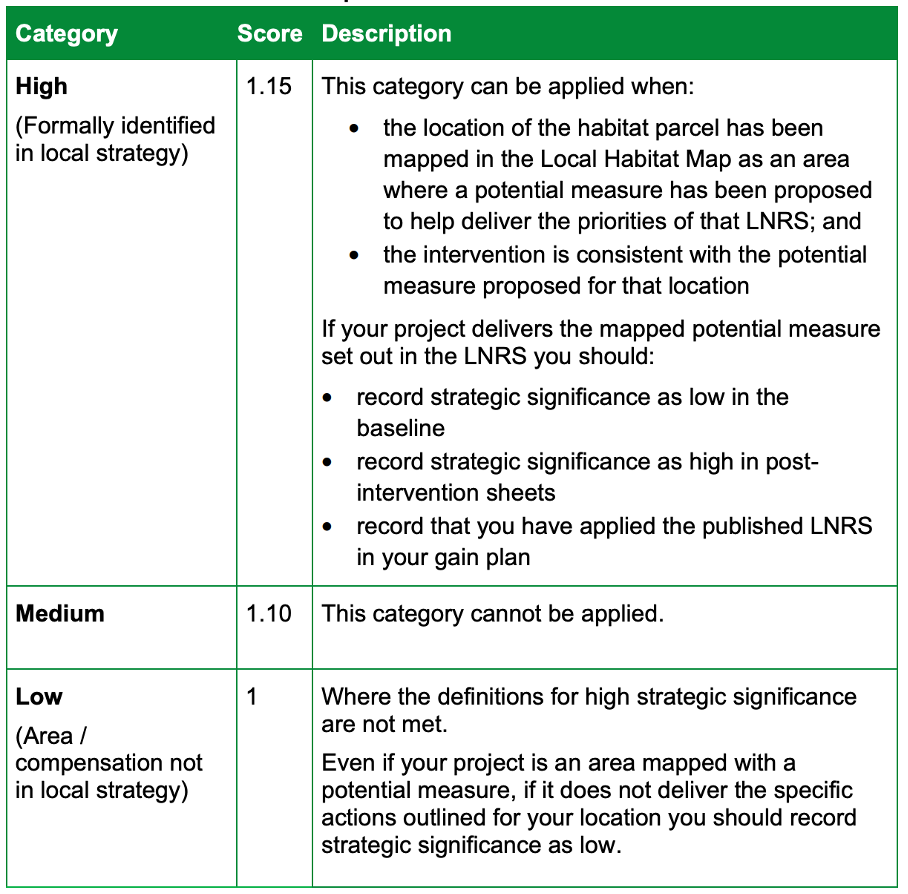
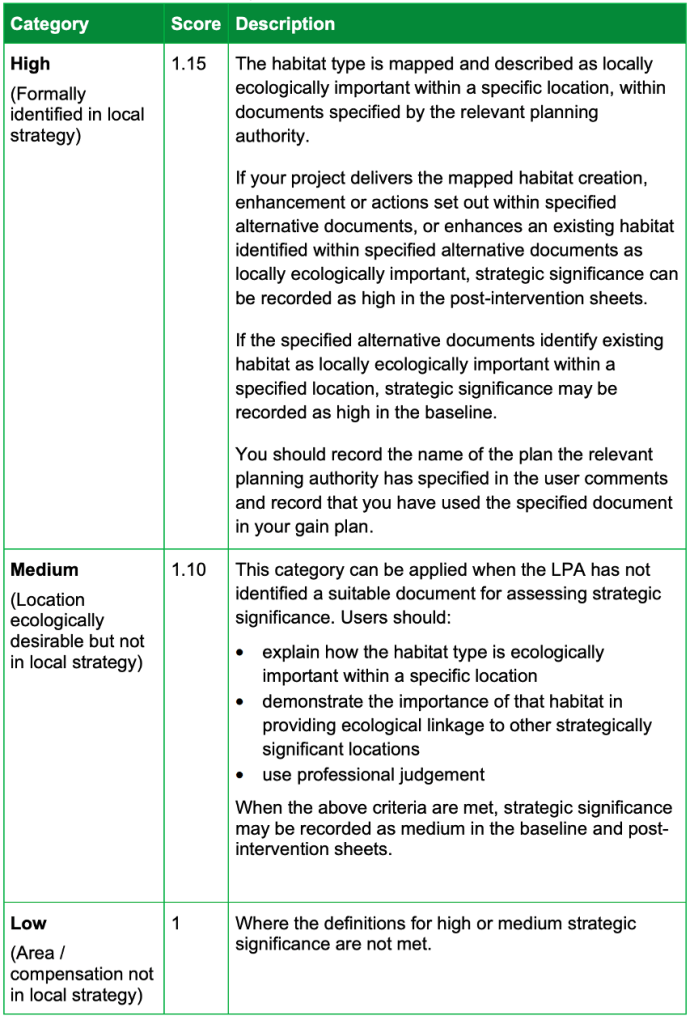
This flowchart sets out how to assess the strategic significance of a habitat parcel. It uses the tables, shown below, from the Statutory Biodiversity Metric User Guide.
When developers cannot meet their obligation to replace habitat lost within their development site, plus at least 10%, they may buy habitat units to offset this lost habitat. These habitat units are available in ‘biodiversity gain sites’.
This article was updated on 23 February 2025 to take account of the development of our new site which dynamically analyses the Biodiversity Gain Register and collates and summarises the published data:
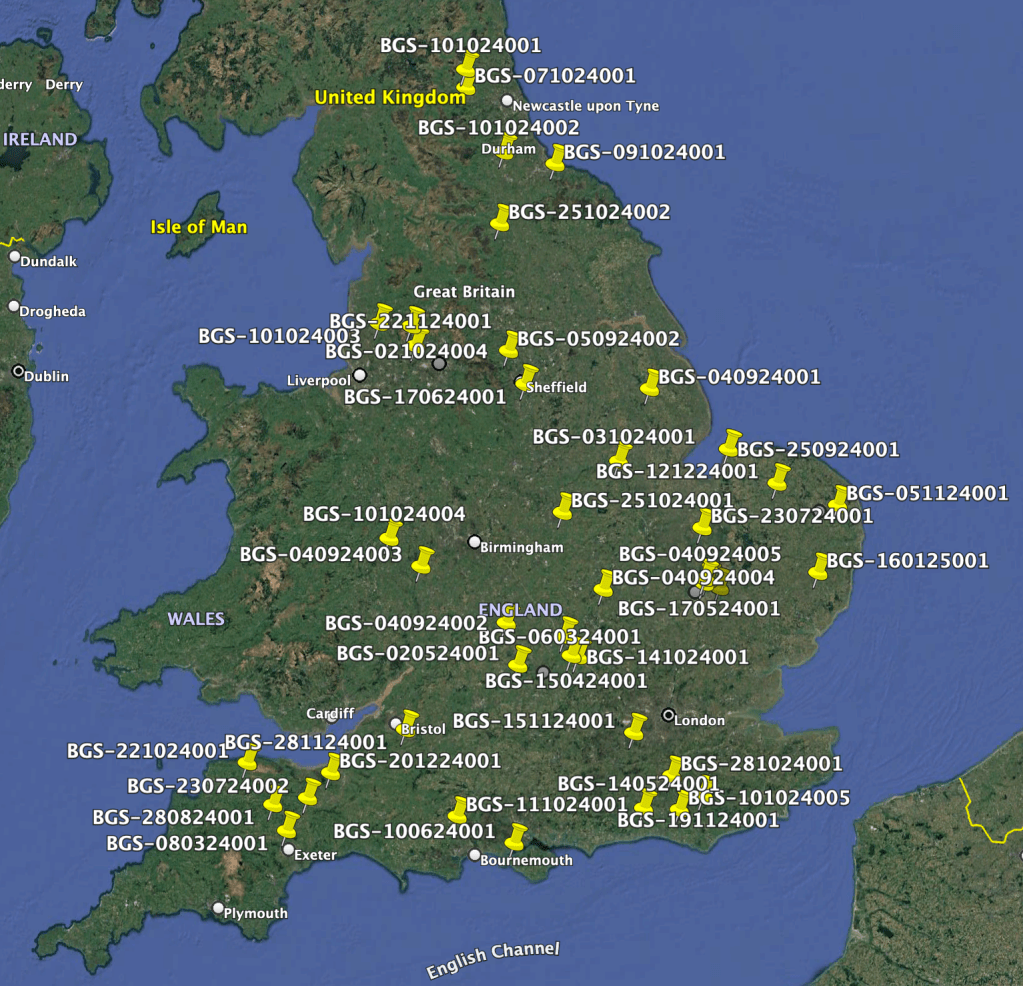
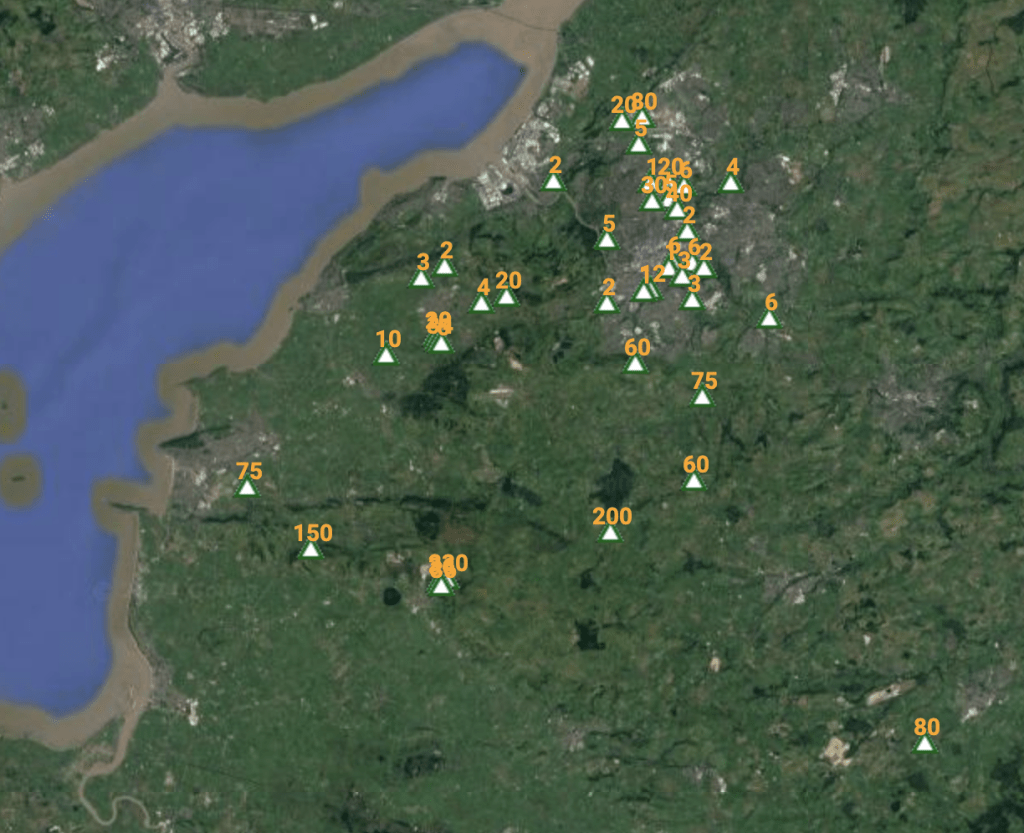
To date, 46 of these biodiversity gain sites (BGS) have been registered in England. They provide:
1,376.7 hectares (ha) of baseline area habitat.
32.76 kilometres (km) of baseline hedgerow habitat.
11.37 km of baseline watercourse habitat.
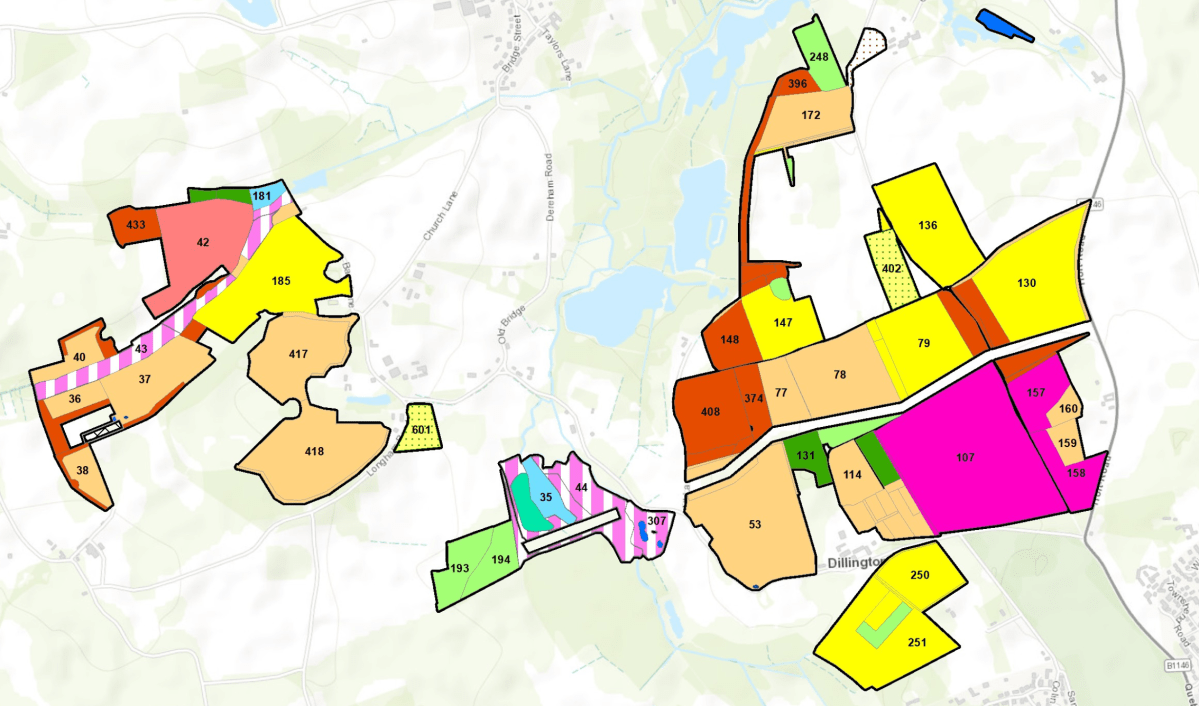
The BGS sites cover 1,770.41 ha, though not all of this area is used for habitat improvement. 1,420.83 ha baseline habitats are made available for offsetting habitat loss caused by development elsewhere where this lost habitat cannot be replaced on the development site itself.
Distribution of biodiversity gain sites in England
19 of the 46 BGS sites are controlled by RSK Biocensus Limited as the Responsible Body but are mostly owned by Environment Bank. One other is controlled by Harry Ferguson Holdings (based on the Isle of Wight) as the Responsible Body, with the remaining sites under the control of various Local Planning Authorities (LPA) as the Responsible Body. We assume that the LPA sites have been created in order to deal with those local developments which require offsite mitigation. Nonetheless, these sites are also selling habitat to developers which require offsite mitigation but are outside the LPA boundary.
We also ask who is policing these sites to ensure that was has bee promised is being delivered? This must especially be the case for LPA sites given that the LPA cannot monitor itself?
In Bristol the LPA has delegated this function to neighbouring authorities using s.101 Local Government Act 1972 (the power for councils to delegate functions to other local authorities). – See 30 Sept 2024 Economy and Skills Committee notes – from paragraph 9. It will be interesting to see how this turns out. However, despite this, no BGS sites have yet been registered in the city, so it is hard to see how this initiative will be delivered where offsite mitigation is required.
The habitat improvement potential
These sites provide a total of 4,819.3 area baseline habitat units (HUs), 325.59 hedgerow baseline HUs and 105.6 watercourse HUs – we have assumed that all the sites have low strategic significance and that the watercourse habitats are free of encroachment.
We have been able to calculate the improved habitat units being created but not the improved habitat units being enhanced. This is because the parameters upon which these baseline habitats are being improved have not been identified.
The take up to date
So far, 31 of these 46 BGS sites have been used by 59 LPAs to allocate lost habitat caused by 85 developments. The majority of habitats are Other neutral grassland and the remainder are Lowland meadows, Traditional orchards, Floodplain wetland mosaic and CFGM, Mixed scrub, Woodland and forest and Hedgerow habitat.
To encourage developers to choose sites as close as possible to the habitat loss, they don’t need to pay a ‘spatial risk’ penalty if the biodiversity gain site is within the same Local Planning Authority (LPA) as the development. However, if the biodiversity gain site is outside the LPA for a particular development, the developer must pay a penalty when calculating the number of habitat units to be offset. If the site is in an adjacent LPA, the penalty is 25%. If it is farther away, the penalty is 50%.
Unfortunately, it appears that developers are not using BGS within their LPA areas (if available) for offsetting but are paying the spatial risk premium, though perhaps this is because they have no choice as there are no local BGS sites available.
Our analysis shows that, to date, the average distance between the centre of the LPA* where the habitat was lost and where its loss is offset is 80.1 km, with the greatest distance between loss and replacement being 344.8 km. Only six sites are within 10 km of the site of the habitat loss, while 23 are over 100 km away.
* It is difficult automatically to calculate the exact site of the habitat loss on the basis of the information provided. If at least Post Codes were provided, this would be possible.
What is particularly notable is that many of the development sites we have examined appear to be in locations where there should be ample opportunities for local habitat to be improved, but nothing has been done to realise this. Even the South Downs National Park LPA has allowed the replacement of habitat lost in two applications on the same site under its care near Petersfield to be exported to a site some 67 km away near Lewes, albeit that it is still in the National Park.
Furthermore, all 46 of the BGS sites are located on private land, in rural settings that are not easily accessible, whereas the lost habitats were largely located in built-up areas.
However, given the requirement that offsite mitigation only be delivered on registered sites, its hard to see what choice developers have apart from testing the BGS market and buying the cheapest habitats required, albeit that this may be miles from the site of the original loss.
This is still a small sample, which will grow over time so, perhaps this will change as more biodiversity gain sites become available and a clearer trend emerges. At the moment, however, the trend is not encouraging and looks like it will result in local nature, especially in urban settings, becoming hollowed out, as we feared it would when the biodiversity net gain requirements became obligatory nearly a year ago. See our article on this: ‘It seems inevitable Bristol will see a steady, inexorable biodiversity decline’
WEMCA’s Local Nature Recovery Strategy (LNRS) will fail to provide Bristol with the benefits promised for nature. While the new Biodiversity Net Gain (BNG) rules require most development in the city to increase biodiversity by at least 10%, unfortunately the LNRS will not apply to most potential development sites.
The LNRS is a locally led and evidence-based strategy which aims to target action and nature investment where it’s most needed. We’re told that the strategy will also focus on biodiversity net gain by increasing the strategic significance of specific habitats. However, it is hard to imagine how the LNRS will help to enhance biodiversity net gain in most, if not all, potential development sites in the city.
We might have been better off, at least as far as the application of biodiversity net gain to new development is concerned, by asking the LPA to specify alternative documents (such as those listed at the end of this article) for assigning strategic significance instead.
The issue
When calculating the impact of a proposed development on biodiversity, one factor taken into account is the strategic significance of any habitat found on a focus area for nature recovery site (coloured purple in the map above). If strategically significant habitats are created or enhanced, then their strategic significance is set to High in the Statutory Metric calculator tool and a 15% uplift to the calculation of its value is applied. Subject to which of the six LNRS areas is being considered, these are the strategically significant habitats in the city:
Ditches
Ecologically valuable lines of trees
Ecologically valuable lines of trees – associated with bank or ditch
Grassland – Floodplain wetland mosaic and CFGM
Grassland – Lowland calcareous grassland
Grassland – Lowland meadows
Heathland and shrub – Mixed scrub
Heathland and shrub – Willow scrub
Individual urban or rural trees
Lakes – Ponds (priority habitat)
Priority habitat (on the River Avon and the Riparian buffers)
Species-rich native hedgerow with trees – associated with bank or ditch
Species-rich native hedgerow with trees
Species-rich native hedgerows – associated with bank or ditch
Species-rich native hedgerows
Urban – Open mosaic habitats on previously developed land
Urban – Biodiverse green roofs
Woodland and forest – Lowland beech and yew woodland
Woodland and forest – Lowland mixed deciduous woodland
Woodland and forest – Other woodland; broadleaved
Woodland and forest – Wood-pasture and parkland
However, a detailed examination of the LNRS map reveals that not all parks and green spaces have been designated as focus area for nature recovery sites. It’s only those which are in one or both of the following:
a location where they can make a greater contribution to ecological networks
deprived areas with a lack of access to nature.
These designations were based on Bristol’s previous work on ecological networks within the city and where wildlife-friendly interventions are most likely to be feasible. This means that the existence, creation or enhancement of these special habitats outside these areas will not attract the 15% strategic significance uplift.
The BNG requirements
The now compulsory Statutory Metric Guide, used for calculating Biodiversity Net Gain (BNG), advises (at page 27) that: ‘Strategic significance is the local significance of the habitat based on its location and habitat type. You should assess each individual habitat parcel, both at baseline and at post-intervention, for on-site and off-site.’
If the LPA has adopted an LNRS then only the High or Low strategic significance multipliers can be used (High – formally identified in local strategy = 1.15. Low – area compensation not in local strategy = 1). If it has not adopted an LNRS, then the Medium strategic significance multiplier may also be used (Location ecologically desirable but not in local strategy = 1.10).
Where an LPA has adopted an LNRS, all those sites which have not been identified as a focus area for nature recovery site will be designated as having Low strategic significance and so attract no uplift, even if they’ve been identified as important habitats in the Local Plan or in another strategic document adopted by the Council. These documents (used where an LPA has not adopted an LNRS) can include:
Draft Local Nature Recovery Strategies
Local Plans and Neighbourhood Plans
Local Planning Authority Local Ecological Networks
Parks and Green Spaces Strategies
Tree and Woodland Strategies
Area of Outstanding Natural Beauty Management Plans
Biodiversity Action Plans
Species conservation and protected sites strategies
Green Infrastructure Strategies
River Basin Management Plans
Catchment Plans and Catchment Planning Systems
Shoreline management plans
Estuary Strategies
Baseline habitats cannot be uplifted
Despite the BNG strategic significance guidance, Defra has stated that LNRS designations only apply to the creation or enhancement of post-development biodiversity mitigation habitats. They don’t apply if these habitats – called the baseline habitats – are found on the site before development begins.
This means that the 15% strategic significance uplift can only be applied where offsite biodiversity mitigation is being delivered in a focus area for nature recovery site. If these habitats are being delivered elsewhere, the uplift may not be applied.
However, even if the baseline habitats were included, it is unlikely to make any difference This is because the focus area for nature recovery sites identified in Bristol are, for the most part, located in public parks or green spaces, on river banks, in riparian buffers or on railway margins, none of which are likely ever to be developed or, in many cases, used to offset habitat lost to development elsewhere.
So far, no announcement has been made as to whether any of Bristol’s focus area for nature recovery sites will be made available for offsite habitat mitigation and the proposed new Local Plan does not commit to using these sites for this purpose.
This, combined with the challenge of finding LNRS suitable for offsite habitat mitigation, registering them as biodiversity gain sites and then managing them, effectively, in perpetuity, suggests that few feasible LNRS sites will be found, especially as many sites are also in demand for public access for recreation.
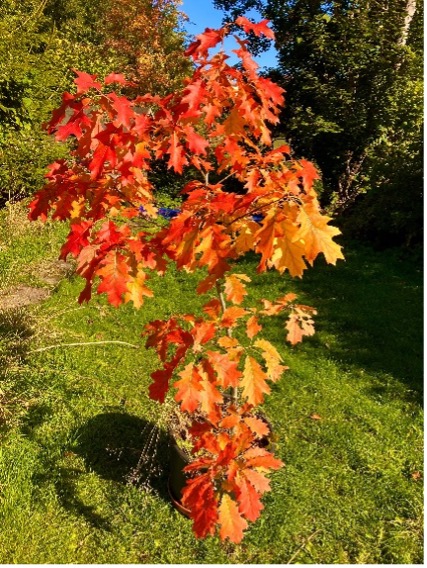
Many thanks for of of you who have asked for trees – over 1,200!
We have now closed the offer.
Planting a tree is, perhaps, one of the most significant things we can do to help protect our future environment, promote nature and make the world a better place for the generations to come. The trees we plant today will continue to provide benefits for the environment, wildlife and people, for hundreds of years.
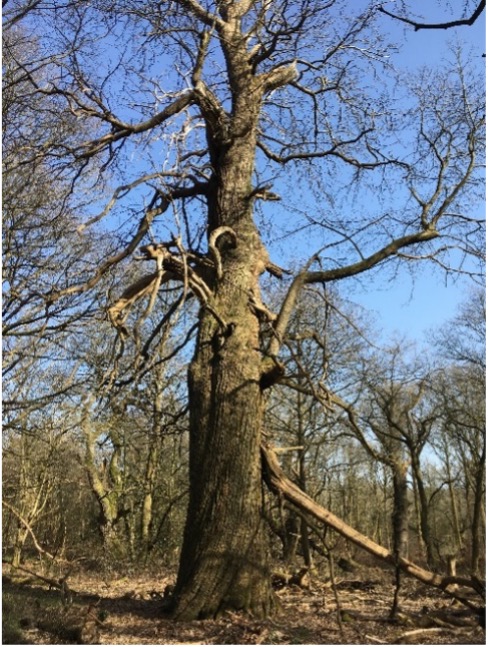
A veteran chestnut
We all know the value of trees in sequestering carbon, and they still represent the most effective and widespread means of removing CO2 from the atmosphere. For instance, a single mature oak tree is the equivalent of 18 tonnes of CO2 or 16 passenger return transatlantic flights. However, it is in our cities that trees provide the greatest benefits; cleaning our air, reducing flooding, improving our physical and mental health, and, crucially, reducing temperatures during heat waves.
Our cities suffer additional problems during heat waves, with all of the concrete and tarmac absorbing a lot of energy from the cooling sun and releasing it as heat. This “heat island” effect can raise temperatures by as much as an additional 12 degree centigrade. Trees can greatly reduce, or even eliminate, this effect, partly through shade but also actively cooling the air by drawing up water from deep underground, which evaporates from the leaves… a process called evapotranspiration. According to the US Department of Agriculture, this cooling effect is the equivalent to 10 room sized air con units for each mature tree. This cooling greatly enhances our resilience to the dangerous heat waves that are predicted to increase in severity and frequency.
A veteran Beech
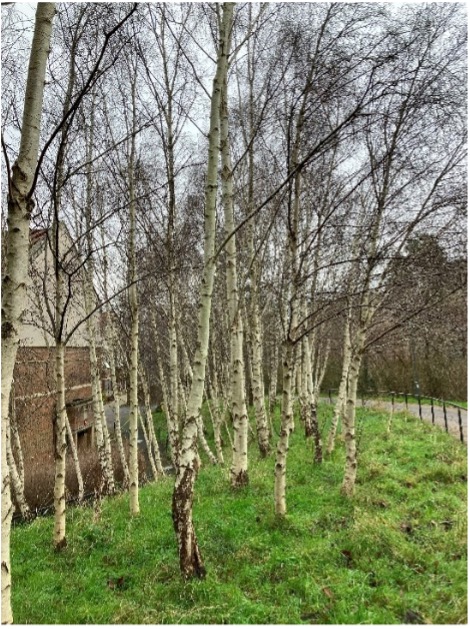
A stand of Silver birch
Also, Trees improve air quality by absorbing both gaseous (e.g., NO2) and particulate pollution. They reduce traffic noise and flooding and improve physical and mental wellbeing.
Thus, trees are a crucial, but often ignored, element in increasing our resilience to climate change.
What are the Bristol Tree Forum doing to help?
It is said that the best time to plant a tree is 20 years ago, and the second-best time is now.
Unfortunately, important mature trees are constantly being lost to development, damage and disease. Though these might easily be replaced by new trees, what is less easy is replacing the decades or even centuries that the tree has taken to grow, the carbon that the tree has sequestered, the ecosystems the tree supports and all of the other benefits trees provide. For these reasons, most of the work of the Bristol Tree Forum focuses on protecting our existing trees. These efforts are particularly crucial in the urban environment where our trees are under the greatest threat.
However, as well as advocating the retention of life-saving trees in our city, Bristol Tree Forum have been encouraging new tree planting by holding an annual tree giveaway since 2020; the ancient trees of the future are being planted today! Most of Bristol’s trees are sited in private land and gardens, so the trees we have are mostly thanks to the efforts of Bristol residents, and it is those residents we must look to if we want to increase our tree canopy.
Over the last four years, we have given away around 10,600 trees, with species as diverse as English and Sessile oak, Downy birch, Silver birch, Grey birch, Alder, Alder buckthorn, Rowan, Scots pine, Sweet chestnut, Sycamore, Spindle, Wild cherry, apple, pear and plum.
This year’s Tree Giveaway has been made possible by the generous support ofMaelor Forest Nurseries, based on the Welsh borders, and Protect Earth whose aim is to plant, and help people plant, as many trees as possible in the UK to help mitigate the climate crisis.
Thanks to Maelor, we are able to offer a variety of species with a wide range of sizes and preferred habitats, including Pedunculate (English) oak, Red oak, Sweet chestnut, Silver birch, Sycamore, Hawthorn, Beech, Hornbeam, Wild cherry, Alder, Red alder, Field maple and Norway maple.
Trees can be ordered using the form below
We will get delivery of trees in February, when the trees can be collected from a site in Redland, Bristol. We will email you when they are ready.
The saplings come bare-rooted (i.e. out of the soil) and will need to be planted as soon as possible after collection, although the viability of the trees over winter can be extended by storing the trees with the roots covered in damp soil.
The form below is to find out who would like to have saplings for planting, which species, how many and where you plan to plant them.
Please provide your email so we can contact you organise collection of the trees. Your contact details will be kept private and will not be used for any other purpose than to process your request.
In a boost for the environment, new legislation now obliges most developers to set out how they will achieve at least 10% more biodiversity than already exists on their proposed development sites.
Developers must now show how they will improve the biodiversity of their development site as a result of their works. Developers must record the (baseline) on-site habitats that exist before development starts and show how they will either enhance or replace these on site. If their proposals fail to reach the 10% threshold, the developer may provide the shortfall elsewhere. This post-development mitigation should be done as closely as possible to the development site, or at least within the Local Authority. However, if this isn’t possible, they can use approved sites anywhere in England.
This approach is called the Biodiversity Gain Hierarchy (found in Schedule 7A of the Town and Country Planning Act 1990 at section 37A). The Hierarchy says it’s a priority to avoid the ‘adverse effects’ to ‘onsite habitat with a habitat distinctiveness score … equal to or higher than four.’ If this can’t be avoided, only then is mitigation permitted. In our experience, nearly all developers ignore the requirement to avoid adverse effects and move straight on to mitigation.
Since the introduction of the Bristol Tree Replacement Standard in 2013, developers (and planners) have ignored the policy requirement to avoid tree removal where at all possible. Instead, they’ve moved straight on to providing compensation for the trees lost to the development. As a result, the money set aside for replacement tree planting was not spent (on occasion reaching nearly £1 million) and many of the lost trees were never replaced.
Under the Hierarchy, habitats that score four are designated as having medium distinctiveness. While many habitats have medium distinctiveness, many don’t. For example, managed grassed areas (called ‘modified grassland’) are often found on urban sites but have a low distinctiveness score. So, too, do many other urban habitats such as allotments and gardens. Developers are not required to avoid harming these, though losses to these habitats must still be mitigated.
There’s no definition of what an ‘adverse effect’ is or any guidance on how it is assessed. However, recent advice from the Bristol’s Chief Planner about the meaning of ‘harm’ suggests that this could be interpreted very broadly or simply ignored because some sort of mitigation will always be available.
In the last extreme, developers may purchase biodiversity credits. We wait to see how this and the offsite biodiversity mitigation market evolves, but a 2012 paper published in the Harvard Environmental Law Review suggests that such environmental markets are prisoners of their own geography because the space available is always constrained:
Markets for water quality, biodiversity, endangered species, fisheries, air quality, and aquatic resources, to name a few, must recognize that the commodities they trade exist at particular geographic scales, and set appropriate spatial limits on the redistribution of environmental quality. The size of geographic trading areas has significant implications for the economic viability of markets and the ecological quality of their offsets.
This will be a particular challenge when providing biodiversity mitigation in urban areas.
The squeeze on green spaces
Land use in Bristol is subject to intense competition by many stakeholders. This is especially true for our green and open spaces, which offer many ‘services’ beyond just habitat provision. There is very little, if any, space available for new biodiversity to be created. At best, some green spaces might be enhanced, but opportunities to do this are likely to be very limited.
For example, Bristol Tree Forum’s examination of the three proposals to develop Bedminster Green shows that, if these proposals are allowed, then nearly 400 new trees will need to be planted to compensate for the lost tree habitat – a medium distinctiveness habitat. There’s no room to plant these trees on site, so offsite provision will be needed. There are very few opportunities for doing any new tree planting (as opposed to replacing lost trees) in the surrounding wards or even across Bristol, let alone, as is usually required, within a mile of a development site.
Instead, these replacement trees will have to be planted somewhere else: ‘in some foreign field that is forever Bristol’. This will inevitably lead to a net loss of biodiversity across the city as nature is ‘hollowed out’. This is unacceptable. The whole purpose of the new biodiversity gain regime is to improve overall local biodiversity, but it seems inevitable that Bristol will instead see a steady, inexorable decline.
We are disappointed that the current draft of the new Local Plan addresses none of these issues and have said so in our responses to the latest consultation:
The new Biodiversity Net Gain (BNG) obligations, which came into force last February, aim to improve our natural environment by requiring that all new developments have a positive impact (a net gain of at least 10%) on biodiversity.
For this reason, we believe that Bristol urgently needs to follow the lead of the other west of England councils, B&NES, South Gloucestershire and North Somerset, and adopt a Biodiversity Net Gain Supplementary Planning Document (SPD). A list of other local authorities that have adopted their own biodiversity SPDs can be seen here on the Local Government Association planning advisory service website – Biodiversity Net Gain in Local Plans and Strategic Planning.
Councils are encouraged to develop a locally specific SPD as part of their Local Plan. This would:
set out local priorities and strategies that require developers to deliver BNG locally
ensure that BNG contributes to wider nature recovery plans such as the newly launched Local Nature Recovery Strategy (LNRS) and other local objectives, and help ensure that the right habitats are provided in the right places
link BNG requirements to other strategic objectives and place-making policies in the Local Plan, to ensure a more holistic approach
set requirements for managing and maintaining habitats provided through development.
Having such a document would clarify exactly what developers need to do in terms of the BNG requirements. While these requirements have many gaps, they are now, as it were, the only game in town and we must try to make the best of them. We believe that developing a robust BNG SPD could help mitigate these problems by adding tougher conditions that developers must meet.
With the launch of the LNRS – a collaborative effort to help people and organisations within WECA and North Somerset take effective action for nature – it has become more important than ever for Bristol City Council to bring this strategy into action, especially where new development is planned.
Two factors causing us the most concern (there are others) are the exclusion of stakeholders from the BNG decision process and the lack of enforcement of BNG requirements.
Consulting stakeholders
We’ve long been concerned that the new BNG regime excludes stakeholder groups such as ours from engaging with and commenting on the approval process for Biodiversity Gain Plans (BGPs) because of the way the planning rules work.
The BGPs are a post-approval requirement (see Schedule 7A of the TCPA ’90, Part 2, section 13(1)), which means there’s no obligation for a developer to demonstrate how it will meet its BNG responsibilities during the application stage (although the Council could require this).
Under current rules, BGPs only need to be submitted for approval to the Planning Authority after an application has been approved. However, there’s no statutory requirement to consult any statutory bodies on BGPs or to publicise or consult on the submission of a BGP prior to its approval. It seems, therefore, that we (and other stakeholders who, like us, are fighting for everyday nature) will have no say in what is proposed, or even have any idea of what a BGP contains or how it could affect us.
Surely this goes against the principles of open governance and localism which councillors should be fighting to defend, especially where it’s likely to have a direct impact on the very places that we Bristolians love and value?
Improving enforcement
As a recent article in Local Government Lawyer magazine points out, there are serious issues around BNG enforcement that need to be resolved.
We’ve been trying to engage with council officers over this issue for some time, but so far without success. Maybe the time has come for the Council to seize the initiative? With the proposed new Local Plan moving towards its public hearings stage early next year and the likelihood that the plan will be adopted next April, maybe now is the time for the reconstituted Local Plan Working Group to take this in hand.
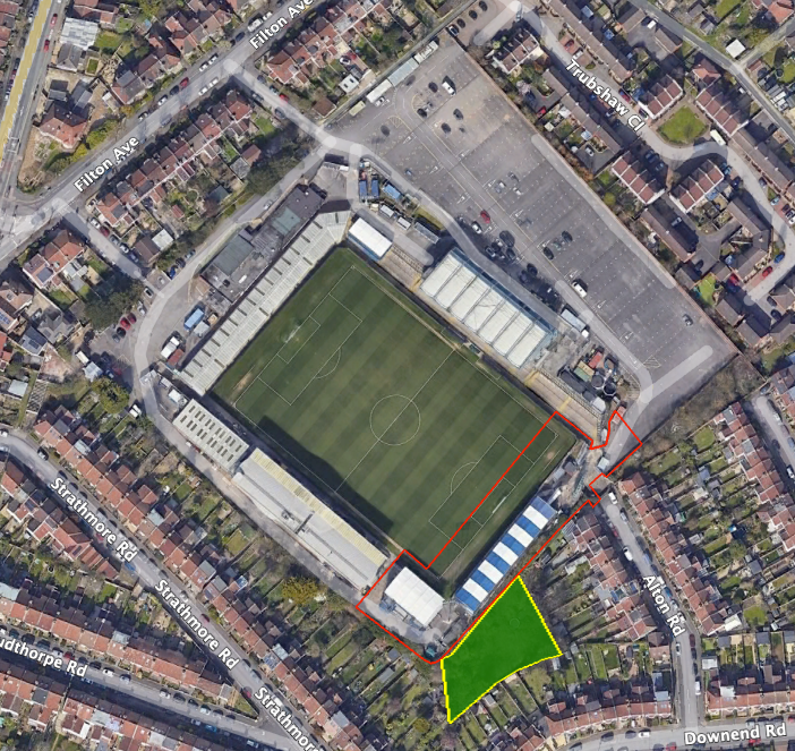
One of our fears is that some planning conditions, such as this one from the recent, pre 12 February 2024, Bristol Rovers Memorial Grounds application are unenforceable. In this case they only oblige the club to submit a proposed Landscape Ecological Management Plan (LEMP). They did this last June. However, the wording of the condition means that the club is not obliged to perfect this or even to carry it out.
Readers may recall that the development had been completed and the new stands occupied long before the main application was made, well before this and other conditions had been submitted or approved. In addition, as part of the eventual approval, the club agreed to plant a wood on a piece of unused land it owns to the south of the new stadium (the area shaded green below), but this has not yet been done.
As part of this agreement, the club is expected to enter into a LEMP to plant the wood and then maintain it in perpetuity. The LEMP Condition says:
Within 6 months of the date of consent, the applicant shall submit a 30-year Landscape and Ecological Management Plan (LEMP). This should address retained features of ecological interest, together with mitigation and enhancements to be provided. The LEMP should set out management compartments, objectives, and prescriptions for all new proposed soft landscaping/planting to demonstrate how all habitats will be managed to their target condition (as specified in the BNGA). It should also show how management of the site will be resourced and monitored.
In this example, all that can be enforced is a failure to submit the LEMP within six months, which, in this case, has been done. There is a S106 imposing LEMP obligations but this is toothless and, anyway, only the Council can enforce it – which it is not obliged to do.
There’s also the practical effect of the Biodiversity Gain Hierarchy – Biodiversity net gain Guidance Paragraph: 008 Reference ID: 74-008-20240214. This effectively means that the developer need not achieve any net gain on site, or even locally, but can instead deliver it anywhere in England or, as a last resort, simply buy BNG credits, though at a premium.
For example, the grant conditions – 11 (The BGP condition), 12 & 14 – in the recent, post-12 February Council application, The White Hall, Glencoyne Square, are unenforceable given their wording as there is only an obligation to submit; again, approval is not required. We assume that a s106 agreement and a Habitat Management and Monitoring Policy (HMMP) will need to be produced, but, at the moment, we still have no idea how the self-acknowledged 38.09% habitat loss will be mitigated, or where.
Given the intense competition for space in the city, it seems inevitable that, as a result of the application of the Biodiversity Gain Hierarchy, Bristol’s nature will, bit by bit, be exported to some far-off field that no one knows or cares about. In theory, a BNG SPD could at least try to ensure that habitats lost to development are replaced locally wherever possible.
It’s been suggested that new SPDs can’t be delivered until after the new Local Plan has been examined and formally adopted. Maybe, but we see no reason why we can’t at least start a conversation about this. As it is, the proposed Local Plan will need substantial redrafting to align with the new BNG rules, having been adopted by the Council before these had been finalised.
It’s also been suggested that there are neither the funds nor enough officer time available to develop this new SPD. However, since all the adjacent councils (members of WECA), and many farther afield, have developed, or are developing, their own SPDs, we can surely save time and expense by looking on these as templates from which to build our own. The examples above alone make it all the more urgent for issues such as this to be resolved with the early adoption of a BNG SPD. We urge the Council to commission officers to draft an SPD as a matter of urgency.
There are six criteria for assessing a tree’s condition. If a tree passes five or six of the criteria, it is in good condition. If it passes three or four of the criteria, it is in moderate condition. If it passes two or fewer of the criteria, it is in poor condition.
These are the six criteria to consider:
A – The tree is a native species (or at least 70% of the block are native species). B – The tree canopy is predominantly continuous, with gaps in canopy cover making up <10% of total area and no individual gap being >5 m wide (individual trees automatically pass this criterion). C – The tree is mature (or more than 50% of the block are mature). D – There is little or no evidence of an adverse impact on tree health by human activities (such as vandalism, herbicide or detrimental agricultural activity). And there is no current regular pruning regime, so the trees retain >75% of expected canopy for their age range and height. E – Natural ecological niches for vertebrates and invertebrates are present, such as deadwood, cavities, ivy and loose bark. F – More than 20% of the tree canopy area is oversailing vegetation beneath.
The ‘Fairly Good’ and ‘Fairly Poor’ condition categories are not available for this habitat type.
Enhancement of this habitat is only possible by improving it so that it meets the criteria B, D and F. It is not possible or appropriate to enhance individual tree/s through meeting just one or two of these criteria, nor by meeting only A or C or E.
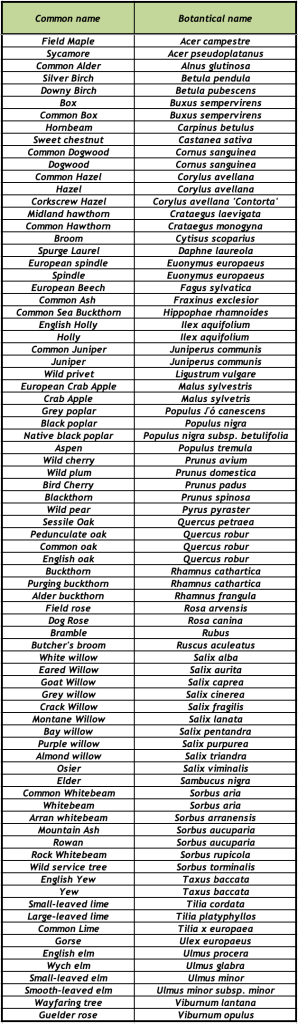
It is important that the species of each tree on site is properly listed by the developer. Here is the list of the native species defined by the Statutory Metric:
With the introduction of the Biodiversity Metric, all existing (i.e. baseline) habitat parcels on proposed development sites are given a calculated habitat value, called Habitat Units (HUs).
Baseline habitat parcels
Baseline habitat is the habitat that exists before a site is developed. Development sites often contain a mosaic of baseline habitats each of whose condition may vary. These are called habitat parcels.
The area of a habitat parcel is measured in hectares (or square metres when using the Small Sites Metric). Linear habitats parcels are measured in kilometres (or metres when using the Small Sites Metric).
The sum of all the ground-based area habitat parcels should equal the area of the proposed development site (the redline boundary).
Calculating HUs
The HU calculation uses the following formula:
HU = Habitat area/length x Distinctiveness x Condition x Strategic Significance.
The Distinctiveness of each habitat is predefined. These are the Distinctiveness scores:
The Strategic significance of a habitat is its importance according to its location and habitat type. Each of these elements is given a score which is then used in the HU formula. These are thescores:
High
1.15
Medium
1.1
Low
1
For example, an area habitat parcel covering a hectare, which is of medium distinctiveness, in moderate condition and of medium strategic significance, is calculated as follows:
1 ha (area) x 4 (distinctiveness) x 2 (condition) x 1.1 (strategic significance) = 8.8 HUs.
Individual trees habitat
There is a special formula for individual trees habitats. This is because they oversail the habitat on the ground and so are non- ground-based habitats, which need to be treated differently from ground-based habitats.
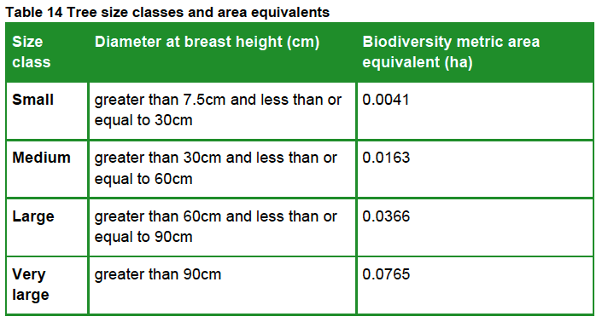
This table shows the four size classes for Individual trees habitats:
It uses the diameter at breast height (DBH measured 1.5 metres above the ground) of each tree growing on a proposed development site (if the tree is multi-stemmed, the largest DBH recorded is used) and assigns a ‘Biodiversity metric area equivalent’ to calculate its habitat area. This value represents canopy biomass, and is based on (but not the same as) the root protection area formula, derived from BS 5837:2012.
For example, a medium-size individual trees habitat covers an area of 0.0163 ha and has medium Distinctiveness. If it is in moderate Condition and of medium Strategic significance the HU value is calculated as follows:
0.0163 ha (area) x 4 (distinctiveness) x 2 (condition) x 1.1 (strategic significance) = 0.14344 HUs.
Post-development habitat creation and enhancement
The biodiversity metric also applies three additional risk factors to all post-development enhanced and created habitat parcels, across all three habitat types – Area, Hedgerow and Watercourse – using this formula:
HU = Habitat area/length x Distinctiveness x Condition x Strategic Significance x Temporal Risk x Difficulty factor x Spatial Risk
Temporal risk
This represents the average time lag between the start of habitat parcel creation or enhancement works and the target outcome date. This is known as the ‘time-to-target condition’ and is measured in years.
If there is a delay in creating or enhancing the habitat parcel, or it has already been enhanced or created, this can be factored in to adjust the time-to-target period either up or down.
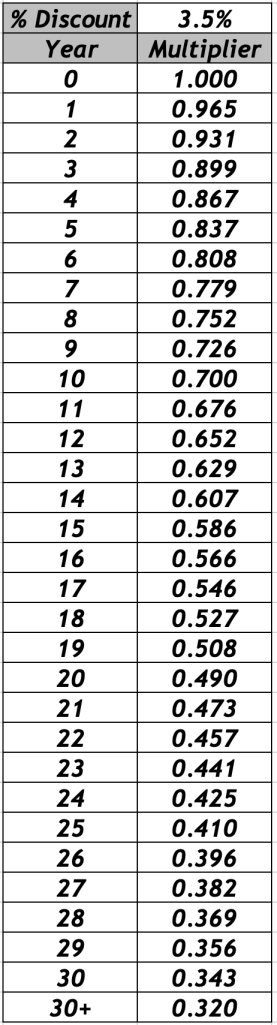
The temporal risk period is automatically applied by the biodiversity metric and changes depending on target habitat condition. As a result, the temporal risk multiplier, based on the 3.5% discount table below, sets the current value of the future habitat being created.
Difficulty of creation or enhancement
The creation and enhancement categories represent the uncertainty of the effectiveness of techniques to create or enhance habitat parcels.
The biodiversity metric automatically assigns the delivery risk and score for each habitat parcel, based on its habitat intervention category.
Category
Value
Low
1
Medium
0.67
High
0.33
Very High
0.1
Spatial risk
Where a project cannot achieve a net gain in biodiversity units on site, then offsite HUs can be used to meet the BNG requirement.
The spatial risk penalty (SRM) reflects the relationship between the location of on-site biodiversity loss and the location of off-site habitat compensation. It affects the number of biodiversity units provided to a project by penalising proposals where off-site habitat is located at a distance from the development site.
If the offsite area is within Local Planning Authority (LPA) boundary or National Character Area (NCA), the penalty is x 1.0.
If it is in a neighbouring LPA or NCA, the penalty is x 0.75.
If it is elsewhere (anywhere in England), the penalty is x 0.5.
The effect of this is that it costs more HUs to achieve the BNG requirement the farther away the offsite mitigation is from the location of on-site biodiversity loss.
Post-development Individual trees habitat creation
When creating Individual trees habitat, post-development size class of a tree is determined by its size when it is planted. Newly planted trees should be recorded as small-sized, unless the tree is actually medium-sized or above at the time of planting.
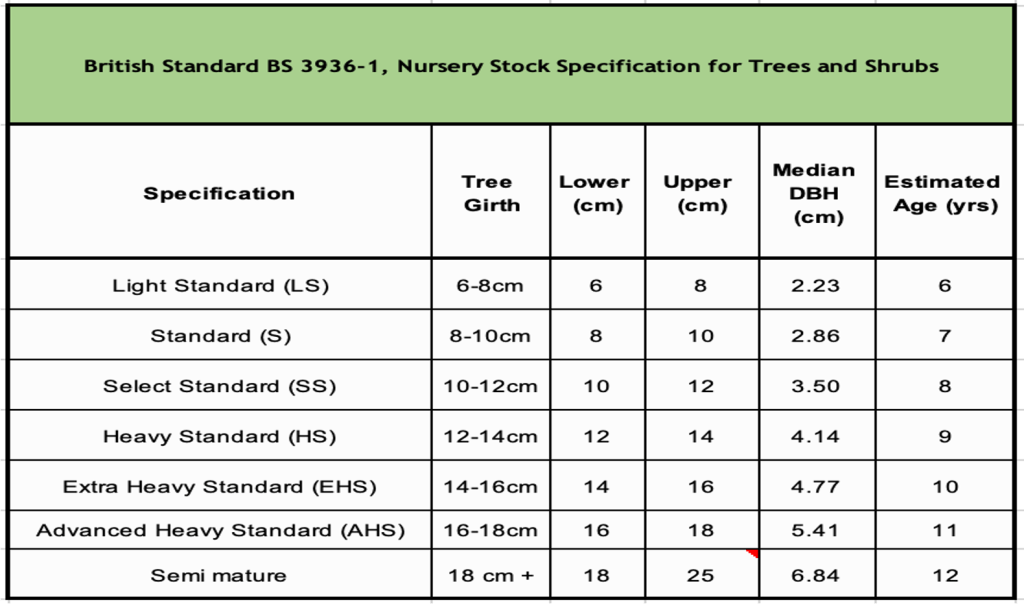
In our experience, nearly all nursery-grown trees are small-sized, as this table, derived from BS 3936-1, demonstrates.
For example, a small-sized tree covers an area of 0.0041 ha and has medium Distinctiveness. The difficulty of creation factor is preset at Low.
If it is planned for it to achieve a moderate Condition, the time-to-target period will be 27 years. If it is planted within the LPA in an area of medium Strategic significance, its HU value will be calculated as follows:
0.0041 ha (area) x 4 (distinctiveness) x 2 (condition) x 1.1 (strategic significance) x 0.382 (temporal risk) x 1 (difficult factor) x 1 (spatial risk) = 0.01378 HUs.
Much has been made of the new rules that require most developments to add at least 10% more biodiversity to a site than was present before development took place. This requirement is known as biodiversity net gain (BNG).
However, a much-overlooked aspect of the new rules is the requirement also to comply with so-called trading rules.
These trading rules set minimum requirements for habitat creation and enhancement to compensate for specific habitat losses resulting from a new development.
If these rules are not followed, a developer cannot claim that there is biodiversity net gain, even if the planning application has achieved the minimum 10% BNG required.
Rule 2 states that biodiversity unit outputs for each habitat type – Area, Hedgerow or Watercourse – must not be added together, traded, or converted between types. The requirement to deliver at least a 10% net gain applies to each separate habitat type.
The trading rules only apply to the point of no net loss of a specific habitat. Once the trading rules have been met for this habitat, the biodiversity net gain requirements can be met by the creation and enhancement of any other habitat, provided it is the same habitat type.
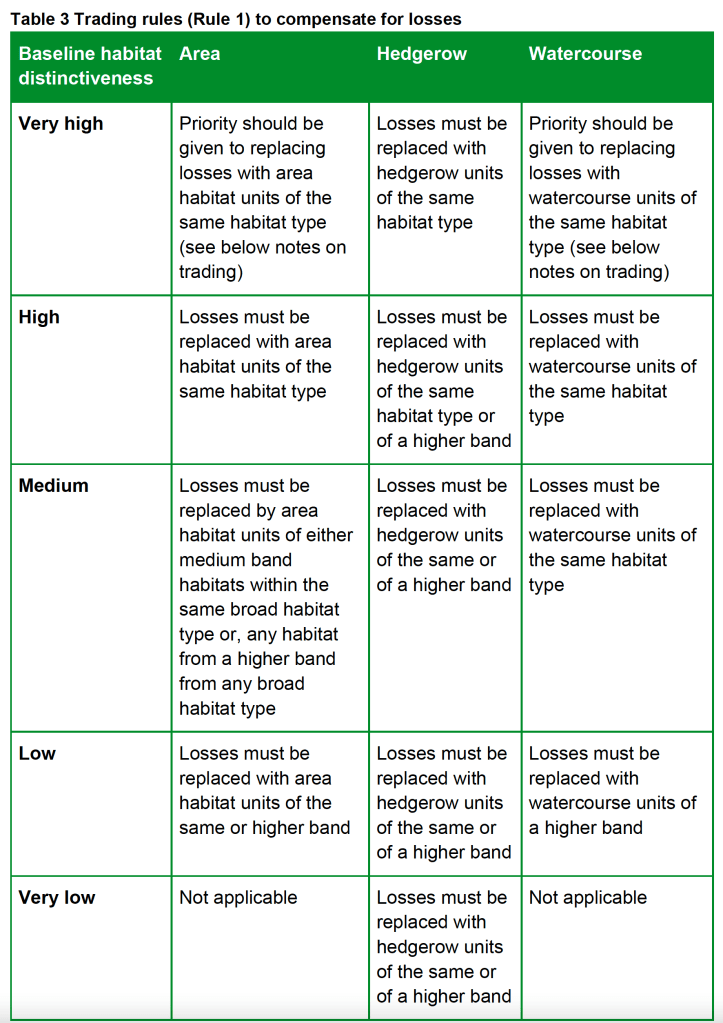
This table from the Statutory Metric sets out how they apply:
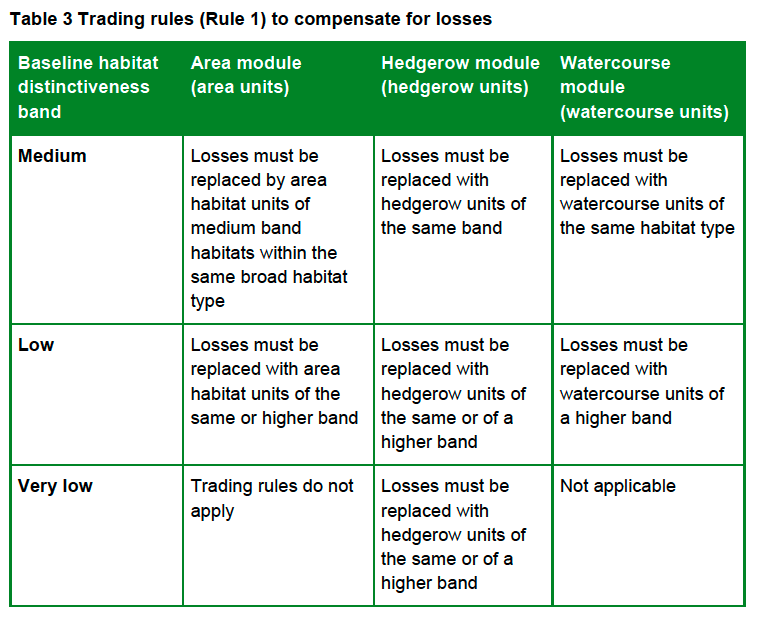
The trading rules for the SSM are slightly different. This is because the SSM does not cater for high and very high distinctiveness habitats (if these are present, the Statutory Metric must be used):
Although the calculator warns of any breaches of the trading rules, the design of the SSM does not allow users to identify where the breaches have occurred. However, the Statutory Metric does. So, if the habitats input into the SSM calculator are transposed to the Statutory Metric calculator, this will reveal where the trading rules breaches are and allow the user to consider how to mitigate the losses whilst still complying with the trading rules.
There are special rules for very high distinctiveness habitats and for compensating for loss of watercourses and high distinctiveness woodland, which are not addressed here.
How the trading rules apply to urban tree habitats
Individual trees habitat has medium distinctiveness. This means that this habitat can only be replaced like for like, although higher distinctiveness habitats can be substituted when the Statutory Metric is used.
Other broad habitats with the same distinctiveness cannot be substituted. For example, Woodland and forest habitat cannot be used to replace lost Individual trees habitat unless it has a higher distinctiveness and the SSM is not being used.
As a result, the requirement to replace lost trees can result in many more trees having to be planted (often off site) than will be lost. In one recent example we examined, 116 replacement trees were needed to comply with the trading rules, even though only 12 were being removed.
Hopefully, developers will now think twice before seeking to remove trees to make way for their plans.
Last year we were able to provide – free of charge – over 2,000 tree saplings for tree lovers to plant in and around Bristol…. and beyond!
This year we plan to give away pedunculate oak (Quercus Robur) and downy birch (Betula Pubescens), each native and supporting lots of wildlife.
Would you like some to plant out in 2024? We have 2,000 to give away.
First come, first served, tho!
Stop Press – We have now distributed all available trees, so this offer is now closed. Thanks for all your support.
Watch out for our offer next year!
Few of us will forget that 2023 was the hottest year ever recorded and far exceeded previous temperature records, both locally and nationally, coming close to the average world temperature of 1.5C that we have all been challenged to avoid!
The Met Office reports that in early September 2023, the UK experienced a significant heatwave with daily maximum temperatures exceeding 30°C somewhere in the UK for seven consecutive days from 4th to 10th and reaching 31 to 32°C across south-east England. While this heatwave would not have been particularly unusual had it occurred during the high summer months (July or August), this was, for September, the longest run of days exceeding 30°C on record.
We all know the value of trees in sequestering carbon, and they still represent the most effective and widespread means of removing CO2 from the atmosphere. For instance, a single mature oak tree is the equivalent of 18 tonnes of CO2 or 16 passenger return transatlantic flights. However, it is in our cities that trees provide the greatest benefits; cleaning our air, reducing flooding, improving our physical and mental health, and, crucially, reducing temperatures during heat waves.
Our cities suffer additional problems during heat waves, with all of the concrete and tarmac absorbing a lot of energy from the sun and releasing it as heat. This “heat island” effect can raise temperatures by as much as an additional 12C. Trees can reduce, or even eliminate, this effect, partly through shade but also actively cooling the air by drawing up water from deep underground, which evaporates from the leaves… a process called evapotranspiration. According to the US Department of Agriculture, this cooling effect is the equivalent to 10 room sized air con units. This cooling greatly enhances our resilience to the dangerous heat waves that are predicted to increase in severity and frequency.
Also, Trees improve air quality by absorbing both gaseous (e.g., NO2) and particulate pollution. They reduce traffic noise and flooding and improve physical and mental wellbeing.
Thus, trees are a crucial, but often ignored, element in increasing our resilience to climate change. It is therefore disappointing that neither the council’s Climate Emergency Action Plan or the ‘Adaptation to a changing climate’ section of the recent draft Bristol Local Plan review make any mention of trees.
We are one of the most biodiversity depleted countries in the world, and have lost nearly 70% of our biodiversity since the industrial revolution. Trees are vital in supporting biodiversity, with oak trees capable of supporting over 2,300 different species, including birds, mammals, invertebrates, mosses, lichen and fungi.
What is Bristol Tree Forum doing to help?
It is said that the best time to plant a tree is 20 years ago, and the second best time is now.
As well as advocating the retention of life-saving trees in our city, Bristol Tree Forum have been encouraging tree planting by holding an annual tree giveaway since 2020. In that year we purchased 1,600 oak saplings from Maelor Forest Nurseries which we distributed free of charge. In 2021/2022 we initially gave away 600 white birch and 400 alder, as well as 900 oak saplings, the latter thanks to a partnership with the Arkbound Oakupy project. We were then contacted by the Forest of Avon Trust who had a surplus of 4,500 tree saplings, over 4,000 of which we were able to distribute through our network of tree planters. Overall, that year we gave away around 6,000 trees including 1,600 oak, 740 silver birch, 860 white birch, 55 grey birch, 600 alder, 100 alder buckthorn, 950 rowan, 45 Scots pine, 60 sweet chestnut, 300 sycamore, 50 spindle and 630 wild cherry. Last year, we manage to distribute 2,102 trees.
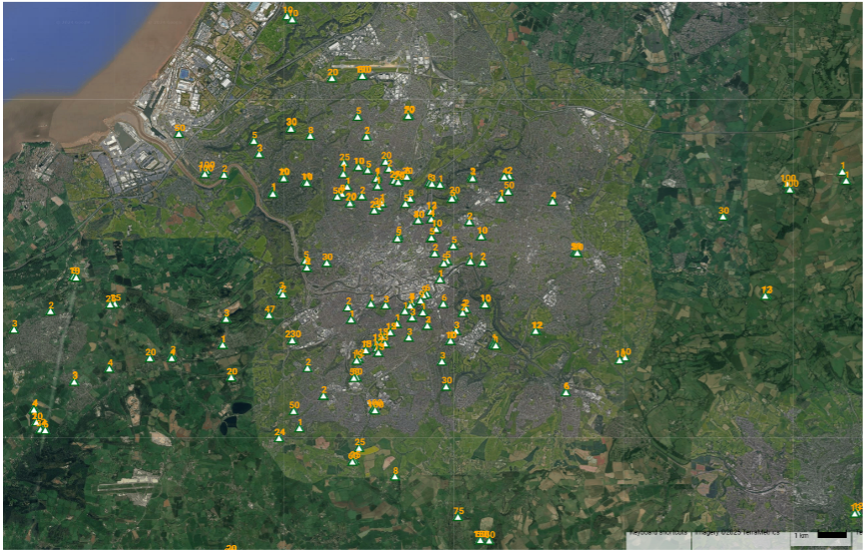
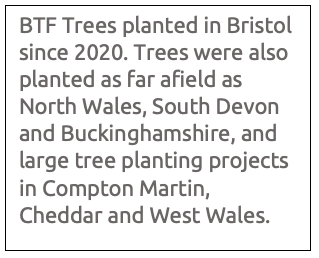
Trees planted in Bristol. Trees were also planted as far afield as West and North Wales, South Devon and Wiltshire.
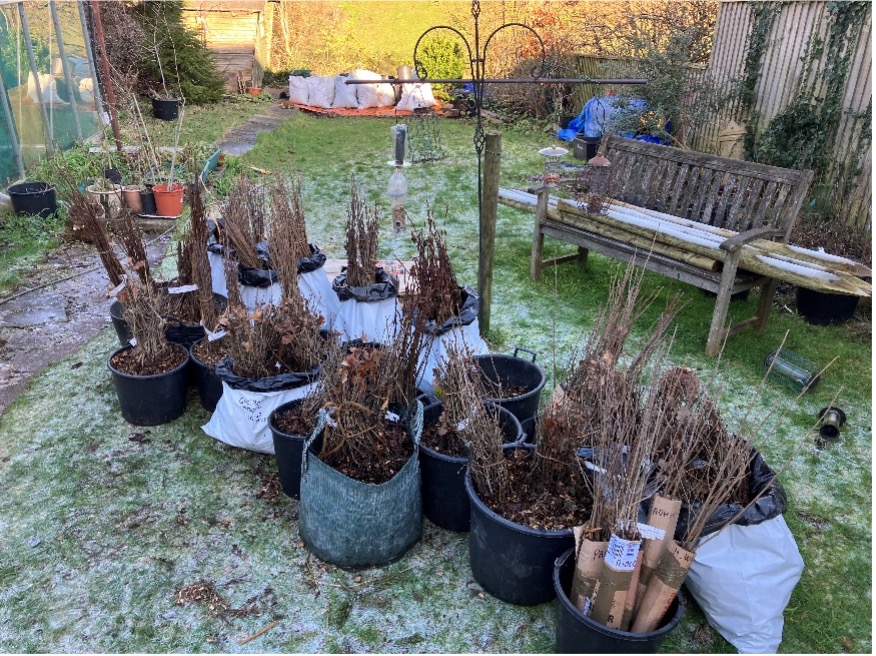
Just some of the trees given away in 2021/22
Flushed with the success of last year’s project, we have ordered another two thousand saplings – pedunculate oak (Quercus Robur) and downy birch (Betula Pubescens) – which we are ready to give away. Each species is a native tree of great benefit to wildlife and is tolerant of urban and rural conditions.
Trees can be ordered using the form below
We will get delivery in late February, when the trees can be collected from a site in Redland, Bristol.
The saplings come bare-rooted (i.e. out of the soil) and need to be planted as soon as possible after collection, although the viability of the trees over winter can be extended by storing the trees with the roots covered in damp soil. The form below is to find out who would like to have saplings for planting and how many, and for you to provide basic contact details (email and/or phone number) for us to organise collection of the trees. Contact details will not be used for any other purpose.





 bristoltreeforum.org