Our proposal for a new Bristol Tree Replacement Standard revisited

Following discussions with the Council about our recent proposal to revise BTRS, we have drafted a new version which we believe will strengthen tree protection across the city even further if it is adopted into the proposed new Local Plan.

Revisions are shown in red.

The latest version of the Biodiversity Metric (BNG 4.0), just published by Natural England,[1] is likely to become mandatory when the balance of the Environment Act 2021 comes into force later this year. We have revisited our June 2022 proposals and reviewed our calculations.  We have met with Bristol City Council Officers and discussed possible alternatives with them.  Here is the revised version.

The starting point for any decision on whether to remove trees (or any other green asset for that matter) is the Mitigation Hierarchy. Paragraph 180 a) of the National Planning Policy Framework sets it out as follows:

If significant harm to biodiversity resulting from a development cannot be avoided (through locating on an alternative site with less harmful impacts), adequately mitigated, or, as a last resort, compensated for, then planning permission should be refused.[3]

BTRS is and should always be ‘a last resort’. This is reflected in the Bristol Core Strategy, policy BCS9 adopts this approach and states that:

Individual green assets should be retained wherever possible and integrated into new developments.[4]

However, with the development of a new Local Plan for Bristol, we believe that the time has come for BTRS to be revised to reflect our changing understanding of the vital importance of urban trees to Bristol in the years since the final part (SADMP[5]) of the Local Plan was adopted in 2014.

In addition, Bristol has adopted Climate and Ecological Emergency Declarations so a new BTRS will be an important part of implementing these declarations. Nationally, the Environment Act 2021[6] (EA 2021) will come force later this year. This will require nearly all developments to achieve a Biodiversity Net Gain (BNG) of at least 10%. Our proposal provides a mechanism for complying with this new requirement and so aligns BTRS with the BNG provisions of the EA 2021.

Background

Under current policy – BCS9 and DM17[7] – trees lost to development must be replaced using this table:
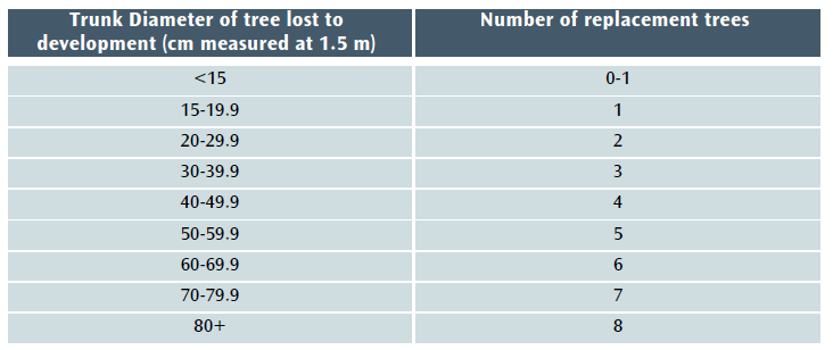
Table 1 The Current DM17/BTRS replacement tree table.

However, when the balance of EA 2021 takes effect, the current version of BTRS will not, in most cases, be sufficient to achieve the 10% BNG minimum that will be required for nearly all developments. A new section 90A will be added to the Town and Country Planning Act 1990 and  set out the level of BNG required (see Schedule 14 of EA 2021[8]).

The Local Government Association says of BNG that it:

…delivers measurable improvements for biodiversity by creating or enhancing habitats in association with development. Biodiversity net gain can be achieved on-site, off-site or through a combination of on-site and off-site measures.[9] GOV.UK says of the Biodiversity Metric that: where a development has an impact on biodiversity, it will ensure that the development is delivered in a way which helps to restore any biodiversity loss and seeks to deliver thriving natural spaces for local communities.[10]

This aligns perfectly with Bristol’s recent declarations of climate and ecological emergencies and with the aspirations of the Ecological Emergency Action Plan,[11] which recognises that a BNG of at least 10% net gain will become mandatory for housing and development and acknowledges that:

These strategies [the Local Nature Recovery Strategies] will guide smooth and effective delivery of Biodiversity Net…

Our proposed new BTRS model

We propose that the Bristol Tree Replacement Standard be amended to reflect the requirements of the EA 2021 and BNG 4.0 and that the BTRS table (Table 1 above) be replaced with Table 2 below:
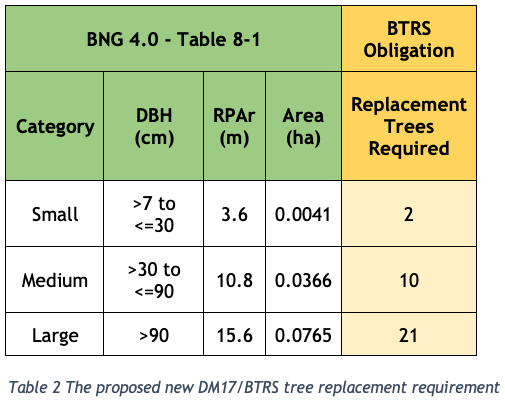
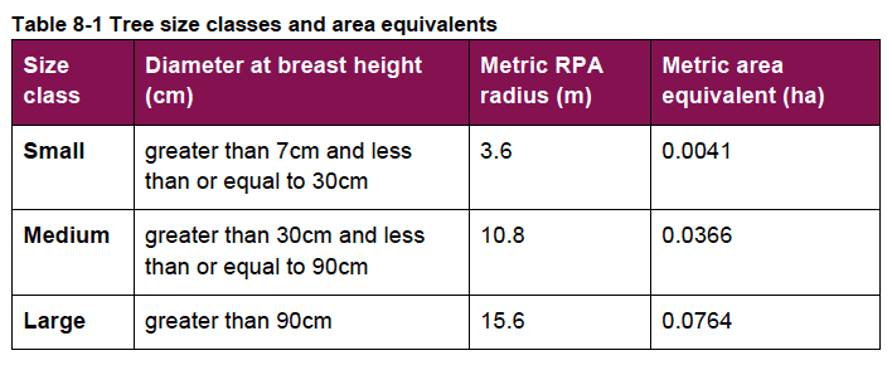
The Replacement Trees Required number is based on the habitat area of each of the three BNG 4.0 tree category sizes (Table 8-1 below) divided by the area habitat of one BNG 4.0 Small category tree (see section 3 below) plus a 10% net gain. This is rounded up to the nearest whole number – you can’t plant a fraction of a tree.

  1. The number and identity (using Id used in the BS5837:2012 survey) of each tree to be removed.
  2. The number and species of the trees to be planted on the development site.
  3. The number and species of the trees to be planted on public land.
  4. Which offsite trees are in to be planted open ground and which in hard standing.
  5. The agreed location and species of each offsite replacement tree which and should be within one mile radius of the lost tree.
  6. Trees planted under BTRS should not replace lost public trees, such as street trees removed in the normal course of tree management.
  7. Like for like replacement.  Compensation for the loss of large-form trees should result in large-form trees being planted.
  8. Require that replacement trees or trees damaged as a result of the development that die within five years of planting will be replaced at the developer’s expense – This is the standard condition for trees planted on a development site.

The reasoning for our proposals is set out below:

  1. Applying the Biodiversity Metric to Urban trees

The most recent Biodiversity Metric[15] (BNG 4.0) published by Natural England this April, defines trees in urban spaces as Individual trees called Urban tree habitats. The User Guide states that:

Individual trees may be classed as ‘urban’ or ‘rural’. Typically, urban trees will be bound by (or near) hardstanding and rural trees are likely to be found in open countryside. The assessor should consider the degree of ‘urbanisation’ of habitats around the tree and assign the best fit for the location.

Individual trees may also be found in groups or stands (with overlapping canopies) within and around the perimeter of urban land. This includes those along urban streets, highways, railways and canals, and also former field boundary trees incorporated into developments. For example, if groups of trees within the urban environment do not match the descriptions for woodland, they may be assessed as a block of individual urban trees.

  1. Calculating Individual trees habitat

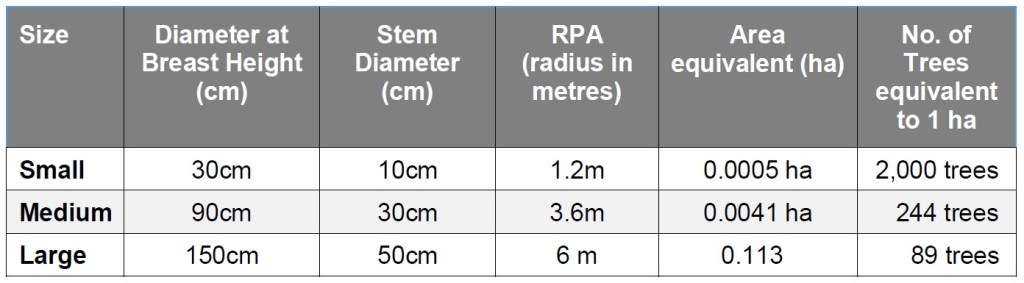
Table 8-1 in the BNG 4.0 user guide is used to calculate the ‘area equivalent’ of individual trees:
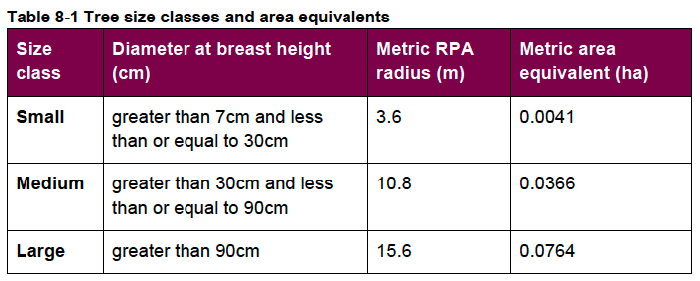
Note that the tree’s stem diameter will still need to be ascertained using BS:5837 2012,[16] and that any tree with a stem diameter (DBH) 7 mm or more and of whatever quality (even a dead tree, which offers its own habitat benefits) is included. Under the current DM17/BTRS requirement, trees with a DBH smaller than 150 mm are excluded, as are BS:5837 2012 category “U” trees. This will no longer be the case.

The Rule 3 of the BNG User guide makes it clear that like-for-like replacement is most often required, so that lost Individual trees (which have Medium distinctiveness) are to be replaced by Individual trees rather than by other habitat types of the same distinctiveness.[17]

  1. Forecasting the post-development habitat area of new Individual trees

The BNG 4.0 User Guide provides this guidance:

8.3.13. Size classes for newly planted trees should be classified by a projected size relevant to the project timeframe.

  • most newly planted street trees should be categorised as ‘small’
  • evidence is required to justify the input of larger size classes

8.3.14. When estimating the size of planted trees consideration should be given to growth rate, which is determined by a wide range of factors, including tree vigour, geography, soil conditions, sunlight, precipitation levels and temperature.

8.3.15. Do not record natural size increases of pre-existing baseline trees within post-development calculations.

Our calculations are based on ‘small’ category replacement trees being planted.

  1. Retain the community benefits of green assets
  1. The likely impact of this policy change

We have analysed tree data for 1,038 surveyed trees taken from a sample of BS:5837 2012 tree surveys submitted in support of previous planning applications. Most of the trees in this sample, 61%, fall within the BNG 4.0 Small range, 38% are within the Medium range, with the balance, 1%, being categorised as Large.

Table 4 below sets out the likely impact of the proposed changes to BTRS. It assumes that all these trees were removed (though that was not the case for all the planning applications we sampled):
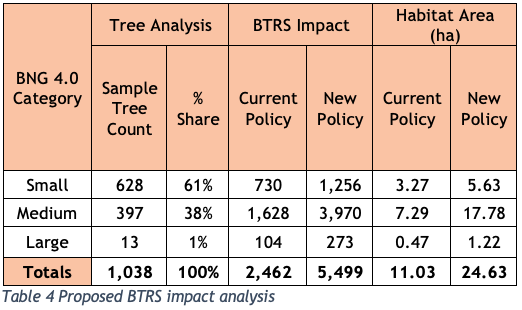
The spreadsheet setting out the basis of our calculations can be downloaded here – RPA Table BNG 4.0 8-1 table Comparison.

Our proposed changes to DM17 and BTRS are set out in Appendices 1 and 2.

Appendix 2 – Our proposed changes to BTRS

Trees – Policy Background

The justification for requiring obligations in respect of new or compensatory tree planting is set out in the Environment Act 2021, Policies BCS9 and BCS11 of the Council’s Core Strategy and in DM 17 of the Council’s Site Allocations and Development Management Policies.[20]

Trigger for Obligation

Obligations in respect of trees will be required where there is an obligation under the Environment Act 2021 to compensate for the loss of biodiversity when Urban tree habitat is lost as a result of development.

Any offsite Urban tree habitat creation will take place in sites which are either on open ground or in areas of hard standing such as pavements and are located as close as possible to the site of the lost tree.

Where planting will take place directly into open ground, the contribution will be lower than where the planting is in an area of hard standing. This is because of the need to plant trees located in areas of hard standing in an engineered tree pit.

All tree planting on public land will be undertaken by the council to ensure a consistent approach and level of quality, and to reduce the likelihood of new tree stock failing to survive.

Level of Contribution

The contribution covers the cost of providing the tree pit (where appropriate), purchasing, planting, protecting, establishing and initially maintaining the new tree. The level of contribution per tree is as follows:

  • Tree in open ground (no tree pit required) £765.21
  • Tree in hard standing (tree pit required) £3,318.88[21]

The ‘open ground’ figure will apply where a development results in the loss of Council-owned trees planted in open ground. In these cases, the Council will undertake replacement tree planting in the nearest appropriate area of public open space.

In all other cases, the level of offsite compensation required will be based on the nature (in open ground or in hard standing) of the specific site which must be identified by the developer and is approved by the Council during the planning approval process. In the absence of any such agreement, the level of contribution will be for a tree in hard standing.

The calculation of the habitat required to compensate for loss of Urban trees is set out in Table 8-1 of the Biodiversity Metric (BNG), published by Natural England. This may be updated as newer versions of BNG become mandatory under the Environment Act 2021.

The following table will be used when calculating the level of contribution required by this obligation:

  1. The number and identity (using Id used in the BS5837:2012 survey) of each tree to be removed.
  2. The number and species of the trees to be planted on the development site.
  3. The number and species of the trees to be planted on public land.
  4. Which offsite trees are in to be planted open ground and which in hard standing.
  5. The agreed location and species of each offsite replacement tree which and should be within one mile radius of the lost tree.
  6. Trees planted under BTRS should not replace lost public trees, such as street trees removed in the normal course of tree management.
  7. Like for like replacement.  Compensation for the loss of large-form trees should result in large-form trees being planted.
  8. Require that replacement trees or trees damaged as a result of the development that die within five years of planting will be replaced at the developer’s expense.

[1]https://publications.naturalengland.org.uk/publication/6049804846366720

[2]https://www.bristol.gov.uk/files/documents/81-spd-final-doc-dec2012/file – Page 20.

[3]https://assets.publishing.service.gov.uk/government/uploads/system/uploads/attachment_data/file/1005759/NPPF_July_2021.pdf

[4]https://www.bristol.gov.uk/files/documents/64-core-strategy-web-pdf-low-res-with-links/file at page 74.

[5]https://www.bristol.gov.uk/files/documents/2235-site-allocations-bd5605/file

[6]https://www.legislation.gov.uk/ukpga/2021/30/contents/enacted

[7]https://www.bristol.gov.uk/files/documents/5718-cd5-2-brislington-meadows-site-allocations-and-development-management-policies/file page 36.

[8]https://www.legislation.gov.uk/ukpga/2021/30/schedule/14/enacted

[9]https://www.local.gov.uk/pas/topics/environment/biodiversity-net-gain.

[10]https://www.gov.uk/government/news/biodiversity-30-metric-launched-in-new-sustainable-development-toolkit.

[11]https://www.bristol.gov.uk/documents/20182/5572361/Ecological_Emergency_Action_Plan.pdf/2e98b357-5e7c-d926-3a52-bf602e01d44c?t=1630497102530.

[12] https://ukhab.org/

[13]https://www.legislation.gov.uk/ukpga/1990/8/section/106

[14]https://www.bristol.gov.uk/files/documents/81-spd-final-doc-dec2012/file

[15] https://nepubprod.appspot.com/publication/6049804846366720

[16]https://knowledge.bsigroup.com/products/trees-in-relation-to-design-demolition-and-construction-recommendations/standard

[17] Table 3-2 Trading rules (Rule 3) to compensate for losses. Any habitat from a higher distinctiveness band (from any broad habitat type) may also be used.  [18] Need to define what ‘important means.

[19] This is based on NPPF para. 180 c). We have inserted ‘will’ instead of ‘should’.

[20] These references may need to be changed to reflect any replacement policies adopted with the new Local Plan.

[21] These values should be updated to the current rates applicable at the time of adoption. The current indexed rates as of June 2023 are £1,171.79 & £5,082.29 respectively.
[22]https://ukhab.org/

Analysing the Armada Way Biodiversity Net Gain Assessment

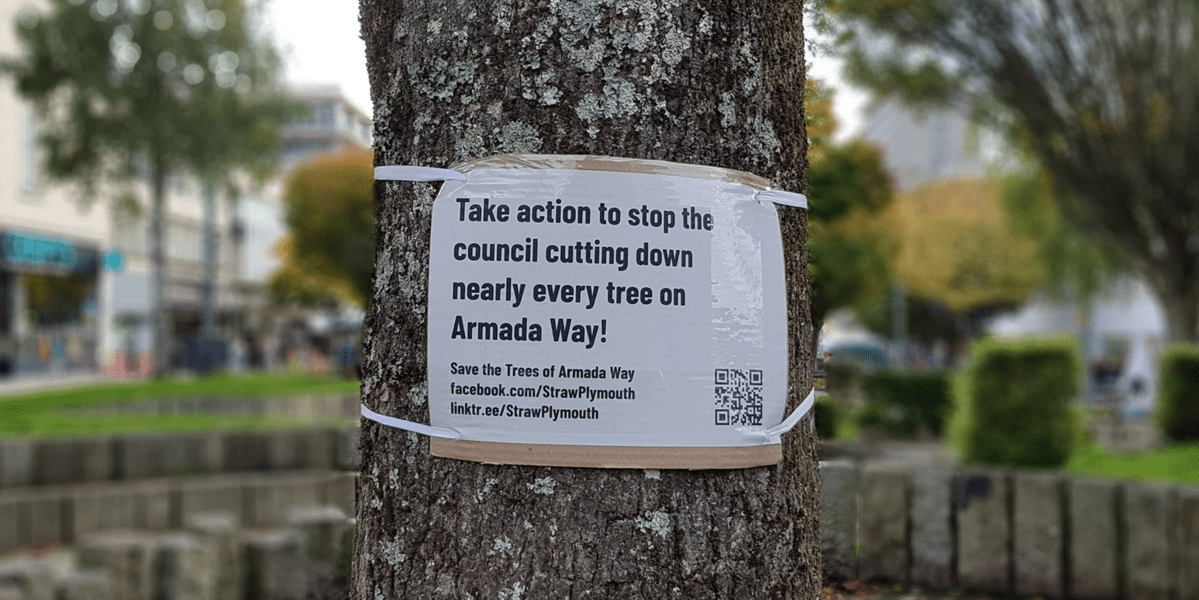
Our Friends at Straw (https://strawplymouth.com/), have been fighting hard to save the few remaining trees on Armada Way, Plymouth so we decided we would try to understand the true impact of the soon-to-be-obligatory Biodiversity Net Gain requirements – how they have been used compared with how they ought to be used – so that the trees that still grow there are properly valued and the loss of their companions can be compensated.

Our conclusion? Over 1,300 extra new trees will need to be planted to replace what has been lost and achieve the 20% net gain promised by the Council.

We have been looking in detail at the Armada Way Biodiversity Net Gain assessment report and calculations, which were provided as part of Plymouth City Council’s ‘Meaningful Community Engagement’. We referred to the Biodiversity Net Gain Metric 3.1 User Guide and additional guidance. This document details our thoughts on the assessment. In summary, we believe the assessment has several flaws that led to the baseline (existing) habitat being undervalued. We also found there was a major flaw in the Metric itself, which led to a significant overestimation of new tree (post-intervention) habitat area. The new Metric (4.0), which supersedes the one used in this assessment, has rectified this issue. If the new Metric were to be used, well over 1000 new trees would need to be planted on site to compensate for losses of healthy, mature trees and achieve the required Biodiversity Net Gain.


Background to Biodiversity Net Gain

Plymouth City Council (PCC) along with many other local authorities, were early adopters of Biodiversity Net Gain (BNG), which is due to become mandatory in November 2023 as part of the Environment Act 2021. While planning permission for nearly all new developments will require a biodiversity increase of 10% or more, Plymouth City Council have decided that they will require at least 20% BNG for this scheme.

The BNG Assessment for the Armada Way development claimed that a 25.09% BNG would be delivered on site. Biodiversity Metric 3.1 was used for the assessment, which was undertaken by the Environment Partnership (TEP) using YGS tree survey data; with baseline habitat ‘walkover survey’ data provided by a local ecologist. The Biodiversity Metric is a tool used by ecologists to measure changes in biodiversity on a development site. Biodiversity Metric

3.1 has now been superseded by Biodiversity Metric 4.0, which was released on 24 March 2023 (more on this later).

In a BNG Assessment, the biodiversity value of a development site, pre and post ‘intervention’, is measured. Post-development biodiversity value can be increased through the enhancement of baseline habitats and/or the creation of new ones either on or offsite.

Biodiversity value is calculated in Habitat Units (HUs). These are derived from the habitat area, the habitat’s ‘distinctiveness’ and its condition, as well as any ‘strategic significance’ applicable to the site of the habitat. The time taken to achieve the target condition of newly created habitats is also taken into account, as well as the difficulty involved in creating the habitat. A 30-year maintenance and monitoring plan must be included to ensure newly created habitats will survive and reach the desired condition within the period.

Requests from STRAW for further information and evidence

STRAW tell us that they had several concerns and queries regarding the Armada Way BNG Assessment so wrote to the assessor asking for clarification on several points. They also wrote to the ecologist who carried out the baseline habitat walkover survey. Despite a follow-up email, they never received a reply from the assessor. The Armada Way development project manager at PCC, assured STRAW and Plymouth Tree Partnership that the BNG Assessment had been ‘triple checked’ and peer-reviewed and promised that the peer review would be shared. Despite repeated requests, this information was never shared.

Concerns about the Armada Way assessment

Significant overestimation of post-intervention habitat area

One of STRAW’s main concerns around the BNG Assessment for Armada Way, was the significantly greater habitat area ascribed to post development (new) trees than to the existing trees, due to an issue with the Metric itself. We accept that the PCC’s ecologist followed Metric 3.1 correctly in using actual Root Protection Area (RPA) calculations for the existing trees and in using the ‘Urban Tree Helper’ tool for new trees to be planted. However, the two methods are not comparable. If the existing tree measurements had been put into the Urban Tree Helper tool, instead of a habitat area of 0.67 hectares (ha), they would have had a habitat area of over 3 ha. This significant flaw in Metric 3.1 has now been addressed in Metric 4.0, which now requires existing tree habitat measurements to be entered into the tool as well as post-intervention (new tree) measurements.

Note: Root protection area (RPA) is used as a proxy for tree habitat area. RPA is calculated using a standard equation provided in BS5837:2012 – Trees in relation to design, demolition and construction. Recommendations, using the ‘diameter at breast height’ (DBH) measurement, where the diameter of the trunk is measured 1.5m above ground.

Although we believe PCC’s ecologist followed the 3.1 User Guide correctly for habitat area calculations, (i.e. using actual root habitat area for the baseline trees and the Urban Tree Helper tool for new trees) we believe they should have noted the significant flaws in the use of different methods for the baseline and post-intervention calculations, which result in the lowest possible habitat area for baseline trees and a significantly exaggerated habitat area for newly planted ones.

Issues with use of the Urban Tree Helper tool only for the new trees

The BNG Urban Tree Helper tool assigns trees to ‘Small’, ‘Medium’ and ‘Large’ categories, according to their DBH. When considering the categories for new trees to be planted, the ‘Small’ category is for trees with a DBH of between 7cm and 30cm after 30 years and the ‘Medium’ category for trees with a DBH of >30 – <=90cm after 30 years. Large category trees are those with a DBH of 90 cm or over.

The 33 new trees (to be planted) were assessed as reaching the ‘Medium’ category after 30 years. Having consulted tree experts and looked at the available literature, we do not believe that these 33 trees should have been assigned to the Medium category. They should have been assigned to the Small category. What is really interesting is that the Medium category trees – those with a DBH of between >30 and <=90cm – are all given a ‘metric area equivalent’ of a tree with a 90cm DBH, so that even a 31 cm DBH tree has the equivalent habitat area of a 90cm DBH tree. This obviously means a significant overestimation in the habitat area for a tree of 31cm DBH. Our researches have found that, if these trees did reach the medium category after 30 years, which is very unlikely, they would only just enter this category – i.e. they would be at the very low end of the range.

Importantly, an existing tree with a 30cm DBH, using Metric 3.1, would be given a habitat area based on 30cm – 0.0041 ha whereas a newly planted tree – still expected to reach a DBH of 30cm after 30 years, would be assigned a habitat area of 0.0366 ha. This is clearly ridiculous given that they are both the same size trees.

Using Metric 3.1, if there were 100 existing trees due to be felled, that all had DBHs of 30cm, the total habitat area would be 0.41 ha. If these were to be replaced by 100 trees that were expected to achieve a DBH of 30cm after 30 years, they would be credited with a habitat area of 3.66 ha even though they would probably never grow so large. This demonstrates this important failing of Metric 3.1 and the huge overestimation of the habitat value of newly created tree habitat area as part of the proposed scheme. Fortunately, this has been addressed in Metric 4.0, with the requirement for existing trees also be assessed using the Urban Tree Helper tool – though this is now too late for the Armada Way trees. Metric 4.0 also addresses the issue of newly planted trees being wrongly assigned to the Medium category and thereby achieving a significantly exaggerated habitat area. All new trees must now be assigned to the Small category unless there is strong evidence to support assigning them to higher categories.

We entered baseline tree data into the Urban Tree Helper tool. The Results show a much higher baseline habitat area (over 3 ha) when following the Metric 4.0 User Guide. Post- intervention habitat area is 1.6 ha; a net loss.

Other concerns with the BNG assessment

Not including all existing trees in the baseline calculations

Apart from this obvious flaw that significantly overestimates new habitat area, we believe the assessment also has several other flaws. There were 11 ‘Category U’ trees that should have been included in the baseline habitat area calculations but were left out. These are trees that were considered unsuitable for retention under BS5837:2012. They should however, according to the Metric 3.1 User Guide, have been included in the baseline calculations. This would have given a greater total habitat area for the baseline urban trees on the site.

Trees growing in groups were also disregarded and counted as just one tree. Had they all been assessed then this would also have increased the baseline habitat area (as detailed in Section 7 of User Guide 3.1).

Misleading statements on damage to the built environment

The BNG assessment stated that ‘the current tree stock is understood to be generally inappropriate to their urban setting, with several causing damage to the built environment’. No evidence was referenced to underpin this statement in relation to Armada Way, and it is not relevant to a BNG Assessment save for assessing their condition. The assessor appears to have used data from a larger tree survey of the area (487 trees), not just Armada Way, and there seems to be no clear evidence in the reports that damage had occurred in Armada Way from the existing (now mostly destroyed) tree stock.

Strategic significance

The BNG Metric includes a consideration of ‘strategic significance’ where local plans and strategies are taken into account. We believe there is room for doubt over the strategic significance being set as ‘low’. The Plymouth and South Devon Joint Local Plan, the Plymouth Plan for Trees and the Plymouth Policy Area Open Space Assessment were possibly relevant and if included might have justified setting the baseline ‘strategic significance’ at ‘medium’ or ‘high’. The Plymouth and South Devon Joint Local Plan refers to the mitigation hierarchy: ‘AVOID LOSS – retain suitable existing arboricultural features on site wherever possible’. DEV26.5 in the plan states that ‘applying Biodiversity Net Gain is not an alternative to the application of the mitigation hierarchy and it would be unacceptable practice for a developer to compensate without first seeking to avoid and mitigate’. Whether or not this should have been considered under ‘strategic significance’, it should have been an important consideration for the project. There appears to be no evidence of any attempt, at any stage of the design process, to retain existing healthy, mature trees.

The Plymouth Plan for Trees (2018) also does not appear to have been considered. The following principles should arguably have been taken into consideration:

  • Plymouth’s trees and woods should be celebrated. Arguably an urban forest in the heart of the city, which happens to be a designated public green space and in a ward with well below average tree cover, should have been valued and celebrated and included in the design from the early stages. Tree canopy cover in the St Peter and the Waterfront ward is 9.3% (forestresearch.gov.uk). The national average for council wards is 16%. The minimum council wards should aim for is 20% (Woodland Trust, 2023). New trees, even if greater in number, would have a much-reduced canopy cover, even in the longer term.
  • Use all available planning and forestry legislation and powers to safeguard Plymouth’s trees. It would be expected that the Plymouth and South Devon Joint Local Plan (adopted in 2019) would have informed the process, particularly: ‘AVOID LOSS – retain suitable existing arboricultural features on-site where-ever possible’.
  • Increase overall canopy cover in the city. The Armada Way proposal appears to reduce canopy cover, despite tree numbers increasing. Tree canopy cover in the St Peter and the Waterfront ward (that Armada Way lies within) is 9.3% (forestresearch.gov.uk). The national average for council wards is 16%. The minimum council wards should aim for is 20% (Woodland Trust 2023).

The Plymouth Policy Area Open Space Assessment identified Armada Way as a Green Corridor. This does not seem to have been considered and could potentially have increased the ‘strategic significance’ score in the BNG assessment. If these plans and strategies were considered and ruled out as having ‘strategic significance’, the reasoning should have been explained in the assessment, or at least provided upon request, to meet BNG transparency principles.

Habitat condition

There may also have been an undervaluation of the condition of tree habitat and ‘other habitats’ in the assessment. The lichen, bryophyte and other epiphyte communities associated with the existing trees (now gone) does not seem to have been adequately considered. There is the potential for bat roosts, and we have photographs of bryophytes, lichen communities and fungi associated with the trees. There were also a number of nests in the trees that were felled (not active ones, but evidence of the suitability of the trees for nesting). These factors form part of the condition assessment of Urban trees.

The condition of grass habitats and hedge features were set to low, even though they had recently been significantly cut back, and according to the User Guide, they should have been given higher scores as a precautionary measure if recently altered/ cut back. We noted at least 10 different plant species making up the grass habitats, possibly over 15 species. If these had been considered, as they should have been, the condition score would have been higher. When we queried this with the ecologist who undertook the habitat walkover survey, they said they visited the site for an hour to look at the grassland which had just been mown and that he was not involved in the BNG assessment. We also understand that the survey was also carried out during the intense heatwave of 2022.

Lack of maintenance budget

It should be noted that the stated BNG (25.09%), which we believe we have shown here to be incorrect, was to be achieved after 30 years. No maintenance budget had been identified beyond the project construction period (approx. 2 years). Further maintenance funding was to be sought from future (unknown) levies on residential development projects, i.e. funding for 28 years of maintenance had not been secured. With the significant uncertainties over changing climatic conditions over this period, and temperature increases highly likely, we would expect a low confidence in survival potential of newly planted trees. This does not comply with the new provisions of the Environment Act 2021 which require that post intervention habitats be maintained for at least 30 years.

From our detailed analysis, we have advised STRAW that if PCC used the same baseline data for urban tree habitat with the baseline urban tree habitat updated to 3.1137 hectares, which is the area calculated using Metric 4.0, PCC would need to plant at least 1,384 ‘Small’ category trees to achieve at least the 20% net gain promised. On this basis, we calculate that the plans as detailed in the TEP BNG assessment will instead deliver a 62.10% net loss of habitat.

Here is a copy of our BNG 4.0 calculation.

Here is a copy of our Urban tree habitat area calculation.


Conclusions and recommendations

We conclude that, ignoring the other issues identified above, even if PCC’s calculations were compliant with the Metric 3.1 User Guide, the information detailed here highlights the actual losses on the ground. These losses should be of concern to PCC and should be communicated to the public. It is too late to amend the plan to include the 110 healthy mature trees that have now been felled. The remaining trees could however be included. Significantly more trees would need to be planted to compensate for these losses than the number currently proposed, and even more to achieve the 20% biodiversity net gain aspired to. We believe that both the assessment and the methodology were flawed and that this is an important case study that should inform other projects.

In our view, it would be prudent now for PCC to undertake a new BNG assessment (particularly as plans have since been amended and most of the trees surveyed have now been felled) using Metric 4.0 and to publicly share the findings, especially given the previous lack of transparency on the ecological assessments.

We sincerely hope that they will do this and meet their obligation to make good the losses which Plymouth has suffered.

Biodiversity Metric 4.0: what’s it all about?

On 24 March 2023 Natural England published Biodiversity Metric 4.0. This revised metric will revolutionise the way we value urban tree habitats, making it clearer than ever that they are a very important habitat.

It is anticipated that BNG 4.0 [1] will be given statutory force when the biodiversity elements of the 2021 Environment Act [2] take effect later this year (see Measuring biodiversity net gain – Publication of Biodiversity Metric 4.0). All new planning applications issued after 24 March, where a Biodiversity Net Gain (BNG) calculation is required, will be required to use it.

Unlike several neighbouring local authorities (e.g., BANES & South Gloucestershire County Council), which have already adopted Supplementary Planning Documents to protect their biodiversity, Bristol City Council has decided not to require this as part of current planning applications until the rest of the EA 2021 comes into force. The failure to do this will have a negative ecological and social impact for the many current planning applications. In the meantime, only developers will benefit.

Given Bristol’s declaration of an ecological emergency in 2020, BNG 4.0 must now be implemented in Bristol. This is a key environment measure which could be adopted at no cost to the council.

The NPPF basis for achieving biodiversity net gain

Paragraph 180 a) of the National Policy Planning Framework [3] (NPPF) echoes the overarching Mitigation Hierarchy principles and obliges local planning authorities to refuse planning permission:

if significant harm to biodiversity resulting from a development cannot be avoided (through locating on an alternative site with less harmful impacts), adequately mitigated, or, as a last resort, compensated for…

Paragraph 179 c), states that plans should:

…pursue opportunities for securing measurable net gains for biodiversity.

BNG 4.0 has been designed to give effect to these two core planning goals.


Pending planning applications

Natural England advises that:

‘Users of previous versions of the Biodiversity Metric should continue to use that metric (unless requested to do otherwise by their client or consenting body) for the duration of the project it is being used for. This is because users may find that certain biodiversity unit values generated in biodiversity metric 4.0 will differ from those generated by earlier versions.

Given that the approach to valuing urban trees has fundamentally changed, we urge all ‘consenting bodies’ (LPAs for most of us) to require developers to adopt this new methodology, for Individual trees habitats at least.

We have always argued that the old Urban tree habitat area calculation methodology used in BNG 3.0 is flawed and unworkable, and we advocated for the use of the calculation method given in BNG 3.1, if only for Urban tree habitat area calculations. With the advent of BNG 4.0, we plan now to argue instead for the BNG 4.0 Individual trees habitat methodology to be used.


The BNG 4.0 Guide

Here is a link to the BNG 4.0 User Guide, which was published with BNG 4.0 (the quotes in italics below are taken from it). We set out below the salient points that cover most trees growing in an urban setting.

What is Individual trees habitat?

BNG 4.0 has made a substantial change to the way trees growing in the urban space will be valued and introduces a new broad habitat category called Individual trees (to replace the Urban tree habitat category first published with BNG 3.0):

8.3.1. The broad habitat type ‘Individual trees’ may be used where a tree (or a group of trees) over 7.5 cm in diameter at breast height (DBH) does not meet or contribute towards the definition of another broad habitat type.

8.3.2. Individual trees should not be recorded separately where they occur within habitat types characterised by the presence of trees, such as orchards, lines of trees or wood-pasture and parkland, but can be recorded where they do not form part of a primary habitat description.

8.3.3. Ancient and veteran trees are irreplaceable habitats and the broad habitat ‘Individual trees’ must not be used to record these.

Even though all irreplaceable habitats fall outside BNG 4.0, they should still be recorded in the metric calculation. A special form for this has been built into the calculator and special rules apply.

Note: Paragraph 8.3.1 refers to trees ‘over 7.5 cm in diameter’ but table 8-1 below refers to trees that are ‘greater than 7 cm’. BS5837:2012 requires all trees 75 mm or over to be surveyed – at paragraph 4.2.4.

Broad habitat type Individual trees can be in either ‘urban’ or ‘rural’ habitats:

8.3.4. Individual trees may be classed as ‘urban’ or ‘rural’. Typically, urban trees will be bound by (or near) hardstanding and rural trees are likely to be found in open countryside. The assessor should consider the degree of ‘urbanisation’ of habitats around the tree and assign the best fit for the location.

8.3.5. Individual trees may also be found in groups or stands (with overlapping canopies) within and around the perimeter of urban land. This includes those along urban streets, highways, railways and canals, and also former field boundary trees incorporated into developments. For example, if groups of trees within the urban environment do not match the descriptions for woodland, they may be assessed as a block of individual urban trees.

Either way, they have the same Medium habitat distinctiveness, so the difference is perhaps academic.

Developers may seek to argue that some urban trees in groups or blocks are a woodland habitat or a ‘Hedgerow – line of trees’ habitat and not Individual trees habitat. BNG 4.0 and earlier versions use a different approach to calculating their habitat sizes. This approach is based on canopy area for woodland habitats and a linear measurement for ‘Hedgerow – line of trees’ habitats. However, it is the degree of ‘urbanisation’ that is key.


Trees in private gardens

Individual trees habitats within private gardens are also to be recorded in the baseline calculation, but should not form part of the post-development BNG calculation:

8.3.6. Established trees within gardens should be recorded in a site baseline.

8.3.7. Where private gardens are created, any tree planting within the created garden should not be included within post-development sheets of the metric. The habitat type ‘Urban – Vegetated garden’ should be used.

This is an important distinction and means we should be alive to any attempt to include newly created habitat in private gardens into post-development BNG calculations. The logic is that, as private space is outside the control of the developer, any post-development habitat management obligations they have cannot be applied to these spaces, and so should be excluded from the post-development calculation.


Measuring Individual trees habitat size

Habitat size is one of the key parameters used for calculating a habitat’s value – called Habitat Units (HUs). For baseline area habitats, the formula is based on four parameters:

HU = Area in hectares x Distinctiveness x Condition x Strategic significance.

Note: For linear habitats, length in kilometres is used instead of area.

The way BNG 4.0 measures the habitat area of Individual trees has reverted to the methodology used in BNG 3.0 but, thankfully, now uses a table that works!

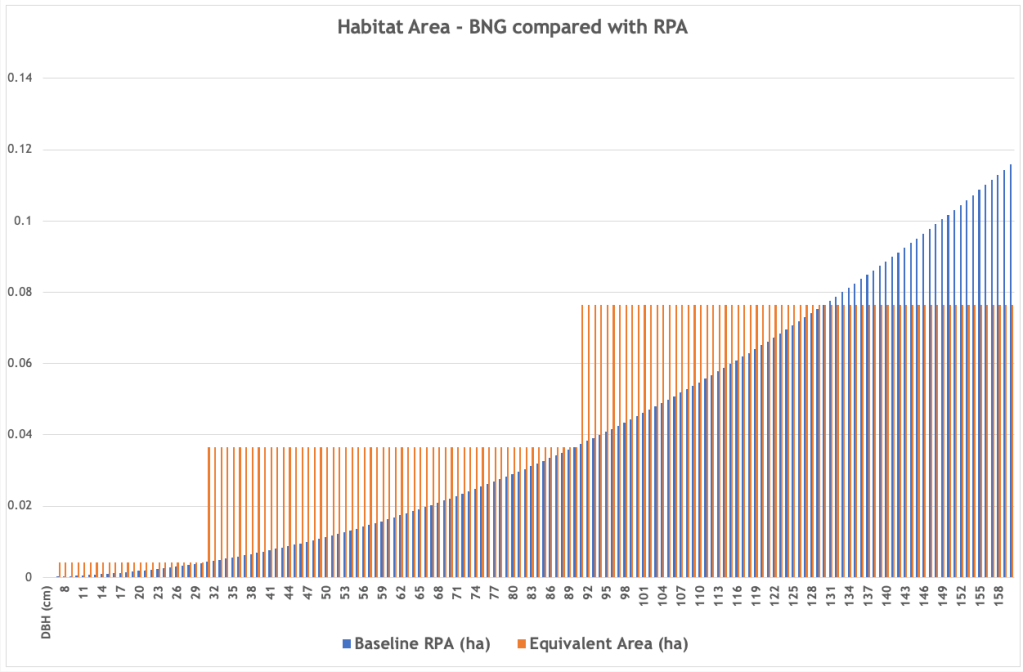
The effect is far more generous than the one used in BNG 3.1 as it values all the trees in the bottom two categories, Small & Medium, at the top of their range. All Large category trees are given the same habitat value as a tree with a stem diameter (called DBH – diameter at breast height) of 130 cm. [4] Given that the vast majority of urban trees fall within this range – with DBHs of between 7cm and 130 cm – this has the effect of greatly enhancing their habitat value.

The following graph illustrates the effect on a range of DBHs from 7 cm to 160 cm; RPA refers to root protection area and the orange stepped lines are the BNG 4.0 habitat area values assigned to each DBH. [5]

This difference is significant. For example, in a recent application we were involved with, trees on the site that had a baseline Urban tree habitat area of 0.7056 ha using BNG 3.1 now have an Individual trees habitat area of 3.1137 ha when the BNG 4.0 methodology is applied. This makes their habitat unit value much greater than it was before.

Here is the BNG 4.0 Individual trees habitat area measurement methodology:

8.3.8. Once the size, number and condition of trees is known, assessors should generate an area equivalent value using the ‘Tree helper’ within the metric tool ‘Main menu’ (Figure 8-2). The ‘area equivalent’ is used to represent the area of Individual trees. This value is a representation of canopy biomass, and is based on the root protection area formula, derived from BS 5837:2012.

8.3.9. Table 8-1 sets out class sizes of trees and their area equivalent. For multi-stemmed trees the DBH of the largest stem in the cluster should be used to determine size class.

Note: The correct metric equivalent area of Large category trees is 0.0765, not 0.0764.

This same approach applies to Individual trees habitats in groups or blocks:

8.3.12. Assessors should account for the size class (Table 8-1) of each Individual trees within a group or block. The number of Individual trees present within a group or block should be entered into the tree helper to calculate area equivalent. Do not reduce any area generated by the tree helper even if tree canopies overlap.


Assessing baseline Individual trees habitat condition

As ‘condition’ is one of the parameters used for calculating the habitat’s value, each Individual trees habitat tree, group or block needs to be assessed against the following criteria. [6]

Condition Assessment Criteria
AThe tree is a native species (or at least 70% within the block are native species).
BThe tree canopy is predominantly continuous, with gaps in canopy cover making up <10% of total area and no individual gap being >5 m wide (Individual trees automatically pass this criterion).
CThe tree is mature (or more than 50% within the block are mature).
DThere is little or no evidence of an adverse impact on tree health by human activities (such as vandalism, herbicide or detrimental agricultural activity). And there is no current regular pruning regime, so the trees retain >75% of expected canopy for their age range and height.
ENatural ecological niches for vertebrates and invertebrates are present, such as presence of deadwood, cavities, ivy or loose bark.
FMore than 20% of the tree canopy area is oversailing vegetation beneath.
Number of criteria passed
Condition Assessment Result (out of 6 criteria)Condition Assessment Score
Passes 5 or 6 criteriaGood (3)
Passes 3 or 4 criteriaModerate (2)
Passes 2 or fewer criteriaPoor (1)
Note that ‘Fairly Good and Fairly Poor’ condition categories are not available for this broad habitat type.

In our experience, very few Individual Urban tree habitats will ever be assessed as in ‘Good’ condition and many will only ever achieve a ‘Poor’ score. Many urban trees are not native, [7] few survive to become mature, most are subject to some form of management or show ‘evidence of an adverse impact on tree health by human activities’, and most trees in a public space will never be allowed to develop ‘natural ecological niches’ as these often also present a public safety risk.

The same challenges will also apply when attempting to assess the future condition of post-development Individual Urban tree habitats after 30 years have passed (we discuss this below). In our view, every such tree should always be assessed as having a ‘Poor’ outcome given the uncertainties they face.


Assessing baseline Individual trees habitat strategic significance

Strategic significance is the fourth parameter used in calculating HUs. There are three categories – High, Medium and Low:

To qualify as ‘High’, the following evidence needs to be available:

5.4.3. Assessors must provide evidence by referencing relevant documents. If published, the relevant strategy is the Local Nature Recovery Strategy (LNRS). If an LNRS has not been published, the relevant consenting body or planning authority may specify alternative plans, policies or strategies to use.

5.4.4. Alternative plans, policies or strategies must specify suitable locations for habitat retention, habitat creation and or enhancements, and might, for example, be:

  • Local Plans and Neighbourhood Plans
  • Local Planning Authority Local Ecological Networks
  • Tree Strategies
  • Area of Outstanding Natural Beauty Management Plans
  • Biodiversity Action Plans
  • Species and protected sites conservation strategies
  • Woodland strategies
  • Green Infrastructure Strategies
  • River Basin Management Plans
  • Catchment Plans and Catchment Planning Systems
  • Shoreline management plans
  • Estuary Strategies

5.4.5. If no alternative is specified, agreement should be sought from the consenting body or Local Planning Authority when determining strategic significance.

In many cases, the proposed development site will fall within one of the criteria above (especially where the authority has adopted a well-designed tree strategy) and so should be given ‘High’ strategic significance.

If it does not then, given that trees nearly always provide ‘a linkage between other strategic locations’, we suggest that Individual trees habitats should always be assigned ‘Medium’ strategic significance.

It is notable that the Medium strategic significance dropdown option in the Metric calculator is still labelled ‘Location ecologically desirable but not in local strategy’. This suggests a wider definition than is perhaps suggested above.


Post-development Individual trees habitat creation. 

Post-development Individual trees habitat creation also uses the same parameters for the HU calculation discussed above, but with a time-to-target factor added. This is the time it will take the new habitat to reach its target condition. If the created Individual trees habitat condition will be Poor, the time-to-target period is ten years, if it will be Medium, it is 27 years, and if it will be Good, it will be 30+ years.

These periods can be increased or reduced in yearly increments if, somehow, habitat creation has been advanced or delayed.

These are then factored into the calculation to allow for the future habitat created using the 3.5% discount tables – so x 0.700 for ten years, x 0.382 for 27 years and x 0.320 for 30+ years.

The calculation also assesses the difficulty of creating the target habitat. For Individual trees habitats, this is pre-set to Low (score 1), so does not affect the eventual calculation.

Existing habitats can also be enhanced on or off site or created off site. We do not discuss this here.

Post-development Individual trees habitat area forecasting 

This assumes that any new tree planted will grow into a Small category tree at the end of the ‘project timeframe’. This is likely to be 30 years by default, as per Part 1 s.9 of Schedule 14 of the 2021 Environment Act. [8] This is the approach advised in the Guide:

8.3.13. Size classes for newly planted trees should be classified by a projected size relevant to the project timeframe.

  • most newly planted street trees should be categorised as ‘small’
  • evidence is required to justify the input of larger size classes.

8.3.14. When estimating the size of planted trees, consideration should be given to growth rate, which is determined by a wide range of factors, including tree vigour, geography, soil conditions, sunlight, precipitation levels and temperature.

8.3.15. Do not record natural size increases of pre-existing baseline trees within post-development calculations.

If a larger Individual trees habitat area projection is advanced, this will need to be justified.

The evidence of tree growth rates is patchy at best – see the About section in our Tree Canopy Prediction tool. To overcome this, we have adopted the simple rule-of-thumb approach commonly used by arboriculturists and assume that a tree’s girth grows by one inch (2.54 cm) a year. We then apply this to the standard tree sizes adopted in BS 3961-1 – Nursery Stock Specification to Trees and Shrubs [9] to calculate the eventual size of a tree 30 years after it has been planted. In all cases, save for semi-mature trees, the tree will be a BNG 4.0 Small category tree.

Here is the model we use:

The age of the tree being planted should not be ‘credited’ when calculating the time-to-target period. Sadly, BNG 4.0 does not take account of mortality rates, which are high for urban trees.


The Trading Rules

Individual trees habitats are given Medium distinctiveness in BNG 4.0 and so are subject to the Rule 3 Trading Rules:

3.2.1. Rule 3 is automatically applied by the metric and sets minimum habitat creation and enhancement requirements to compensate for specific habitat losses (up to the point of no net loss). These requirements are based on habitat type and distinctiveness, as set out in Table 3-2 (below).

In effect, any habitat losses may not be traded down. In this case, the broad habitat category is Individual trees. Given that there are very few habitats with high or very high distinctiveness that are likely to be either applicable or feasible, this will mean that Individual trees habitats will mostly need to be replaced like-for-like.

In our view, urban trees are too important to be substituted by any other, non-tree habitat.

The effect of these rules is that, not only will the proposed project have to achieve at least 10% biodiversity net gain when the Environment Act 2021 takes effect later in 2023, it will also need to comply with the Trading Rules. In some cases, this will mean that far more than the minimum 10% net gain will need to be achieved.

We look forward with interest to seeing how developers will ‘manage’ this new metric.


A copy of the article can be downloaded from here – Biodiversity Metric 4.0: what’s it all about?


[1] http://publications.naturalengland.org.uk/publication/6049804846366720

[2] https://www.legislation.gov.uk/ukpga/2021/30/contents/enacted

[3] https://assets.publishing.service.gov.uk/government/uploads/system/uploads/attachment_data/file/1005759/NPPF_July_2021.pdf

[4] This is a girth of 4.08 metres.

[5] This is the spreadsheet it is based on – BNG 4.0 – Individual trees BNG Analysis.xlsx

[6] See Biodiversity Metric 4.0 – Technical Annex 1 – Condition Assessment Sheets and Methodology & Biodiversity Metric 4.0 – Technical Annex 2 – Technical Information

[7] See table 2 of the Woodland Condition Survey forms linked to https://woodlandwildlifetoolkit.sylva.org.uk/assess for the list of recognised native tree and shrub species.

[8] https://www.legislation.gov.uk/ukpga/2021/30/schedule/14/enacted

[9] https://www.thenbs.com/PublicationIndex/documents/details?Pub=BSI&DocID=16650

Valuing our urban trees – part III

When is tree not a tree?

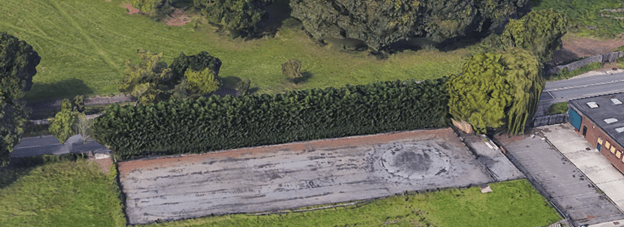
Figure 1  Leyland cypress trees on the boundary of the former Police Dog & Horse Training Centre, Bristol.

The Biodiversity Metric 3.0 (BNG 3.0) User Guide defines Urban Tree habitats as follows:

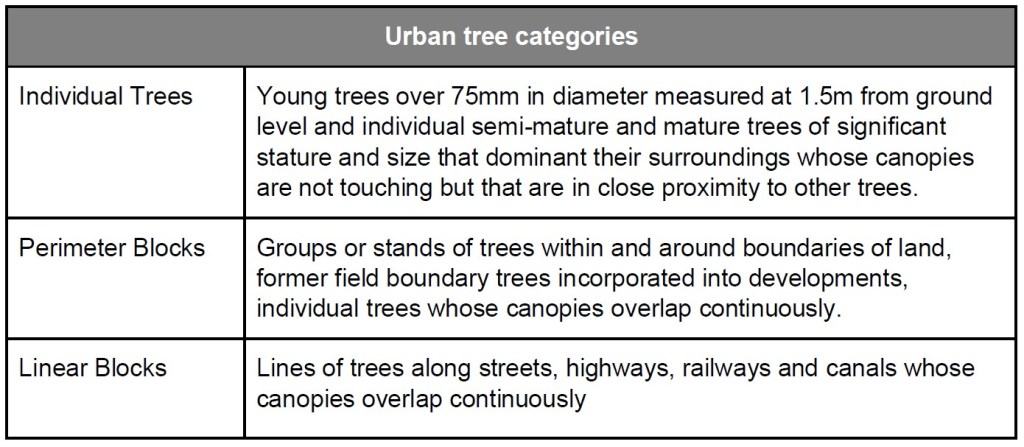
Individual TreesYoung trees over 75mm in diameter measured at 1.5m from ground level and individual semi-mature and mature trees of significant stature and size that dominant their surroundings whose canopies are not touching but that are in close proximity to other trees.
Perimeter BlocksGroups or stands of trees within and around boundaries of land, former field boundary trees incorporated into developments, individual trees whose canopies overlap continuously.
Linear BlocksLines of trees along streets, highways, railways and canals whose canopies overlap continuously.

These habitats are measured by area (hectares). Using this measurement and other parameters (Distinctiveness, Condition and Strategic Significance), their baseline biodiversity value is calculated in area biodiversity habitat units (ABHUs).

BNG 3.0 also includes separate calculations for two types of linear habitat, one of which is ‘Hedgerows and Lines of Trees’. These linear habitats are measured in kilometres. Using this measurement and the same parameters used for ABHUs, their baseline biodiversity value is calculated in hedgerow biodiversity units (HBUs).

Hedgerow habitats are a feature almost unique to the British Isles, but ‘Lines of Trees’ have been included as a linear habitat as they ‘display some of the same functional qualities as hedgerows’.

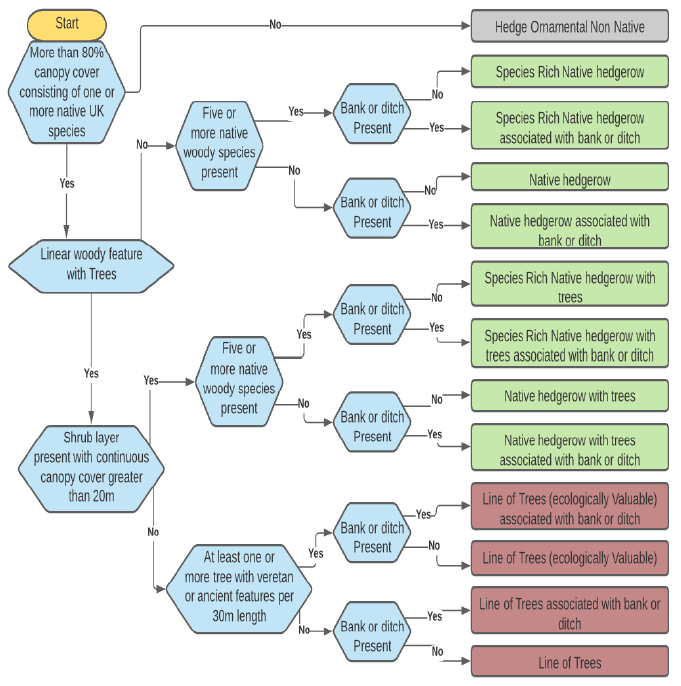
Box 8-2 of the BNG 3.0 User Guide (Figure 2) uses this key to help identify Hedgerow or Line of Trees habitat types:

Figure 2 Box 8.2 – BNG 3.0 User Guide

The BNG 3.0 User Guide states that ‘Urban trees are considered separately to lines of trees in the wider environment, since they generally occur in an urban environment surrounded by developed land’. However, it is possible for disagreements to arise where the site is not clearly part of ‘an urban environment’, even though the trees fall within the Urban Tree habitat definition as either Perimeter or Linear Blocks.

A recent example demonstrates the issue. It involved 34 Leyland cypress trees growing along the boundary of the former Police Dog & Horse Training Centre on Clanage Road, Bristol, on the edge of the city. These trees were planted to form a screen between Clanage Road and the training centre (Figures 1 & 3).

This issue was argued before the Planning Inspector when the Secretary of State called the matter in (APP/Z0116/V/21/3270776) following a grant of planning permission for a change of use to a touring caravan site.

It was agreed at the inquiry that these trees had been planted between 1.5 to 2 metres apart, had developed average stem diameters of 33 cm and had grown to about 10 metres high and eight metres wide. The whole row is about 72 metres (0.072 km) long.

Figure 3 The site on the edge of the city (red boundary line)

Using the flow chart at Box 8-2 above, the developer’s ecologist argued that these trees were a Hedge Ornamental Non-native habitat. So, using the BNG 3.0 calculator, they would be assessed as a linear habitat 0.072 kilometres long. This habitat is given a Very Low Distinctiveness (score 1) and has a Poor Condition (score 1) [1]. Because of its location, it was given a Strategic Significance of Within area formally identified in local strategy (score 1.15). As such, the baseline habitat value is calculated as 0.072 x 1 x 1 x 1.15 = 0.08 HBUs.

We argued that these trees formed an Urban Tree habitat and that, using the BNG 3.0 calculator, it should be treated as 34 Medium-sized trees with a combined area of 0.1384 hectares with a Medium Distinctiveness (score 4) and is in Poor Condition (score 1) – even though it was agreed that the trees were in good condition and could be categorised as B2 using BS 5837:2012. Because of its location, it was given a Strategic Significance of Within area formally identified in local strategy (score 1.15). On this basis, the baseline habitat value is calculated as 0.1384 x 4 x 1 x 1.15 = 0.64 ABHUs (nearly 8 times the HBU value).

Whilst Rule 4 of the BNG 3.0 User Guide (page 37) states that ‘… the three types of biodiversity units generated by this metric (for area, hedgerow and river habitats) are unique and cannot be summed’, it is clear that adopting either of these two approaches will result in very different outcomes when assessing biodiversity net gain.

In our view it is vital not to undervalue baseline habitats by the selective use of the habitat definitions given in BNG 3.0.

The planning inquiry decision (refusal) has now been published – APP/Z0116/V/21/3270776.

A copy of this blog is available here.


Valuing our urban trees – part I

Valuing our urban trees – part II


[1] The Very Low Distinctiveness and Poor Condition parameters are the only options available for this habitat type under BNG 3.0.

Valuing our urban trees – part I

At last, some good news: city trees have been given the same habitat and biodiversity value as their country cousins.
Or have they?

STOP PRESS

Since writing this blog, we have now responded to Defra’s Small Sites Metric (SSM) Consultation. It develops further our critique of the way that urban tree habitats are being undervalued. Perhaps urban trees are now the poor country cousin?

It is available here – Bristol Tree Forum response to the Small Sites Metric consultation


Our second blog dealing with Urban Tree habitat condition assessment is available here – Valuing our urban trees – part II.


Our third blog dealing with habitat selection is available here – Valuing our urban trees – part III.


The important contribution that urban trees (native and non-native) make to our cities has finally been recognised by Natural England, with their publication of Biodiversity Metric 3.0 (BNG 3.0) on 7 July. It states that:

Trees in urban areas can, under the right conditions, provide a large range of habitat opportunities, supporting lichens, bryophytes, invertebrates and birds. Tree planting in urban areas has for over two hundred years also introduced non-native species into towns and cities. In the context of biodiversity, native species are the preferred option. However, non-native tree species can contribute positively to biodiversity richness particularly in relation to providing a seasonal food source for nectar feeders and other invertebrates as well as supporting vertebrates that feed on species that are hosted by non-native trees. Examples are early and late flowering species of Prunus and aphids on varieties of Acer providing food for species higher up the food chain.

Trees in urban areas provide opportunistic sites for biodiversity to colonise and re-colonise, increasing connectivity and contributing to biodiversity critical mass between already established patches or sites. This is especially true where transport corridors are populated with mixed native species.

What’s an urban tree?

The new BNG 3.0 habitat category, urban tree, includes individual trees, lines of street trees and blocks of trees growing within the urban setting.

BM3.0 Guide – TABLE 7-1: Urban tree definitions

The previous urban tree habitat categories, woodland, orchard and street tree, which appeared in the beta test version of Biodiversity Metric 2.0 (BNG 2.0) have been discarded.

The urban tree habitat calculation has been set to ‘medium’ distinctiveness and ‘low’ difficulty for both habitat creation and enhancement. Urban trees are categorised into small, medium or large. Their condition may also be assessed as poor, moderate or good.

The problem with BNG 3.0

The three size bands set out in the table below are useful when creating new habitats or enhancing existing ones (for example, nursery-raised standards ready for planting have a stem diameter of around 30 cm and so are Medium). However, these bands are not useful for assessing the baseline habitat of existing urban trees.

This is the size table used in BNG 3.0:

BM3.0 Guide – TABLE 7-2: Urban tree size by girth and their area equivalent

NB: the second column of this table is wrongly labelled. It should read Girth (circumference) at Breast Height, not Diameter.

The RPA formula used is simple: RPA radius = 12 x DBH (Stem Diameter is also known as DBH – Diameter at Breast Height). This value is then used to calculate the RPA using the formula DBH = PI * RPAr^2.

Every application to develop land where trees will be affected should produce a BS:5837-compliant survey, called an Arboricultural Impact Assessment (AIA). This will report the stem diameters of all the trees growing on and around the site. The AIA also reports several other tree features including species, height, cardinal point canopy radii, condition, life stage and the BS:5837 category – a measure of the quality of the tree.

However, the BNG 3.0 table above provides no logical way of establishing whether a given surveyed tree with a stem diameter of, say, 15 cm or 40 cm – halfway between categories – is Small, Medium, or Large.

It would be better if the table gave ranges – say Small up to 10 cm, Medium 10-50 cm and Large 50 cm or more – but this has not been done. Also, doing this would distort the habitat calculation with all Small trees set to their upper range and all Large trees set to their lower range.

Our solution

Why use the table at all? It would be far simpler to calculate a tree’s baseline habitat area just by using the calculated RPA provided in the AIA. It would be better still to use its actual measured canopy area, which will have been reported in the AIA and thus be readily available.

In our view, RPA does not reflect the habitat value of a tree. All it does is use a formulaic approach to solving the problem of finding an acceptable way to protect trees. It bears little relationship to the habitat or biodiversity value of a tree.  It would be far better to calculate a tree’s canopy cover (TCC), the standard method of working out the value of a tree. Every AIA reports the canopy radii of the four cardinal compass points of each tree surveyed. These can be averaged and used to calculate TCC.

The Bristol One City Plan adopted TCC as the measure of tree planting success when it set the target to double TCC by 2046. TCC is a standard measure used by the various i-Tree tools and Forest Research uses it in its UK Ward Canopy Cover Map which used i-Tree Canopy. We used it to calculate the TCC of the city’s wards in our 2018 Bristol Tree Canopy Cover Survey and we are using it to update the new city-wide survey for 2021.

We made these observations when Natural England was consulting on its beta test version, but these seem to have been overlooked. We hope they now take note.

Some further thoughts

The introduction of the three new urban tree poor/moderate/good condition criteria, set out in detail in the BNG 3.0 Technical Supplement, will require all AIA surveys to include this data. Perhaps BS:5837 should be updated to require this to be recorded in the AIA.

Where tree surveys identify mixed urban tree conditions, the person undertaking the BNG 3.0 calculation will need to record more than one urban tree baseline habitat to capture this information.

BNG 2.0, which was only published as a beta test to allow for wider public consultation, is still being used by Bristol’s Local Planning Authority (LPA) for pending applications but needs to be abandoned. Pending applications which require a biodiversity net gain report should be required to recast their calculations using BNG 3.0 rather than still relying on BM2.0. This is particularly true for the Council’s own, direct applications such as the one pending for the Baltic Wharf Caravan Park.

Our initial analysis shows a significant net gain deficit when BNG 2.0 is used instead of BNG 3.0. This is especially true for urban street trees, which are significantly undervalued under BM2.0. Furthermore, the LPA is currently allowing applications which propose a zero net gain outcome, even though the Environment Bill (currently being considered in Parliament) will require a net gain of 10% above the baseline valuation.

Given that the Council has declared climate and ecological emergencies and aims to achieve carbon neutrality by 2030, it is surprising that developers continue to be allowed to present biodiversity net gain proposals that either undervalue biodiversity or offer no net gain whatsoever.

Conclusion

We welcome the publication of BNG 3.0, but its flaws need to be corrected.

As Natural England recognises in its recent blog – Biodiversity Metric 3.0 – a milestone moment for biodiversity net gain:

Publishing Biodiversity Metric 3.0 was a landmark moment for biodiversity net gain, it will become the metric used to calculate and evidence whether a project has achieved the biodiversity net gain requirements set out in the Environment Bill. Biodiversity Net Gain (BNG) is:

an approach to development, and/or land management, that leaves nature in a measurably better state than beforehand‘ …

Biodiversity Metric 3.0 ensures that:

all habitats, from street trees to woodlands, green roofs to grasslands are recorded, scored and valued for their importance for wildlife. At the same time, it provides an evidence-based, transparent, consistent and easy to use way of ensuring that nature is considered within the design of developments and in land management practice, leaving nature in a better place than it was before, benefitting wildlife, people and places.

Bristol City Council’s declaration of climate and ecological emergencies and its commitment to achieve carbon neutrality by 2030 means that it needs now to ensure that the latest, most accurate biodiversity net gain calculations are part of all pending and future planning applications.