We believe the time has come to revise the Bristol Tree Replacement Standard (BTRS), to reflect our changing understanding of the vital importance of urban trees to Bristol and how they contribute to biodiversity gain.
The current BTRS Standard, adopted nearly a decade ago in July 2014, provides a mechanism for calculating the number of replacements needed for any trees that are removed for developments. It was ground-breaking in its time as it, typically, required more than 1:1 replacement of trees lost to development.
Since then, Defra has published the statutory version of the Biodiversity Metric (SM) (on 29 November 2023), which became mandatory on 12 February 2024. In addition, Bristol has adopted Climate and Ecological Emergency Declarations, so an updated BTRS would be an important part of implementing these declarations. It would require all new developments, subject to some exceptions, to achieve a Biodiversity Net Gain (BNG) of at least 10%. Where developments are exempt, BTRS will still apply.
Although Councillors rejected our proposals for a new Standard at their meeting on 31 October last, we’ve revisited our July 2023 proposals and recast our calculations. These proposals, set out below, provide a mechanism for complying with the new requirements and align the BTRS with the BNG provisions of the EA 2021.
The purpose of the BTRS is that it should only ever be a last resort and not the default choice – which, unfortunately, it has become. When considering any development involving established trees, the presumption should always be that trees will be retained. If this is not possible, then the impact of the proposed development must be mitigated. Only if this is impossible, should compensation for their loss be considered. This is the meaning of the Mitigation Hierarchy, as set out in paragraph 180 a) of the National Planning Policy Framework, which states:
If significant harm to biodiversity resulting from a development cannot be avoided (through locating on an alternative site with less harmful impacts), adequately mitigated, or, as a last resort, compensated for, then planning permission should be refused.
This is reflected in the Bristol Core Strategy, policy BCS9(page 29),which states that:
Individual green assets should be retained wherever possible and integrated into new developments.
This is repeated in the proposed replacement for BCS9 – Policy BG1: Green infrastructure and biodiversity in new development(page 124) – which ‘aims to ensure that green and blue infrastructure and provision for nature is incorporated into new development’ so that, among other things:
The provision of green infrastructure in new development should … Retain and incorporate important existing green infrastructure such as trees (Policy BG4 ‘Trees’), hedgerows and water features …
It is a shame that the requirement is only an aspiration, not an obligation.
Background
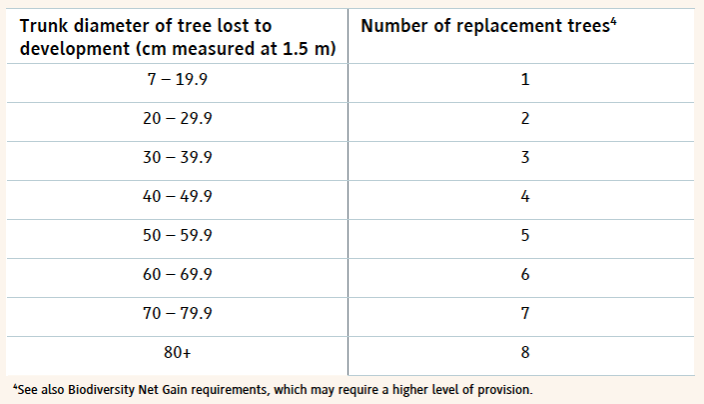
Under the new proposed policy – BG4: Trees (page 131) – trees lost to development will be replaced using this table:
Table 1 The proposed BG4 tree replacement table.
However, when the balance of EA 2021 takes effect, the current version of the BTRS will not, in most cases, be enough to achieve the 10% BNG minimum required for nearly all developments. A new Section 90A and Schedule 7A will be added to the Town and Country Planning Act 1990 and will set out the level of BNG required.
Under the statutory framework for biodiversity net gain, subject to some exceptions, every grant of planning permission is deemed to have been granted subject to the condition that the biodiversity gain objective is met (“the biodiversity gain condition”). This objective is for development to deliver at least a 10% increase in biodiversity value relative to the pre-development biodiversity value of the onsite habitat. …
Many development proposals will aim to achieve more than the minimum 10% gain voluntarily. Others may not but will still need to achieve much more in order to comply with the SM trading rules (page 140). This is based on the habitat type lost and its distinctiveness. In the case of Individual tree habitats – Urban or Rural – losses must be replaced within the same broad habitat (i.e. more Individual trees) or with a habitat of a higher distinctiveness.
However, for the sake of certainty, we propose only using the minimum 10% BNG required.
Our proposed new BG4 (BTRS) model
We propose that the table in BG4 be amended to reflect the requirements of the EA 2021 and SM and that the BG4 table (Table 1 above) be replaced with Table 2 below:
Table 2 Our proposed BG4 tree replacement requirement
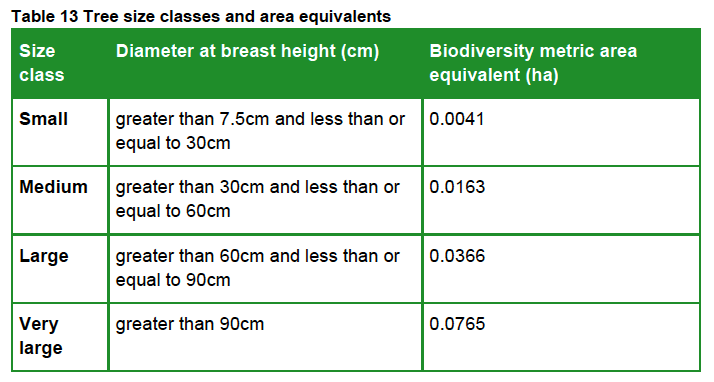
The Replacement Trees Required number is based on the habitat area of each of the four SM tree category sizes (Table 13 below), divided by the area habitat of one BNG 4.0 Small category tree (see section 3 below) plus a 10% net gain. This is rounded up to the nearest whole number (since you can’t plant a fraction of a tree).
The reasoning for our proposal is set out below:
1. Applying the Biodiversity Metric to Urban trees
Use the broad habitat type ‘Individual trees’ to record trees where:
they are found as an individual or as part of a group;
are over 7.5cm in diameter at breast height (DBH).
Individual trees should also be recorded where they meet the definition of an irreplaceable habitat but would not otherwise be recorded.
Do not otherwise record individual trees if they occur within an area habitat type characterised by the presence of trees, examples of these are:
woodlands
orchards
wood-pasture and parkland
Individual trees are classed as ‘urban’ or ‘rural’. You should consider the degree of ‘urbanisation’ of habitats around the tree and assign the best fit for the location.
2. Calculating Individual trees habitat
Table 13 in the SM User Guide is used to calculate the ‘area equivalent’ of individual trees:
The biodiversity metric uses set values to represent the area of trees depending on their diameter at breast height. This value is a representation of canopy biomass, and is based on the root protection area formula, derived from BS 5837:2012.
You should report the number of individual trees within your project and input tree count into the ‘tree helper’ within the biodiversity metric tool to generate area values for data input. For multi-stemmed trees, use the DBH of the largest stem. You should:
account for each individual tree within a group or block of trees.
record the habitat underneath the tree canopy separately.
not reduce any area generated by the tree helper.
not deduct the area of individual trees from other habitats.
make clear in the user comments how many trees contribute towards the total area.
Recording trees within private gardens
You should assess most individual trees that are recorded in private gardens. You should record:
any medium, large and very large trees as individual trees
any small trees that are ancient or veteran
Recording trees within hedgerows
You should assess most individual trees that are recorded within hedgerows. You should record:
any medium, large and very large trees as individual trees
any small trees unless they are ancient or veteran.
You must assess the linear value of hedgerows within the hedgerow module separately.
Individual Tree habitats have medium distinctiveness and so, under Rule 1 of SBNG, ‘Losses must be replaced by area habitat units of either medium band habitats within the same broad habitat type or, any habitat from a higher band from any broad habitat type.’
3. Forecasting the post-development area of Individual trees
The SBNG User Guide provides this guidance:
You should use the tree helper to calculate the area for created trees.
You should categorise most newly planted individual trees as ‘small’, unless the tree is medium sized or above at the time of planting.
You should not factor in the age of nursery stock when using the ‘creation in advance’ function. The ‘creation in advance’ function should only be used where trees are planted in advance of the development (for example, as screening or as structural landscaping).
Exceptions
You cannot count:
newly planted trees within private gardens
natural size increases of baseline trees
trees planted as part of hedgerow creation or enhancement as individual trees.
Our calculations are based on Small category replacement trees being planted as per the SM guidance.
4. The likely impact of this policy change
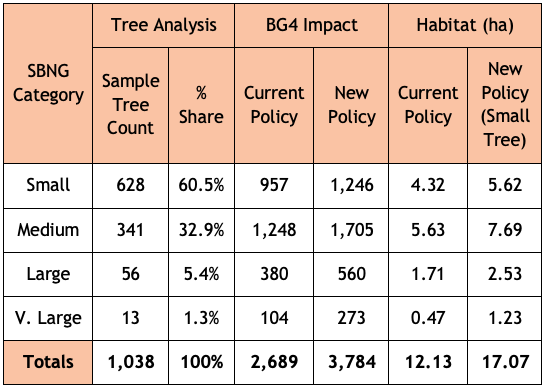
We have analysed tree data for 1,038 surveyed trees taken from a sample of BS:5837 2012 tree surveys submitted in support of previous planning applications. Most of the trees in this sample, 60.5%, fall within the SM Small tree category, 32.9% are within the Medium tree category, 5.4% are in the Large tree category with the balance, 1.3%, being categorised as Very Large.
Table 4 below sets out the likely impact of the proposed changes to BG4. It assumes that all these trees were removed (though that was not the case for all the planning applications we sampled) and replaced with SM Small category trees:
On 24 March 2023 Natural England published Biodiversity Metric 4.0. This revised metric will revolutionise the way we value urban tree habitats, making it clearer than ever that they are a very important habitat.
It is anticipated that BNG 4.0 [1] will be given statutory force when the biodiversity elements of the 2021 Environment Act [2] take effect later this year (see Measuring biodiversity net gain – Publication of Biodiversity Metric 4.0). All new planning applications issued after 24 March, where a Biodiversity Net Gain (BNG) calculation is required, will be required to use it.
Unlike several neighbouring local authorities (e.g., BANES & South Gloucestershire County Council), which have already adopted Supplementary Planning Documents to protect their biodiversity, Bristol City Council has decided not to require this as part of current planning applications until the rest of the EA 2021 comes into force. The failure to do this will have a negative ecological and social impact for the many current planning applications. In the meantime, only developers will benefit.
Given Bristol’s declaration of an ecological emergency in 2020, BNG 4.0 must now be implemented in Bristol. This is a key environment measure which could be adopted at no cost to the council.
The NPPF basis for achieving biodiversity net gain
Paragraph 180 a) of the National Policy Planning Framework [3] (NPPF) echoes the overarching Mitigation Hierarchy principles and obliges local planning authorities to refuse planning permission:
if significant harm to biodiversity resulting from a development cannot be avoided (through locating on an alternative site with less harmful impacts), adequately mitigated, or, as a last resort, compensated for…
Paragraph 179 c), states that plans should:
…pursue opportunities for securing measurable net gains for biodiversity.
BNG 4.0 has been designed to give effect to these two core planning goals.
Pending planning applications
Natural England advises that:
‘Users of previous versions of the Biodiversity Metric should continue to use that metric (unless requested to do otherwise by their client or consenting body) for the duration of the project it is being used for. This is because users may find that certain biodiversity unit values generated in biodiversity metric 4.0 will differ from those generated by earlier versions.‘
Given that the approach to valuing urban trees has fundamentally changed, we urge all ‘consenting bodies’ (LPAs for most of us) to require developers to adopt this new methodology, for Individual trees habitats at least.
We have always argued that the old Urban tree habitat area calculation methodology used in BNG 3.0 is flawed and unworkable, and we advocated for the use of the calculation method given in BNG 3.1, if only for Urban tree habitat area calculations. With the advent of BNG 4.0, we plan now to argue instead for the BNG 4.0 Individual trees habitat methodology to be used.
The BNG 4.0 Guide
Here is a link to the BNG 4.0 User Guide, which was published with BNG 4.0 (the quotes in italics below are taken from it). We set out below the salient points that cover most trees growing in an urban setting.
What is Individual trees habitat?
BNG 4.0 has made a substantial change to the way trees growing in the urban space will be valued and introduces a new broad habitat category called Individual trees (to replace the Urban tree habitat category first published with BNG 3.0):
8.3.1. The broad habitat type ‘Individual trees’ may be used where a tree (or a group of trees) over 7.5 cm in diameter at breast height (DBH) does not meet or contribute towards the definition of another broad habitat type.
8.3.2. Individual trees should not be recorded separately where they occur within habitat types characterised by the presence of trees, such as orchards, lines of trees or wood-pasture and parkland, but can be recorded where they do not form part of a primary habitat description.
8.3.3. Ancient and veteran trees are irreplaceable habitats and the broad habitat ‘Individual trees’ must not be used to record these.
Even though all irreplaceable habitats fall outside BNG 4.0, they should still be recorded in the metric calculation. A special form for this has been built into the calculator and special rules apply.
Note: Paragraph 8.3.1 refers to trees ‘over 7.5 cm in diameter’ but table 8-1 below refers to trees that are ‘greater than 7 cm’. BS5837:2012 requires all trees 75 mm or over to be surveyed – at paragraph 4.2.4.
Broad habitat type Individual trees can be in either ‘urban’ or ‘rural’ habitats:
8.3.4. Individual trees may be classed as ‘urban’ or ‘rural’. Typically, urban trees will be bound by (or near) hardstanding and rural trees are likely to be found in open countryside. The assessor should consider the degree of ‘urbanisation’ of habitats around the tree and assign the best fit for the location.
8.3.5. Individual trees may also be found in groups or stands (with overlapping canopies) within and around the perimeter of urban land. This includes those along urban streets, highways, railways and canals, and also former field boundary trees incorporated into developments. For example, if groups of trees within the urban environment do not match the descriptions for woodland, they may be assessed as a block of individual urban trees.
Either way, they have the same Medium habitat distinctiveness, so the difference is perhaps academic.
Developers may seek to argue that some urban trees in groups or blocks are a woodland habitat or a ‘Hedgerow – line of trees’ habitat and not Individual trees habitat. BNG 4.0 and earlier versions use a different approach to calculating their habitat sizes. This approach is based on canopy area for woodland habitats and a linear measurement for ‘Hedgerow – line of trees’ habitats. However, it is the degree of ‘urbanisation’ that is key.
Trees in private gardens
Individual trees habitats within private gardens are also to be recorded in the baseline calculation, but should not form part of the post-development BNG calculation:
8.3.6. Established trees within gardens should be recorded in a site baseline.
8.3.7. Where private gardens are created, any tree planting within the created garden should not be included within post-development sheets of the metric. The habitat type ‘Urban – Vegetated garden’ should be used.
This is an important distinction and means we should be alive to any attempt to include newly created habitat in private gardens into post-development BNG calculations. The logic is that, as private space is outside the control of the developer, any post-development habitat management obligations they have cannot be applied to these spaces, and so should be excluded from the post-development calculation.
Measuring Individual trees habitat size
Habitat size is one of the key parameters used for calculating a habitat’s value – called Habitat Units (HUs). For baseline area habitats, the formula is based on four parameters:
HU = Area in hectares x Distinctiveness x Condition x Strategic significance.
Note: For linear habitats, length in kilometres is used instead of area.
The way BNG 4.0 measures the habitat area of Individual trees has reverted to the methodology used in BNG 3.0 but, thankfully, now uses a table that works!
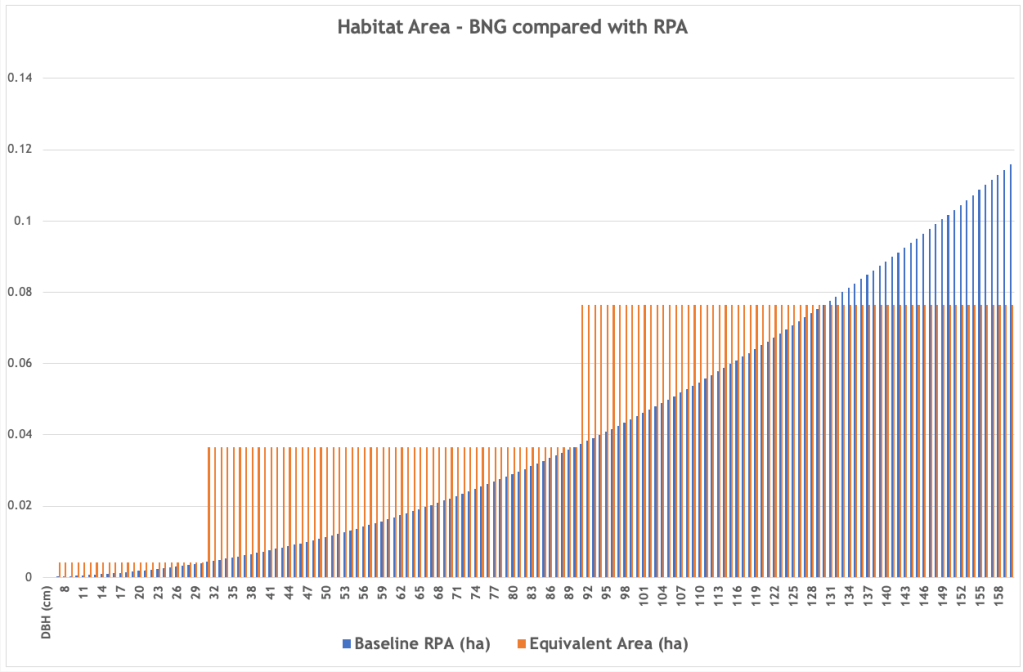
The effect is far more generous than the one used in BNG 3.1 as it values all the trees in the bottom two categories, Small & Medium, at the top of their range. All Large category trees are given the same habitat value as a tree with a stem diameter (called DBH – diameter at breast height) of 130 cm. [4] Given that the vast majority of urban trees fall within this range – with DBHs of between 7cm and 130 cm – this has the effect of greatly enhancing their habitat value.
The following graph illustrates the effect on a range of DBHs from 7 cm to 160 cm; RPA refers to root protection area and the orange stepped lines are the BNG 4.0 habitat area values assigned to each DBH. [5]
This difference is significant. For example, in a recent application we were involved with, trees on the site that had a baseline Urban tree habitat area of 0.7056 ha using BNG 3.1 now have an Individual trees habitat area of 3.1137 ha when the BNG 4.0 methodology is applied. This makes their habitat unit value much greater than it was before.
Here is the BNG 4.0 Individual trees habitat area measurement methodology:
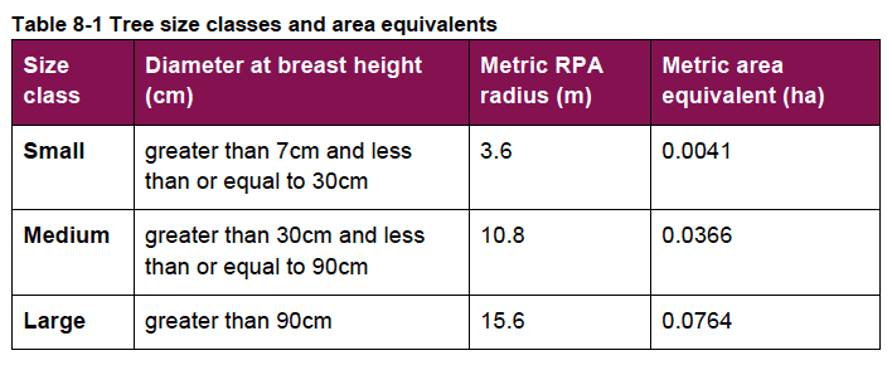
8.3.8. Once the size, number and condition of trees is known, assessors should generate an area equivalent value using the ‘Tree helper’ within the metric tool ‘Main menu’ (Figure 8-2). The ‘area equivalent’ is used to represent the area of Individual trees. This value is a representation of canopy biomass, and is based on the root protection area formula, derived from BS 5837:2012.
8.3.9. Table 8-1 sets out class sizes of trees and their area equivalent. For multi-stemmed trees the DBH of the largest stem in the cluster should be used to determine size class.
Note: The correct metric equivalent area of Large category trees is 0.0765, not 0.0764.
This same approach applies to Individual trees habitats in groups or blocks:
8.3.12. Assessors should account for the size class (Table 8-1) of each Individual trees within a group or block. The number of Individual trees present within a group or block should be entered into the tree helper to calculate area equivalent. Do not reduce any area generated by the tree helper even if tree canopies overlap.
Assessing baseline Individual trees habitat condition
As ‘condition’ is one of the parameters used for calculating the habitat’s value, each Individual trees habitat tree, group or block needs to be assessed against the following criteria. [6]
Condition Assessment Criteria
A
The tree is a native species (or at least 70% within the block are native species).
B
The tree canopy is predominantly continuous, with gaps in canopy cover making up <10% of total area and no individual gap being >5 m wide (Individual trees automatically pass this criterion).
C
The tree is mature (or more than 50% within the block are mature).
D
There is little or no evidence of an adverse impact on tree health by human activities (such as vandalism, herbicide or detrimental agricultural activity). And there is no current regular pruning regime, so the trees retain >75% of expected canopy for their age range and height.
E
Natural ecological niches for vertebrates and invertebrates are present, such as presence of deadwood, cavities, ivy or loose bark.
F
More than 20% of the tree canopy area is oversailing vegetation beneath.
Number of criteria passed
Condition Assessment Result (out of 6 criteria)
Condition Assessment Score
Passes 5 or 6 criteria
Good (3)
Passes 3 or 4 criteria
Moderate (2)
Passes 2 or fewer criteria
Poor (1)
Note that ‘Fairly Good and Fairly Poor’ condition categories are not available for this broad habitat type.
In our experience, very few Individual Urban tree habitats will ever be assessed as in ‘Good’ condition and many will only ever achieve a ‘Poor’ score. Many urban trees are not native, [7] few survive to become mature, most are subject to some form of management or show ‘evidence of an adverse impact on tree health by human activities’, and most trees in a public space will never be allowed to develop ‘natural ecological niches’ as these often also present a public safety risk.
The same challenges will also apply when attempting to assess the future condition of post-development Individual Urban tree habitats after 30 years have passed (we discuss this below). In our view, every such tree should always be assessed as having a ‘Poor’ outcome given the uncertainties they face.
Assessing baseline Individual trees habitat strategic significance
Strategic significance is the fourth parameter used in calculating HUs. There are three categories – High, Medium and Low:
To qualify as ‘High’, the following evidence needs to be available:
5.4.3. Assessors must provide evidence by referencing relevant documents. If published, the relevant strategy is the Local Nature Recovery Strategy (LNRS). If an LNRS has not been published, the relevant consenting body or planning authority may specify alternative plans, policies or strategies to use.
5.4.4. Alternative plans, policies or strategies must specify suitable locations for habitat retention, habitat creation and or enhancements, and might, for example, be:
Local Plans and Neighbourhood Plans
Local Planning Authority Local Ecological Networks
Tree Strategies
Area of Outstanding Natural Beauty Management Plans
Biodiversity Action Plans
Species and protected sites conservation strategies
Woodland strategies
Green Infrastructure Strategies
River Basin Management Plans
Catchment Plans and Catchment Planning Systems
Shoreline management plans
Estuary Strategies
5.4.5. If no alternative is specified, agreement should be sought from the consenting body or Local Planning Authority when determining strategic significance.
In many cases, the proposed development site will fall within one of the criteria above (especially where the authority has adopted a well-designed tree strategy) and so should be given ‘High’ strategic significance.
If it does not then, given that trees nearly always provide ‘a linkage between other strategic locations’, we suggest that Individual trees habitats should always be assigned ‘Medium’ strategic significance.
It is notable that the Medium strategic significance dropdown option in the Metric calculator is still labelled ‘Location ecologically desirable but not in local strategy’. This suggests a wider definition than is perhaps suggested above.
Post-development Individual trees habitat creation.
Post-development Individual trees habitat creation also uses the same parameters for the HU calculation discussed above, but with a time-to-target factor added. This is the time it will take the new habitat to reach its target condition. If the created Individual trees habitat condition will be Poor, the time-to-target period is ten years, if it will be Medium, it is 27 years, and if it will be Good, it will be 30+ years.
These periods can be increased or reduced in yearly increments if, somehow, habitat creation has been advanced or delayed.
These are then factored into the calculation to allow for the future habitat created using the 3.5% discount tables – so x 0.700 for ten years, x 0.382 for 27 years and x 0.320 for 30+ years.
The calculation also assesses the difficulty of creating the target habitat. For Individual trees habitats, this is pre-set to Low (score 1), so does not affect the eventual calculation.
Existing habitats can also be enhanced on or off site or created off site. We do not discuss this here.
Post-development Individual trees habitat area forecasting
This assumes that any new tree planted will grow into a Small category tree at the end of the ‘project timeframe’. This is likely to be 30 years by default, as per Part 1 s.9 of Schedule 14 of the 2021 Environment Act. [8] This is the approach advised in the Guide:
8.3.13. Size classes for newly planted trees should be classified by a projected size relevant to the project timeframe.
most newly planted street trees should be categorised as ‘small’
evidence is required to justify the input of larger size classes.
8.3.14. When estimating the size of planted trees, consideration should be given to growth rate, which is determined by a wide range of factors, including tree vigour, geography, soil conditions, sunlight, precipitation levels and temperature.
8.3.15. Do not record natural size increases of pre-existing baseline trees within post-development calculations.
If a larger Individual trees habitat area projection is advanced, this will need to be justified.
The evidence of tree growth rates is patchy at best – see the About section in our Tree Canopy Prediction tool. To overcome this, we have adopted the simple rule-of-thumb approach commonly used by arboriculturists and assume that a tree’s girth grows by one inch (2.54 cm) a year. We then apply this to the standard tree sizes adopted in BS 3961-1 – Nursery Stock Specification to Trees and Shrubs [9] to calculate the eventual size of a tree 30 years after it has been planted. In all cases, save for semi-mature trees, the tree will be a BNG 4.0 Small category tree.
Here is the model we use:
The age of the tree being planted should not be ‘credited’ when calculating the time-to-target period. Sadly, BNG 4.0 does not take account of mortality rates, which are high for urban trees.
The Trading Rules
Individual trees habitats are given Medium distinctiveness in BNG 4.0 and so are subject to the Rule 3 Trading Rules:
3.2.1. Rule 3 is automatically applied by the metric and sets minimum habitat creation and enhancement requirements to compensate for specific habitat losses (up to the point of no net loss). These requirements are based on habitat type and distinctiveness, as set out in Table 3-2 (below).
In effect, any habitat losses may not be traded down. In this case, the broad habitat category is Individual trees. Given that there are very few habitats with high or very high distinctiveness that are likely to be either applicable or feasible, this will mean that Individual trees habitats will mostly need to be replaced like-for-like.
In our view, urban trees are too important to be substituted by any other, non-tree habitat.
The effect of these rules is that, not only will the proposed project have to achieve at least 10% biodiversity net gain when the Environment Act 2021 takes effect later in 2023, it will also need to comply with the Trading Rules. In some cases, this will mean that far more than the minimum 10% net gain will need to be achieved.
We look forward with interest to seeing how developers will ‘manage’ this new metric.
Many thanks to all of you who have lodged comments on this application (nine so far). Here is one great example:
This proposal flies in the face of the objective of the city council to double tree canopy cover in a generation.
There is clear evidence that climate change is in part being driven by the city heat island effect. Bristol is already two degrees warmer than the surrounding area. A mitigation of this is to ensure that all car parking areas are shaded by trees- and not simply by a perimeter screen, but the use of suitable trees 20 metres apart to cover the entire area. This particular complex already has huge areas of unshaded car parking, and the proposal would only increase this.
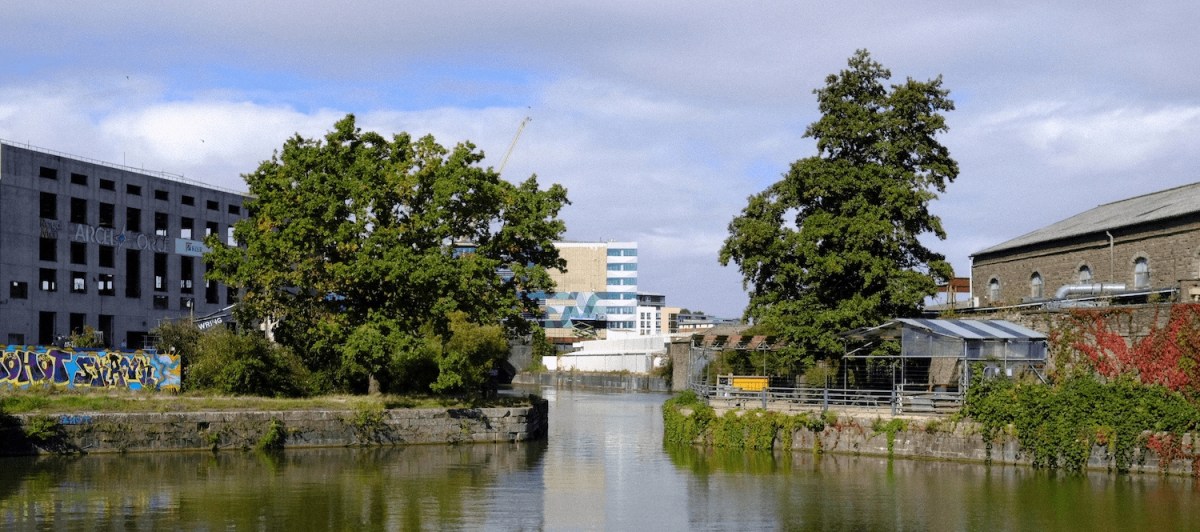
The Frome Valley is a key feature of the city’s biodiversity. It is one of a series of wildlife corridors that form a key feature of the attractiveness of the city to humans. This corridor is increasingly being eroded by development. As the River Frome has a huge water catchment area, which is increasingly being developed, creating much greater and faster run off, it floods rapidly and frequently. The fact that flood water is now diverted at the site of the Eastgate shopping centre into the northern stormwater interceptor will not prevent future floods upstream.
Visually this remnant woodland of the Frome Valley is crucial it counteracting the utter ugliness and dreariness of the developed site. This of course originates from the original use of the site as a football and greyhound racing stadium. Bristol deserves better.
What is desperately needed throughout this site is more trees being planted on the land owned by the various firms in the area, and not the destruction of the trees that by happy chance have survived.
The wonderful veteran oak in particular, probably 300 years old, should become the centrepiece of a revival of this dreary area.
This is our earlier blog. Time is running out to lodge your objections. If you want to do so, please lodge your objections here in the Planning application comments section.
With Bristol City Council’s budget cuts, two decisions have been made regarding the management of Bristol’s treescape that make no economic sense, and threaten the reputation of the City as a Green and pleasant place to live and locate a business.
With Bristol City Council’s budget cuts, two decisions have been made regarding the management of Bristol’s treescape that make no economic sense, and threaten the reputation of the City as a Green and pleasant place to live and locate a business.
Decision 1: Slashing of street tree management budget
The budget for managing street trees has been cut by nearly 78% from £240,000 to £53,000.
Emergency cover outside normal working hours is no longer being provided through the tree management contract, despite having no cost benefit.
Tree management will be limited to felling to address safety risks, despite greater initial costs and the long term consequent loss of tree sites – felling costs the same as 16 years of maintenance. As a result, Bristol’s street tree population will rapidly fall into decline as they are steadily removed, never to be replaced.
Decision 2: No planting of street trees, either replacement or new, even when cost neutral
Bristol City Council has operated a number of innovative schemes allowing residents or community groups to sponsor replacement or new street trees. Despite fully funding the planting, and maintenance for two years, such planting will no longer be permitted.
At the moment, when a tree is replaced in an existing tree pit it costs £295. This covers regular watering until the tree is established and two years maintenance. If the trees dies whilst establishing itself, it is replaced at no extra cost.
If the Council can be persuaded to change its mind about not planting new trees, then this cost could to increase to the £765 that developers are required to pay – the overall costs of planting a tree and maintaining it during its lifetime. Planting a tree at a brand new site could add around £2,000-£2,500 if a special tree pit needs to be installed.
Currently there is huge support from the community for replacing lost trees. Around £200,000 of developers’ money is set aside for this purpose, Metrobus is committed to planting 200-300 trees as part of their planning condition, and Bristol University has donated funds to plant 60-100 public street trees.
It makes little sense, in times of budget constraints, to renounce external funding sources that fully cover planting and maintenance costs.
These decisions are a false economy for Bristol City Council
With no pollarding of street trees, increased tree growth will lead to more subsidence claims against the Council, and create more highway damage, pavement trip hazards, and infrastructure damage.
New tree growth from previous pollarding points will become unstable, increasing the probability of personal injury and property damage claims against the Council.
Just a couple of additional subsidence or injury claims could negate the Council’s entire “cost saving”.
This short-term decision makes no sense – if a tree can be maintained for some 16 years – the one-off cost of felling it, then surely it makes better economic sense to spread this inevitable cost and maintain the tree rather than fell it as a short-term ‘solution’ – a ‘solution’ which loads all the costs up front and will lead to greatly increased and unavoidable expenditure in not very many years time?
These decisions will threaten Bristol’s reputation as a Green City
Bristol currently has a great reputation as a Green City and a fantastic place to live.
Reputational damage will result from any decision that damages the Green environment of the City, particularly in the period following its place as the 2015 European Green Capital.
These decisions were taken with no consultation with stakeholders
There has been no consultation regarding these decisions with other Departments within Bristol City Council, who will have to deal with the foreseeable consequences, with insurers, who will face additional damage claims, Avon and Somerset Police, who will have to address public order consequences of mass felling, or Bristol Tree Forum, with its wide-reaching understanding of tree issues.
What you can do
Contact your Councillor and email the Mayor and demand that these decisions be overturned.
Contact us here at Bristol Tree Forum to register your support and offer to help defend Bristol’s public tree spaces.
Spread the word and forward this blog to others interested in saving trees.
The evidence for physical and mental health benefits from contact with nature, such as reducing rates of non-communicable diseases is clear.
A range of bodies, including Government agencies, have promoted the potential physical and mental health benefits of having access to green spaces.
The evidence for physical and mental health benefits from contact with nature, such as reducing rates of non-communicable diseases is clear. So are the challenges for preserving and extending urban green spaces.
Green space is natural or semi-natural areas partially or completely covered by vegetation that occur in or near urban areas and provide habitat for wildlife and can be used for recreation. They are many and varied – from tree-covered streets & avenues to squares, play areas, schools, cemeteries, parks, woodlands, nature reserves and allotments.
Sadly, only half of us live close to green space. Green space is expected to decrease as urban infrastructure expands.
Key benefits include:
Physical and mental illnesses associated with sedentary urban lifestyles are an increasing economic and social cost.
Areas with more accessible green space are associated with better mental and physical health.
The risk of mortality caused by cardiovascular disease is lower in residential areas that have higher levels of ‘greenness’.
There is evidence that exposure to nature could be used as part of the treatment for some conditions.
There are challenges to providing green spaces, such as how to make parks easily accessible and how to fund both their creation and maintenance.
The recent decisions made by the City Council in response to the drastic cuts made by the government will create a dramatically changed world for the whole Bristol environment. We have got used to our street trees being manicured, our parks being regularly mown and tended, new trees being widely and enthusiastically planted, developer’s plans being closely monitored. We may have moaned about minor inefficiencies, criticised delays and decisions, but we have expected to be listened to and mostly we have been.
It is all going to change. By 2020 Bristol parks are going to have to find their own finance, parks users will have to pay for the privilege of using them and parks groups will have to take over maintenance. Street trees will cease to be pollarded. Last winter leaves were not swept until they had all fallen, and only now have most gutters been cleared. Next autumn sweep your own gutters and keep your own gutters clear, the Council won’t be able to do it!
And it will be no use protesting, shouting, writing rude e-mails to your local Councillor. There is little that they can do. Its put-your-money-time-and-effort-where-your-mouth-is time. Getting out there, talking and co-operating with your neighbours, getting wet, doing the stuff that needs to be done – as many are already doing. There are lots of dangers in this. There will be a degree of chaos, there will be mistakes. But it is also an opportunity to ‘act local’ and show that we are all responsible for where we live, that the parks are our parks, that we value trees and our public spaces, that we don’t expect “them” to solve all our problems.
And there will be some ‘up side’. The natural world is an exuberant world. Things may be less tidy, but biodiversity thrives in messy places. Unswept gutters and untrimmed hedges may cause problems, but we can help ourselves to resolve these issues – and hedge trimmings and fallen leaves makes great leaf mould.
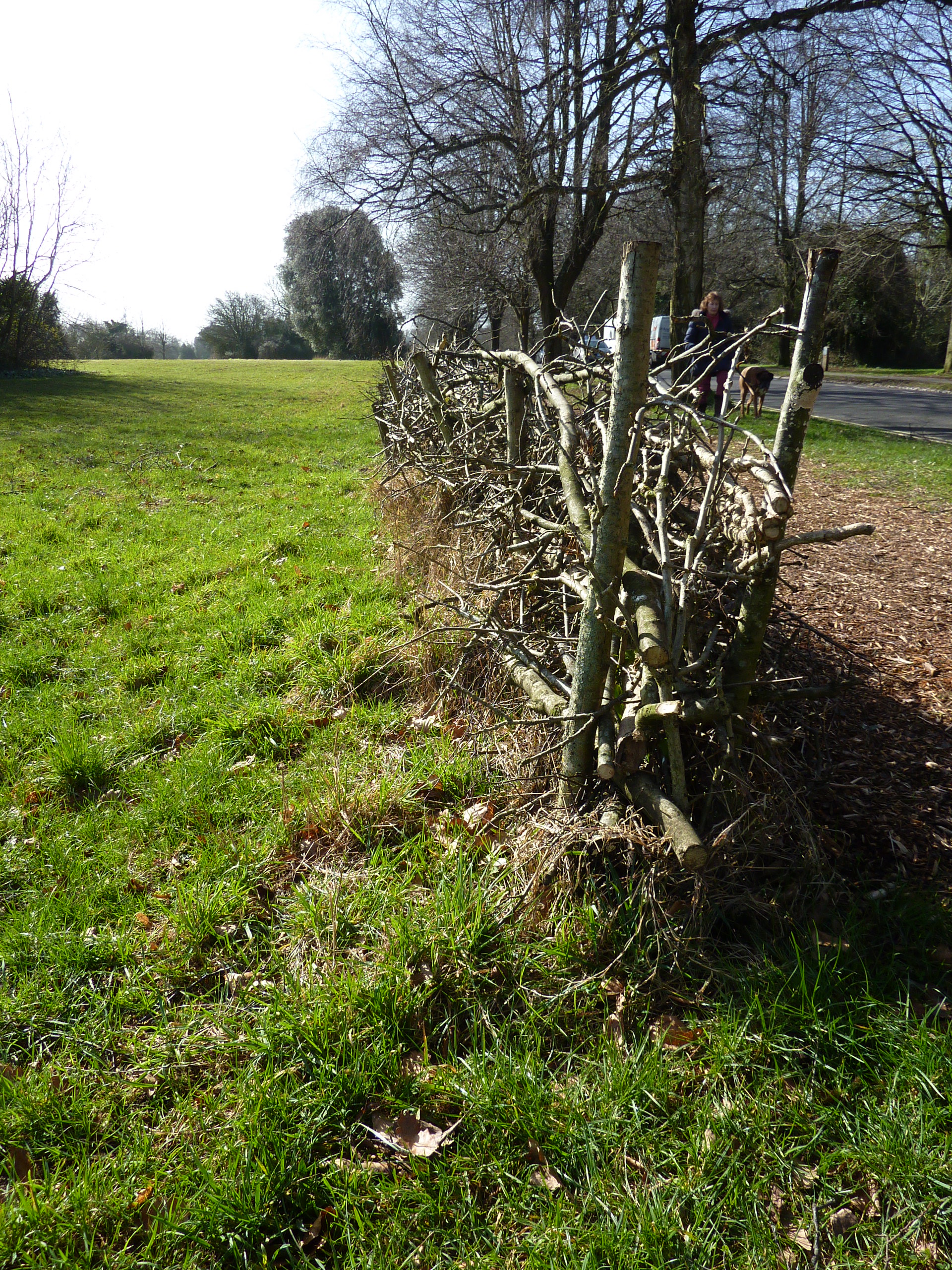
Here is the a “dead hedge” on the downs, rebuilt by volunteer labour last month to help protect the wildflower meadow beside it from joggers; just one example of what self-help can do.
Who knows, we might even get our urban sparrows back.
Bristol Tree Forum has just added a new page to our web site. The new Trees of Bristol page provides access to an interactive guide to many of Bristol’s remarkable public tree collections – collections which are accessible to us all in and around the city including Clifton and Durdham Downs, Ashton Court Estate, Kings Weston Estate, Bishops Knoll and many other open and green spaces such as Eastville, St Andrews and Victoria parks.
We aim to help those who love and care for trees to track down and visit any of over 100 locations where trees can be enjoyed. We have already mapped some 15,000 trees (and growing), many of which are within easy walking or cycling distance.
There is also a special Stumps Collection page which builds on Bristol City Council’s trees data and shows all the sites in the city where there is an opportunity for any of us to have a new replacement tree planted. If you are interested in planting a tree at one of these locations, please take a look at our Become a tree champion page and contact us.
We would like to thank the following for their help and support in developing this new feature
If you have any queries or comments about the project, or if you would like to volunteer to help or have a tree collection that you would like to share with us, please get in touch via our Contact page or by emailing us at info@bristoltrees.space.





 bristoltreeforum.org