Monday, 7 November 2022 starting at 6:00 pm – City Hall, College Green, Bristol
Our Agenda
Introduction from Chair, Mark Ashdown
Finding our remarkable UK & Irish urban trees – Paul Wood
Panel Discussion between Paul Wood and Andy Bryce
Our Tree Champions
Bristol’s emerging local plan
Election of officers and financial report
AOB
We are looking forward to seeing you there.
Paul Wood
Paul is the author of three books: London’s Street Trees: A Field Guide to the Urban Forest; London is a Forest; London Tree Walks: Arboreal Ambles Around the Green Metropolis and is the editor of the Great Trees of London map. He has a lifelong passion for nature, especially trees, and was formerly a trustee of the London Wildlife Trust. He is currently working on a book about 1,000 remarkable urban trees throughout the UK and Ireland, to be published by Penguin in 2023.
Paul regularly leads walks and gives talks about trees in urban areas. As well as London, Paul has led walking tours around the streets of Bath, Sheffield, Dublin and even Philadelphia.
Andy Bryce
Andy is the Trees and Woodlands Manager at Bristol City Council. He manages Bristol’s team of tree officers and is responsible for managing our existing tree stock. Andy joined BCC in November 2021 having previously worked as an arborist at The National Arboretum, Westonbirt, latterly as its Collections Manager. Andy has worked in arboriculture for over 20 years, six of which were as an arborist in Bristol. Andy’s current research interest is tree pests and diseases.
You will all have seen young trees planted in vacant tree pits in the streets of Bristol. These trees are replacement trees. There was once a tree growing there before – maybe some time ago.
These replacement trees are paid for by sponsorship, or by funds paid by Developers when they have felled trees on a building site and there is no room to replace the felled trees on the building site. In the latter case more than one tree has been “lost” – the one on the building site and the one that was previously in the tree pit.
In order to increase Bristol’s tree canopy – vital in this time of a climate emergency – we must see trees being planted in new places as well as getting all the “old” sites being filled more quickly.
Trees for Streets
To try to get this initiative going, Bristol has joined Trees for Streets.
Quotes from the Flyer for Trees for Streets
‘Bristol City Council has joined the Trees for Streetsnational street tree sponsorship scheme, which aims to plant thousands of additional trees in streets and parks across the city, by supplementing the council’s tree budgets through public and corporate sponsorship.’
and
‘Trees for Streets is the National Street Tree Sponsorship Scheme from the urban tree charity Trees for Cities, funded by the government’s Green Recovery Challenge Fund and City Bridge Trust. The project uses technology to empower people and makes it easy for residents and organisations to get involved in greening their communities.’
and
‘Our mission is to fund the planting of more than 250,000 additional street trees nationwide over the next ten years by hosting online tree sponsorship schemes on behalf of local councils and delivering local promotion and engagement activity to bring these schemes to life.’
Comment
Bristol has long had a Tree Sponsorship scheme, run by TreeBristol (part of Bristol City Council).
In the 2021/2022 planting season £456,000 was spent by Bristol Council in planting of trees. A portion of this money is retained by BCC for maintaining the trees planted 55% of this money came from mitigation funds paid by Developers who had felled trees somewhere in the city in order to build on the land released. (So, the money was not being spent on NEW trees, just on replacements).
10% of that money came from sponsorship, with 6.5% coming from private sponsorship (individuals and groups) and 3.5% coming from business sponsorship. Even then a lot of that money was spent on replacing trees which had been lost i.e., not on providing trees in new sites. It is a difficult “sum” to achieve. Money from Developers is for the replacement of trees lost to development. The Bristol Tree Replacement Standard achieves an amount for replacement trees based on the size of the trees lost. Eventually the trees may grow to a size which more than compensates for the environmental value of trees lost. But it remains true that each replacement tree goes in to a tree site that has lost a tree formerly growing there – so the Council is spared the expense of replacing lost trees that it owned.
Representatives of the Bristol Tree Forum have attended two meetings now where this new scheme has been explained and described.
The Trees for Streets scheme is not going to fund the trees, nor plant the trees, so we would have worded the sentence “Our mission is to fund the planting of more than 250,000 additional street trees…….” slightly differently with instead “Our mission is to facilitate and organise the funding of the planting of more than 250,000 additional street trees…”
The Trees for Streets scheme is similar to Bristol’s former scheme in that it will provide a web based choosing and ordering and paying for system, whereby residents and organisations and businesses can find available tree sites for planting trees in Streets and Parks.
There are differences between the Trees for Streets Scheme and Bristol’s former scheme, and they are:
Bristol’s former sponsorship scheme was largely one of replacement for trees lost. A sponsor (an individual, a group or a business) would select, from the Council’s mapping, a site where formerly there had been a tree, and would pay for its planting. New site planting came from One Tree per Child (whips) or from national grants where Bristol would win a bid for a grant and spend the money.
The new scheme hopes to facilitate, through sponsorship, the planting of a new tree in a new site. These sites have to be found, and checked for Services (underground utility provision), and then put forward in the Council mapping for planting with a tree.
Residents, and other types of sponsor, will be able to suggest new sites for trees by answering the question “Where would you like to see a tree planted?” with their own suggestions. The sponsor would need to pay for the tree, but Trees for Streets might be able to assist with organising the funding, using their funding know how.
Initially this kind of new planting of Street Trees will only be possible in streets that currently have green verges, or in new sites in Parks.
(Trees in “hard ground” – pavements, plazas, city squares, etc. will need to be planted in engineered tree pits – and that is expensive. If a sponsor (which can be an individual, a group or a business) is prepared to meet that cost, then efforts will be made to agree suitable sites and then check them for Services and other criteria, such as the width of the pavement.)
Trees for Streets has national funding and this gives it an improved platform with web support and advertising which could see many more trees sponsored. Maybe businesses reached by the advertising will see a role in supporting tree planting in the more “tree poor” areas of Bristol?
Bristol is to offer residents the option to water their sponsored tree when it is outside their property – at a reduced cost (£160/tree v £295/tree). It gives people an option at a lower cost – and it avoids trucks driving about with lots of water in a bowser. It has worked elsewhere, and Bristol is going to try it.
DEFRA has provided funds for the setting up of Trees for Streets, and maybe future DEFRA grants will be channelled through this new national scheme. Bristol has, by making individual bids, obtained grants for tree planting from DEFRA in the past, and will still want to continue to make these bids for new funding for the actual purchase and planting of trees for new sites.
Choose the location of your tree from the map or suggest a spot in a grass verge in your street or neighbourhood. The questions on the website take you through the choices.
Answer a few questions about the location and you.
If all works out your tree will be planted during the next available planting season.
Bristol Tree Forum’s Tree Champions are to be offered training from Bristol’s Tree Officers so that they can help residents, organisations and businesses with determining the suitability of sites that are suggested.
The Bristol Tree Replacement Standard (BTRS), which was adopted nearly a decade ago in 2013, provides a mechanism for calculating the number of replacements for any trees that are removed for developments. It was ground-breaking in its time as it typically required more than 1:1 replacement.
The presumption should always be that trees should be retained. The application of BTRS should only ever be a last resort. It should not be the default choice, which it seems to have become.
The starting point for any decision on whether to remove trees (or any other green asset) is the Mitigation Hierarchy[2] which states, firstly, avoid; then, if that is not possible, minimise; then, if that is not possible, restore; and, as a last resort, compensate (the purpose or BTRS). BCS9 adopts this approach and states that:
Individual green assets should be retained wherever possible and integrated into new developments.
However, with the emergence of a new Local Plan for Bristol, we believe that the time has come for BTRS to be revised to reflect our changing understanding of the vital importance of trees to the city in the years since the last version of the Local Plan was adopted in 2014.
In addition, Bristol has adopted Climate and Ecological Emergency Declarations so a new BTRS will be an important part of implementing these declarations. Nationally, the new Environment Act 2021 (EA 2021) is coming into force late next year.
Our proposal provides a mechanism for complying with the new legal requirement for 10% Biodiversity Net Gain (BNG) which will be mandatory when EA 2021 takes effect.
Background
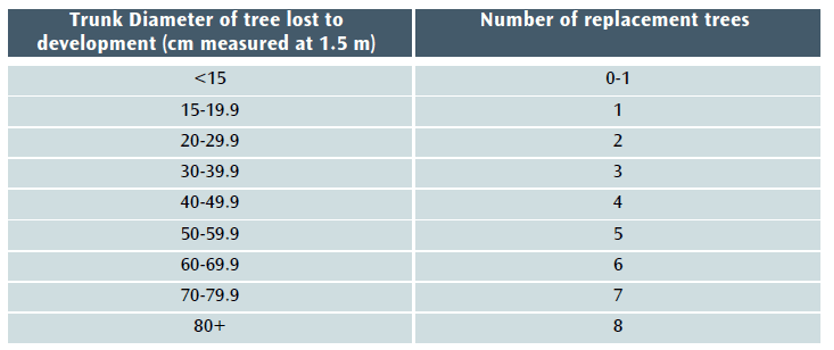
Under current policy – BCS9 and DM17 – trees lost to development must be replaced using this table:
Table 1 The Current BTRS replacement tree table
However, when the balance of the Environment Act 2021 (EA 2021) takes effect late in 2023, the current version of BTRS will not, in most cases, be sufficient to achieve the 10% biodiversity net gain (BNG) that will be required for nearly all developments. Section 90A will be added to the Town and Country Planning Act 1990 and will set out the level of biodiversity net gain required ( Schedule 14 of the EA 2021).
The Local Government Association says of BNG that it:
…delivers measurable improvements for biodiversity by creating or enhancing habitats in association with development. Biodiversity net gain can be achieved on-site, off-site or through a combination of on-site and off-site measures.[3]
GOV.UK says of the Biodiversity Metric that:
where a development has an impact on biodiversity, it will ensure that the development is delivered in a way which helps to restore any biodiversity loss and seeks to deliver thriving natural spaces for local communities.[4]
This aligns perfectly with Bristol’s recent declarations of climate and ecological emergencies and with the aspirations of the Ecological Emergency Action Plan,[5] which recognises that a BNG of 10% net gain will become mandatory for housing and development and acknowledges that:
These strategies [the Local Nature Recovery Strategies] will guide smooth and effective delivery of Biodiversity Net…
Our proposed new BTRS model
We propose that the Bristol Tree Replacement Standard be amended to reflect the requirements of the EA 2021 and BNG 3.1 and that the BTRS table (Table 1) be replaced with Table 2 below:
Table 2 The proposed new BTRS tree replacement table
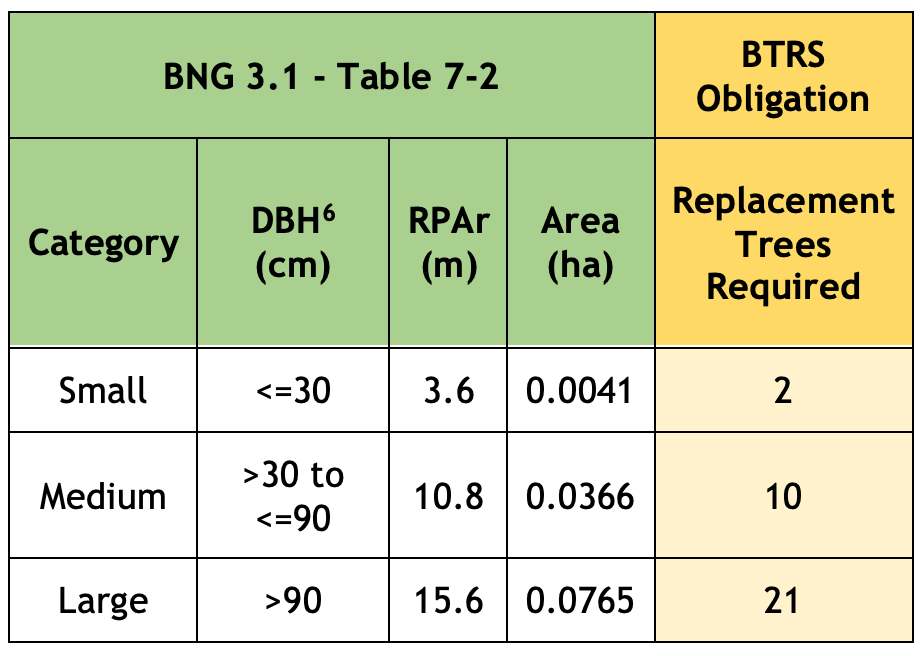
The Replacement Trees Required number is based on the habitat area of each of the three BNG 3.1 tree categories (Table 7-2 below) divided by the area habitat of one 30-year old BNG 3.1 Small tree (Table 3 below) plus 10% net gain. This is rounded up to the nearest whole number since you can’t plant a fraction of a tree.
The reasoning for our proposal is set out below:
Applying the Biodiversity Metric to Urban trees
The most recent Biodiversity Metric (BNG 3.1) published by Natural England, defines trees in urban spaces as Urban tree habitats. The guidance states that:
the term ‘Urban tree’ applies to all trees in urban situations. Urban trees may be situated within public land, private land, institutional land and land used for transport functions.
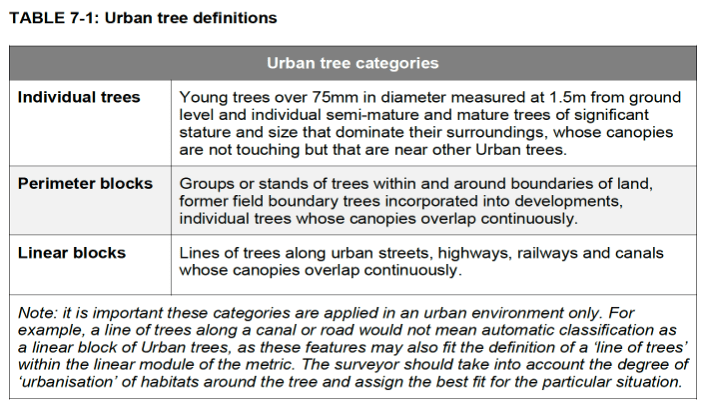
Table 7-1 divides Urban tree habitats into three categories:
Paragraph 8.5 of the 3.1 BNG Guidance makes it clear that lines of trees in an urban environment should not be treated as a linear habitat:
Urban trees are considered separately to lines of trees in the wider environment, since they generally occur in an urban environment surrounded by developed land.
Calculating Urban tree habitat
Urban tree baseline habitat area is measured in hectares and is based on the Root Protection Area[7] (RPA) of each tree impacted by a proposed development. RPA is used instead of tree canopy because it is considered to be the best proxy for tree biomass.
In most cases, RPA is obtained from an Arboricultural Impact Assessment (AIA), which complies with British Standard 5837 2012 – Trees in relation to design, demolition and construction (BS:5837).
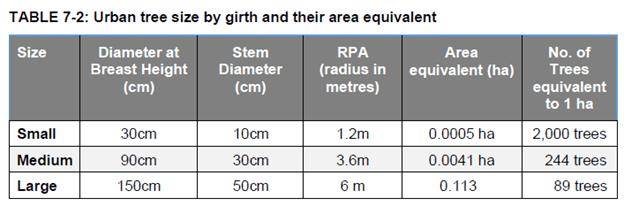
Where no AIA is available, Table 7-2 is used:
Note that the tree’s size will still need to be ascertained, and that any tree with a stem diameter (DBH) 75mm or more and of whatever quality (even a dead tree, which offers its own habitat benefits) is included . Under BTRS, trees with a DBH smaller than 150 mm are excluded, as are BS:5837 category “U” trees.
The guidance also makes it clear that, given the important ecosystem services value provided by trees, where possible like-for-like compensation is the preferred approach, so that lost Urban trees are replaced by Urban trees rather than by other types of urban habitat.[8]
Replacing lost trees
To calculate the number of trees required to replace Urban tree habitat being lost, table 7-2 above is used on this basis:
Size classes for newly planted trees should be classified by projected size at 30 years from planting.
We have used the median DBH sizes for new stock trees as set out in BS 3936-1: Nursery Stock Specification for trees and shrubs as the basis for calculating the eventual size of a newly planted trees after 30 years and assumed that a tree adds 2.54 cm (1”) to its girth annually.
This results in a predicted stock tree size after 30 years’ growth. This is then assigned to one of the three Urban tree categories set out in table 7-2: Small, Medium or Large. In all cases save for Semi-mature tree stock, the eventual size of stock trees after 30 years falls within the BNG 3.1 size category Small, which has a habitat area of 0.0041 hectares. This value is then used to calculate how many new trees will be required to replace trees lost to the development, plus a 10% biodiversity net gain. This gives a compensation size per replacement tree of 0.0045 ha (0.0041 hectares + 10%).
Table 3 below shows the basis our our calculation:
Table 3 Annual stock tree growth predictions
The Trading Rules
It may be that a notional positive biodiversity net gain can be achieved by replacing fewer trees than this analysis indicates. However, this is not enough. The calculation should also comply with the Trading Rules that apply to Urban tree habitats.
Paragraph 7.6 of the 3.1 BNG Guidance states:
The mitigation hierarchy and trading rules apply to Urban trees. Given Urban trees are a ‘Medium’ distinctiveness habitat, trading rules stipulate that the same broad habitat type (or a higher distinctiveness habitat) is required. However, given the important ecosystem services value provided by trees, where possible ‘like for like’ compensation is the preferred approach (i.e. where possible any loss of Urban trees should be replaced by Urban trees – rather than other urban habitats).
Rule 3 of the User Guide states: ‘”Trading down’ must be avoided. Losses of habitat are to be compensated for on a ‘like for like’ or ‘like for better’ basis. New or restored habitats should aim to achieve a higher distinctiveness and/or condition than those lost…’
The likely impact of this policy change
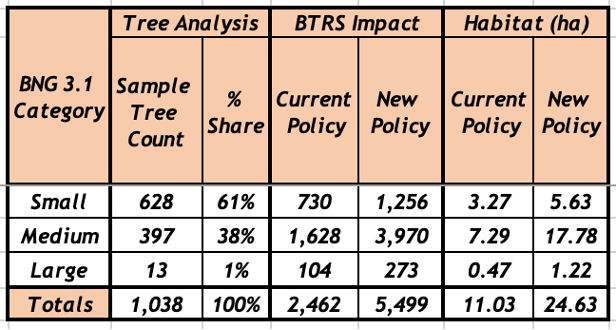
We have analysed tree data for 1,038 surveyed trees taken from a sample of AIAs submitted in support of previous planning applications. Most of the trees in this sample, 61%, fall within the BNG 3.1 Small range, 38% within the Medium range, with the balance, 1%, categorised as Large.
Table 4 below sets out the likely impact of the proposed changes to BTRS. It assumes that all these trees were removed (though that was not the case for all the planning applications we sampled):
Table 4 Proposed BTRS impact analysis
The spreadsheet setting out the basis of our calculations can be downloaded here – RPA Table 7-2 Comparison.
This article was amended on 7 November 2022 to include references to Lines of Trees in the urban environment, the application of the Trading Rules to Urban tree habitats and fix a broken link.
Appendix 1
Our proposed changes to BTRS, set out in the Planning Obligations Supplementary Planning Document, page 20.
Trees – Policy Background
The justification for requiring obligations in respect of new or compensatory tree planting is set out in the Environment Act 2021, Policies BCS9 and BCS11 of the Council’s Core Strategy and in DM 17 of the Council’s Site Allocations and Development Management Policies.
Trigger for Obligation
Obligations in respect of trees will be required where there is an obligation under the Environment Act 2021 to compensate for the loss of biodiversity when Urban tree habitat is lost as a result of development.
Any offsite Urban tree habitat creation will take place in sites which are either on open ground or in areas of hard standing such as pavements.
Where planting will take place directly into open ground, the contribution will be lower than where the planting is in an area of hard standing. This is because of the need to plant trees located in areas of hard standing in an engineered tree pit.
All tree planting on public land will be undertaken by the council to ensure a consistent approach and level of quality, and to reduce the likelihood of new tree stock failing to survive.
Level of Contribution
The contribution covers the cost of providing the tree pit (where appropriate), purchasing, planting, protecting, establishing and initially maintaining the new tree. The level of contribution per tree is as follows[9]:
Tree in open ground (no tree pit required) £765.21
Tree in hard standing (tree pit required) £3,318.88
The ‘open ground’ figure will apply where a development results in the loss of Council-owned trees planted in open ground. In these cases, the Council will undertake replacement tree planting in the nearest appropriate area of public open space.
In all other cases, the level of offsite compensation required will be based on the nature (in open ground or in hard standing) of the specific site which will has been identified by the developer and is approved by the Council during the planning approval process. In the absence of any such agreement, the level of contribution will be for a tree in hard standing.
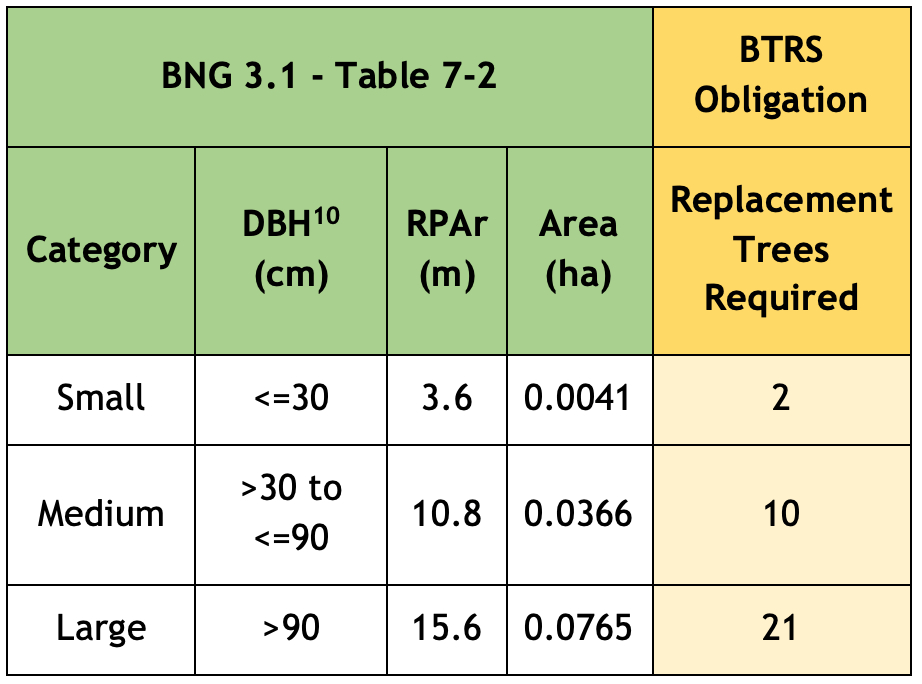
The calculation of the habitat required to compensate for loss of Urban trees is set out in Table 7-2 of the Biodiversity Metric (BNG), published from time to time by Natural England. This may be updated as newer versions of BNG are published.
The following table will be used when calculating the level of contribution required by this obligation:
[6] DBH = Diameter at Breast Height. RPAr = Root Protection Area radius. Area = the calculated BNG habitat area.
[7] RPA area = π × r2 where r is 12 x the tree’s DBH for a single stemmed tree. For multi-stemmed trees, the DBH of the largest stem in the cluster should be used to determine r.
[9] These values should be updated to the current rates applicable at the time of adoption. The current indexed rates as of April 2022 are £1,041.6 & £4,517.89 respectively.
[10] DBH = Diameter at Breast Height. RPAr = Root Protection Area radius. Area = the calculated BNG habitat area.
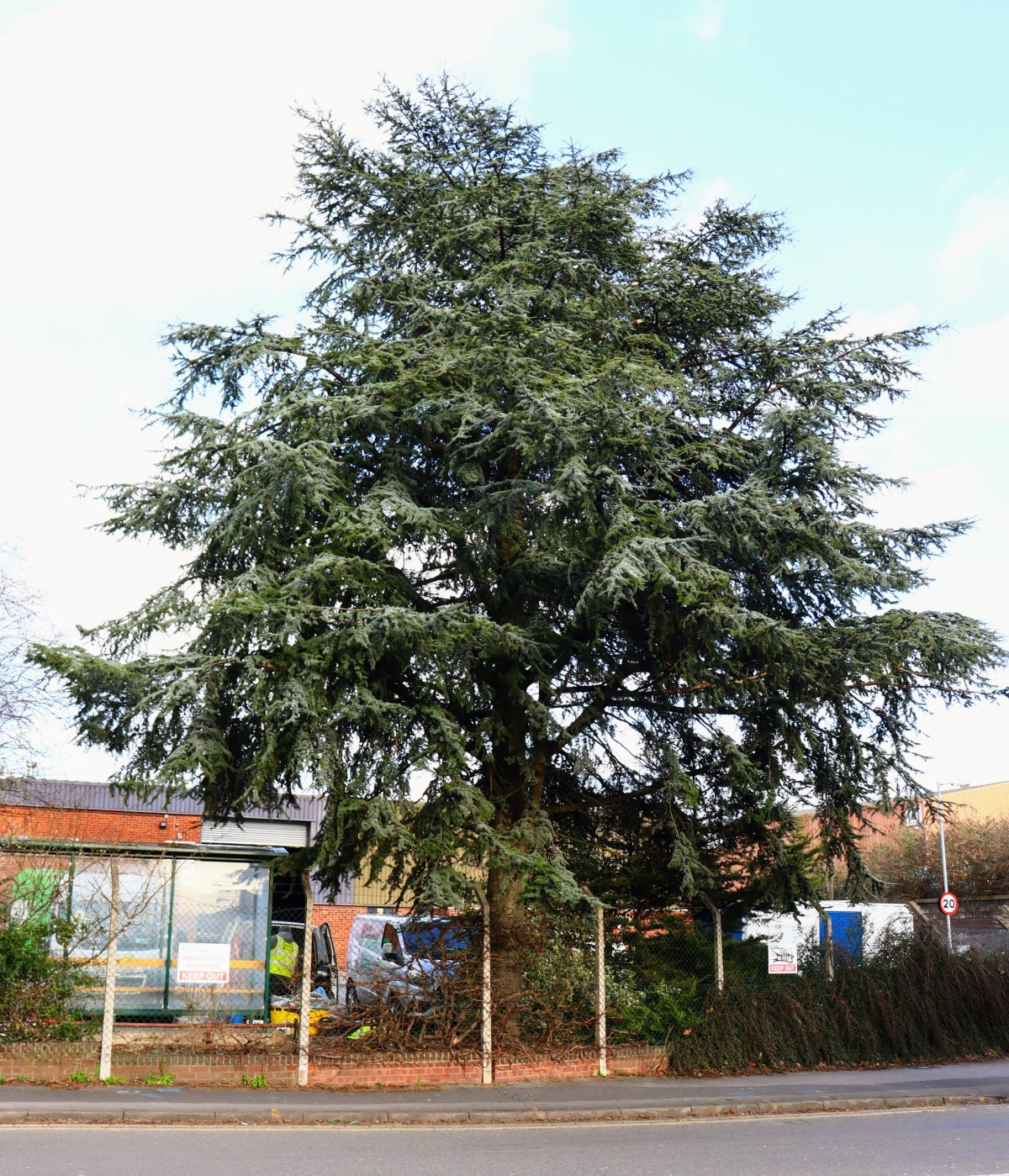
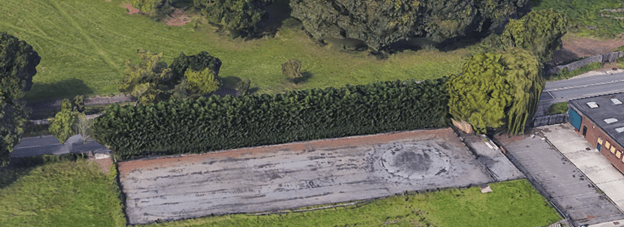
Figure 1 Leyland cypress trees on the boundary of the former Police Dog & Horse Training Centre, Bristol.
The Biodiversity Metric 3.0 (BNG 3.0) User Guide defines Urban Tree habitats as follows:
Individual Trees
Young trees over 75mm in diameter measured at 1.5m from ground level and individual semi-mature and mature trees of significant stature and size that dominant their surroundings whose canopies are not touching but that are in close proximity to other trees.
Perimeter Blocks
Groups or stands of trees within and around boundaries of land, former field boundary trees incorporated into developments, individual trees whose canopies overlap continuously.
Linear Blocks
Lines of trees along streets, highways, railways and canals whose canopies overlap continuously.
These habitats are measured by area (hectares). Using this measurement and other parameters (Distinctiveness, Condition and Strategic Significance), their baseline biodiversity value is calculated in area biodiversity habitat units (ABHUs).
BNG 3.0 also includes separate calculations for two types of linear habitat, one of which is ‘Hedgerows and Lines of Trees’. These linear habitats are measured in kilometres. Using this measurement and the same parameters used for ABHUs, their baseline biodiversity value is calculated in hedgerow biodiversity units (HBUs).
Hedgerow habitats are a feature almost unique to the British Isles, but ‘Lines of Trees’ have been included as a linear habitat as they ‘display some of the same functional qualities as hedgerows’.
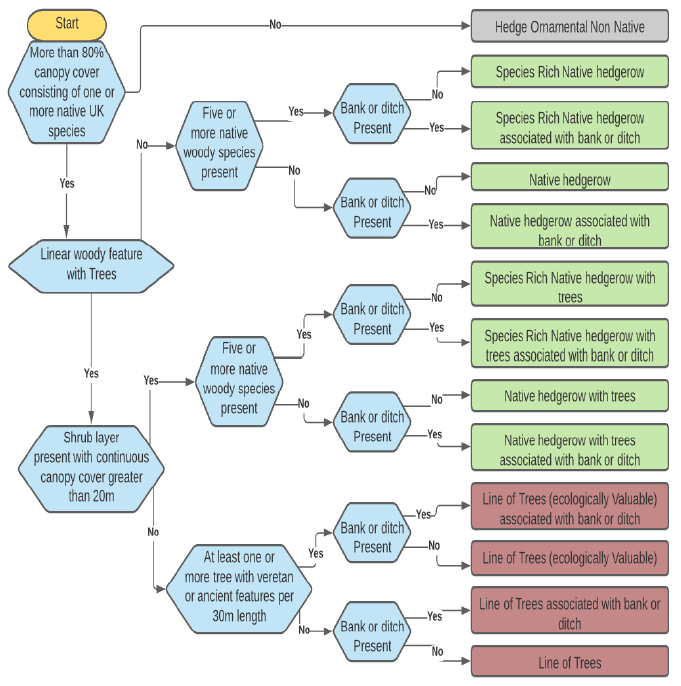
Box 8-2 of the BNG 3.0 User Guide (Figure 2) uses this key to help identify Hedgerow or Line of Trees habitat types:
Figure 2 Box 8.2 – BNG 3.0 User Guide
The BNG 3.0 User Guide states that ‘Urban trees are considered separately to lines of trees in the wider environment, since they generally occur in an urban environment surrounded by developed land’. However, it is possible for disagreements to arise where the site is not clearly part of ‘an urban environment’, even though the trees fall within the Urban Tree habitat definition as either Perimeter or Linear Blocks.
A recent example demonstrates the issue. It involved 34 Leyland cypress trees growing along the boundary of the former Police Dog & Horse Training Centre on Clanage Road, Bristol, on the edge of the city. These trees were planted to form a screen between Clanage Road and the training centre (Figures 1 & 3).
This issue was argued before the Planning Inspector when the Secretary of State called the matter in (APP/Z0116/V/21/3270776) following a grant of planning permission for a change of use to a touring caravan site.
It was agreed at the inquiry that these trees had been planted between 1.5 to 2 metres apart, had developed average stem diameters of 33 cm and had grown to about 10 metres high and eight metres wide. The whole row is about 72 metres (0.072 km) long.
Figure 3 The site on the edge of the city (red boundary line)
Using the flow chart at Box 8-2 above, the developer’s ecologist argued that these trees were a Hedge Ornamental Non-native habitat. So, using the BNG 3.0 calculator, they would be assessed as a linear habitat 0.072 kilometres long. This habitat is given a Very Low Distinctiveness (score 1) and has a Poor Condition (score 1) [1]. Because of its location, it was given a Strategic Significance of Within area formally identified in local strategy (score 1.15). As such, the baseline habitat value is calculated as 0.072 x 1 x 1 x 1.15 = 0.08 HBUs.
We argued that these trees formed an Urban Tree habitat and that, using the BNG 3.0 calculator, it should be treated as 34 Medium-sized trees with a combined area of 0.1384 hectares with a Medium Distinctiveness (score 4) and is in Poor Condition (score 1) – even though it was agreed that the trees were in good condition and could be categorised as B2 using BS 5837:2012. Because of its location, it was given a Strategic Significance of Within area formally identified in local strategy (score 1.15). On this basis, the baseline habitat value is calculated as 0.1384 x 4 x 1 x 1.15 = 0.64 ABHUs (nearly 8 times the HBU value).
Whilst Rule 4 of the BNG 3.0 User Guide (page 37) states that ‘… the three types of biodiversity units generated by this metric (for area, hedgerow and river habitats) are unique and cannot be summed’, it is clear that adopting either of these two approaches will result in very different outcomes when assessing biodiversity net gain.
In our view it is vital not to undervalue baseline habitats by the selective use of the habitat definitions given in BNG 3.0.
The planning inquiry decision (refusal) has now been published – APP/Z0116/V/21/3270776.
Assessing the condition of urban tree habitats using Biodiversity Metric 3.0
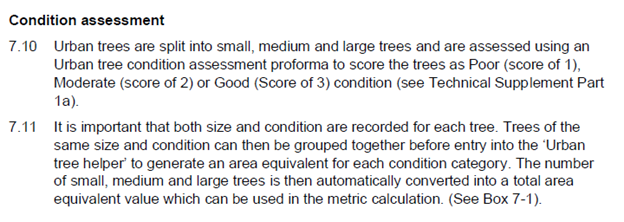
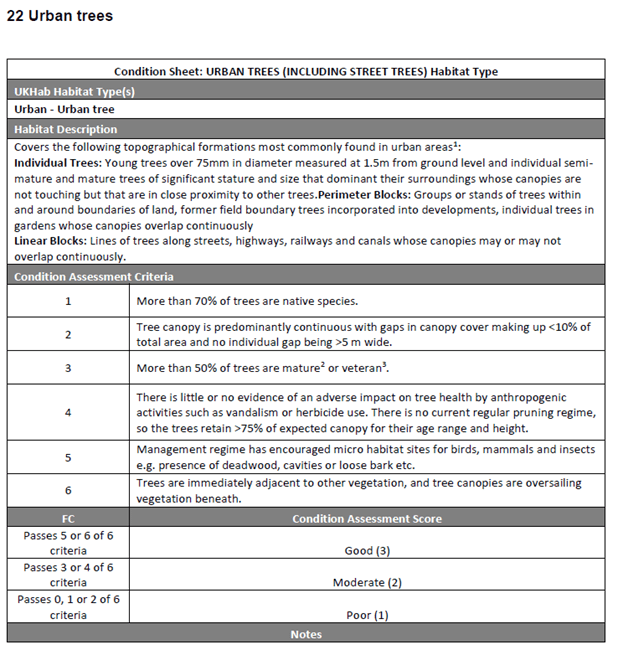
Our recent blog – Valuing our urban trees I, pointed out the failings of the methodology for calculating the size of urban tree habitats as set out in Biodiversity Metric 3.0 (BNG 3.0). We would now like to show how this is compounded by the inappropriate assessment criteria used to determine the condition of Urban Tree habitats, as also set out in BNG 3.0 (see Annex 1).
We use the following example – taken from a recently approved planning application[1] which will result in the removal of 13 urban trees – to demonstrate why this is approach is inappropriate.
Figure 1 The example tree – Google Street View 2020
This street tree is a London Plane (Platanus × acerifolia) with a stem diameter (called DBH) of 118 cm. It is a non-native species planted in hard standing on Bridge St, Bristol BS1 2AN in about 1967. Using BS 5837:2012 – Trees in relation to design, demolition and construction – Recommendations (a BSI Standards Publication), it has been categorised as A,1,2 (see Annex 2). The developer’s Arboriculturalist described it as having a ‘Large, broad crown with excellent form and vigour.’
The tree’s BS 5837:2012-calculated Root Protection Area (RPA) radius[3] is 14.6 metres, so it has an RPA of 630 square metres. The tree has an average crown radius of 9.88 metres and a calculated canopy area of 306 square metres.
Using BNG 3.0 TABLE 7-2: Urban tree size by girth and their area equivalent (see Annex 1), the calculated RPA of the tree is set at Large, so its habitat size is limited to just 113 square metres – a discount of 82% of its calculated RPA and 37% of its canopy area.
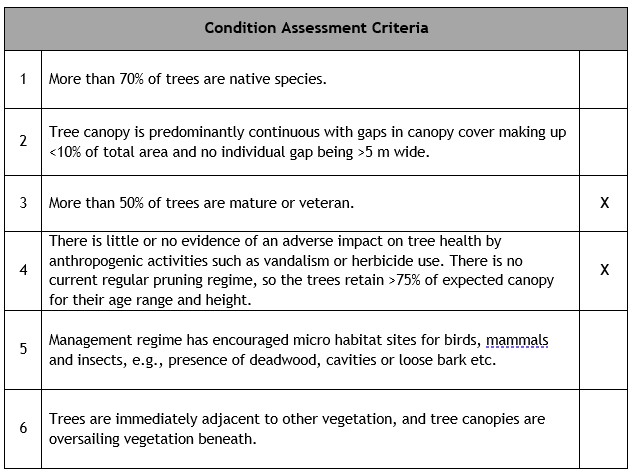
Notwithstanding categorisation of the tree as A,1,2, the BNG 3.0 Condition Assessment Criteria categorises the condition of this tree as Poor because it meets only two of the six criteria, as shown below:
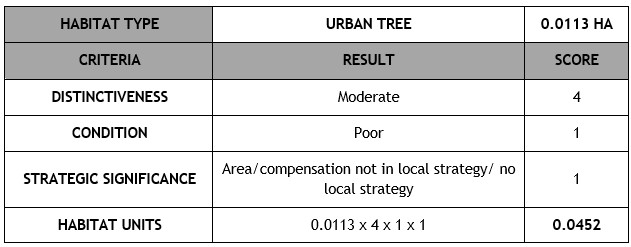
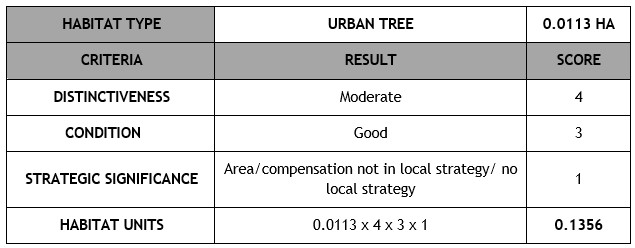
Using BNG 3.0, the calculation of the baseline habitat (called Habitat Units) of this tree is as follows:
Had the BS 5837:2012 condition of the tree been allowed for and its condition set to ‘Good’, then the habitat units of this tree would be three times the habitat unit value of 0.0452, i.e., 0.1356 as shown below.
Not only has the true size of the urban tree habitat been significantly undervalued (because its actual RPA has not been used), but its assessed condition using the BNG 3.0 criteria is also clearly inappropriate given that this tree has been assessed at the highest category under BS 5837:2012:
Category A – Trees of high quality with an estimated remaining life expectancy of at least 40 years …that are particularly good examples of their species, especially if rare or unusual; or those that are essential components of groups or formal or semi-formal arboricultural features (e.g., the dominant and/or principal trees within an avenue).
The proposed solution
BNG 3.0 is seriously flawed when it comes to evaluating Urban Tree habitats. We have already commented on this when it comes to calculating habitat size.
In our view, the solution to the issue of assessing the correct condition of urban tree habitats is already available in BS 5837:2012. The standard may require some amendment to align it with BNG 3.0, but it is a well-established and practical approach used by the arboricultural community. This British Standard gives recommendations and guidance on the relationship between trees and design, demolition and construction processes and is used whether or not planning permission is required.
Last year we were pleased to be able to provide – free of charge – 1,600 oak saplings for tree lovers to plant around Bristol, and as it turns out, around the country.
STOP PRESS 11 Feb 2022 – We have now reached our target and are no longer taking any new Orders. Thank you all for your support.
Due to COVID-19 restrictions in 2020 and delays in government funding, there were postponements and cancellations of many major tree planting projects. A consequence of this was that large numbers of tree saplings planned for planting projects were threatened with destruction, including 750,000 two year old English oak tree saplings at the Maelor Forest Nursery in Wrexham.
Rather than see these trees destroyed, Bristol Tree Forum purchased 1,000 of the oak saplings for free distribution to anyone able to plant them.
As a result of the amazing response to this scheme we increased our order to 1600 saplings all of which were distributed and planted.
Oak plantings in and around Bristol
…. and beyond
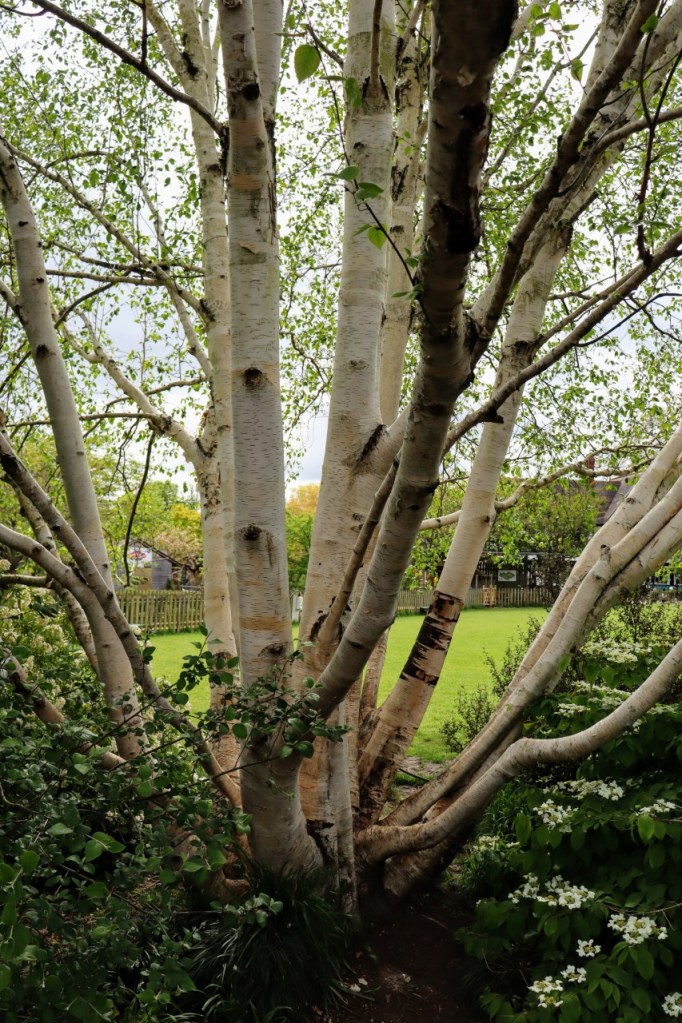
Due to the success of last year’s project, the Bristol Tree Forum have ordered another thousand saplings. Because we may have somewhat exhausted the demand for oaks, this year we have ordered a mixture of white (or downy) birch and alder. Both are native trees of great benefit to wildlife, and are tolerant of poor soil and wet conditions.
White Birch
Black alder (T Davis Sydnor)
For those that would prefer oak saplings, we have partnered with the Arkbound Foundation who are distributing oaks as part of their Oakupy project. These can either be ordered using the form below, or directly from Oakupy. We will get delivery in late January or early February. The trees can be collected from a site in Redland, Bristol.
The saplings come bare-rooted (i.e. out of the soil) and need to be planted as soon as possible after collection, although the viability of the trees over winter can be extended by storing the trees with the roots covered in damp soil.
The form below is to find out who would like to have saplings for planting and how many, and for you to provide basic contact details (email and/or phone number) for us to organise collection of the trees. Contact details will not be used for any other purpose.
The importance of planting trees?
Despite advances in carbon capture technology, the most efficient and cost-effective way to sequester carbon from the atmosphere is to plant trees. For instance, a single mature oak tree is the equivalent of 18 tonnes of CO2 or 16 passenger return transatlantic flights.
Trees are vital in supporting biodiversity, with oak trees capable of supporting over 2,300 different species, including birds, mammals, invertebrates, mosses, lichen and fungi.
Trees improve air quality by absorbing both gaseous (e.g., NO2) and particulate pollution. They reduce traffic noise and flooding and improve physical and mental wellbeing. Crucially, with life threatening heat waves predicted to occur every other year by 2050, trees can reduce the city heat island effect, potentially saving lives.
This project is funded by the Bristol Tree Forum in partnership with the Arkbound Foundation.
However, a consequence of the adoption of this motion is that there is greater pressure to develop on other sites. Those advocating development on open spaces within Bristol have begun, arbitrarily and without proper justification, to declare such open spaces to be brownfield. To inaccurately describe a development site as brownfield places Development Committee members under undue pressure to approve a planning application when, as greenfield, a site should fall under the additional protection engendered by the landmark motion.
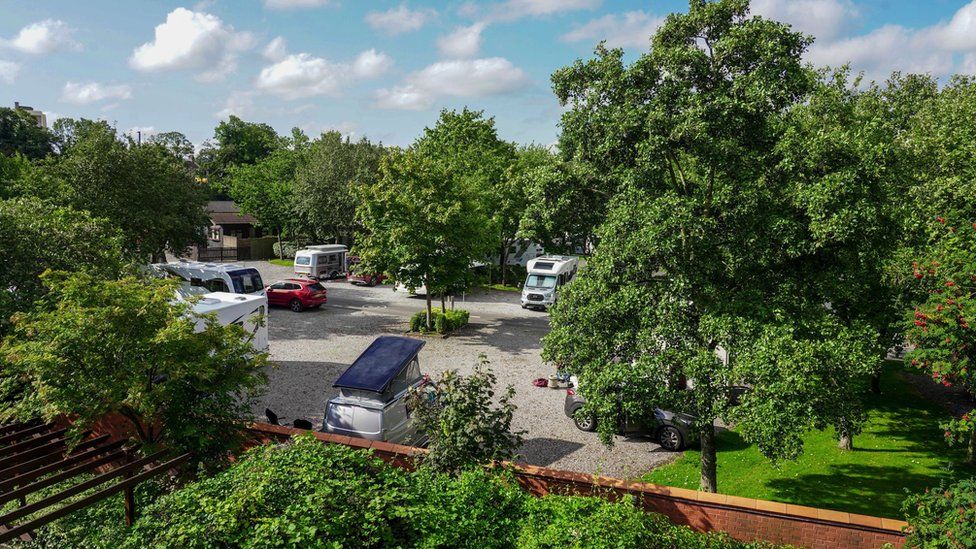
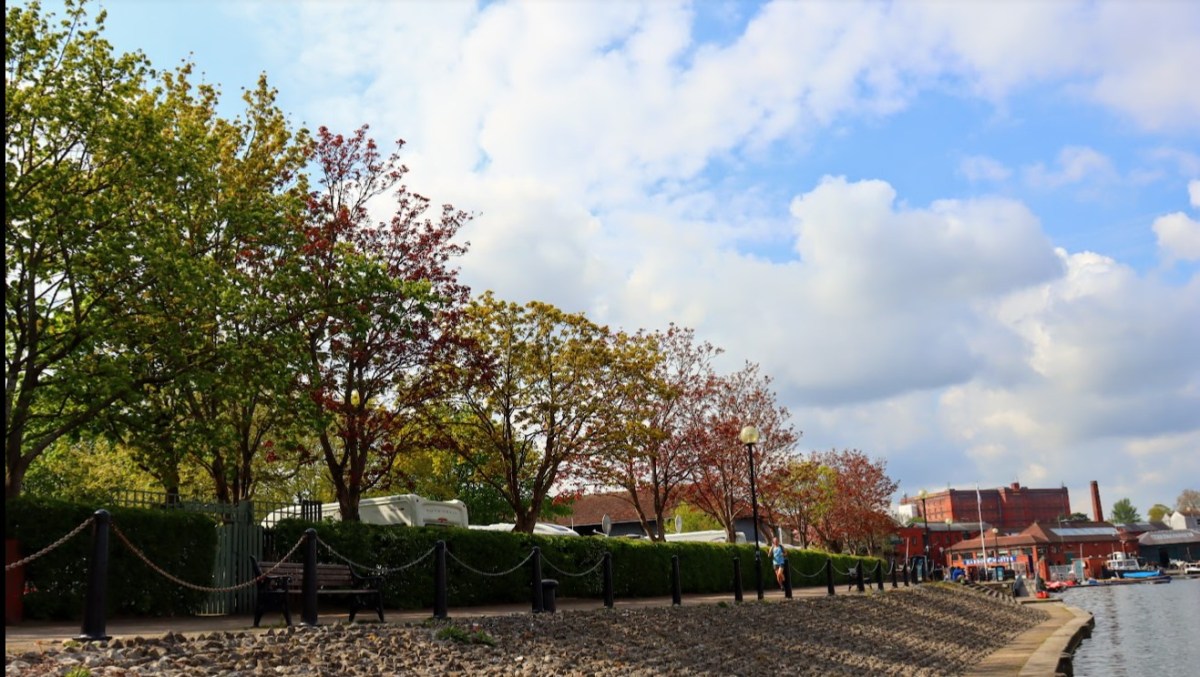
Baltic Wharf Caravan Park
Recent examples (see below) where the term brownfield has been misused are the Bristol Zoo Gardens car park on College Rd, Clifton and the Baltic Wharf Caravan Park on the Floating Harbour in Hotwells, each of which have been mislabelled as brownfield sites despite not falling within with the recognised legal definition.
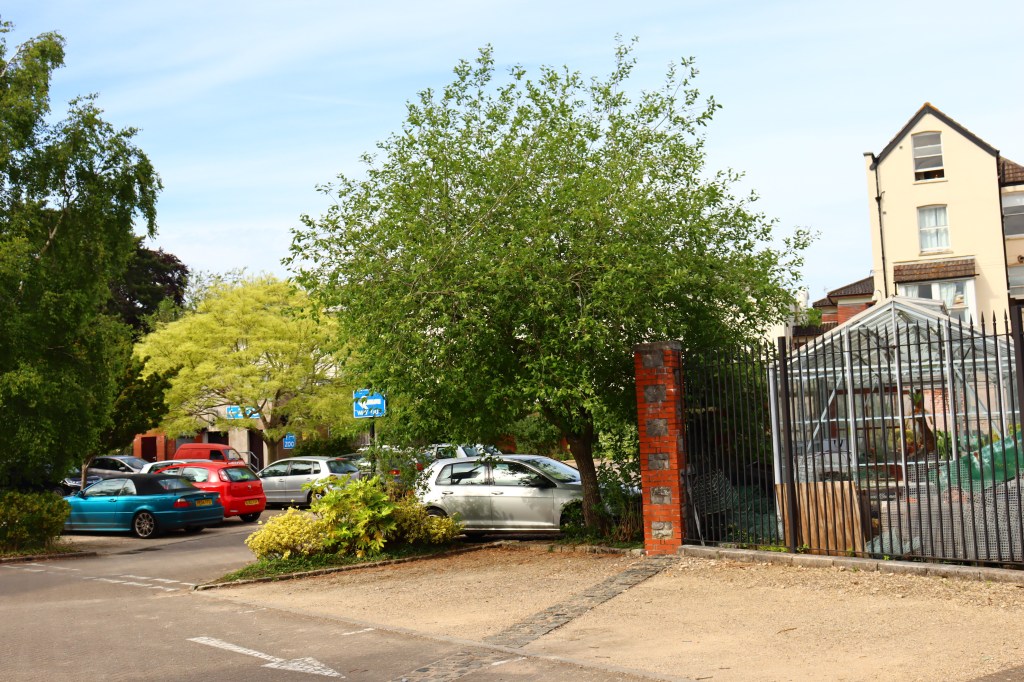
Bristol Zoo Gardens car park
The term brownfield site is used to describe certain types of previously developed land. Most dictionary definitions refer to this land as being currently or previously occupied by a permanent structure which generally includes the potential for contamination. In planning law there is a definition which must apply when considering planning proposals. This is detailed in the National planning policy framework (NPPF – called ‘Previously developed land’, p.70) as:
“Land which is or was occupied by a permanent structure…. and any associated fixed surface infrastructure”.
The definition excludes land which is maintained as a garden:
“….. land in built-up areas such as residential gardens, parks, recreation grounds and allotments…“
In addition to the definition, there is a statutory requirement for local authorities to maintain an up to date register of brownfield sites which are appropriate for development:
The Town and Country Planning act also addresses the situation where a fragment of the site might be considered brownfield, but other parts of the curtilage is green space:
“Greenfield land is not appropriate for inclusion in a brownfield land register. Where a potential site includes greenfield land within the curtilage, local planning authorities should consider whether the site falls within the definition of previously developed (brownfield) land in the National Planning Policy Framework. Where it is unclear whether the whole site is previously developed land, only the brownfield part of the site should be included in Part 1 of the register and considered for permission in principle”.
Mislabelling as brownfield examples in recent planning applications
Bristol Zoo Gardens car park, College Rd, Clifton (21/01999/F)
The planning proposal makes the statement “The application site is brownfield, previously developed land, as it is a car park“. Mayor Marvin Rees similarly defined the site in a subsequent tweet criticising some members of the Development Committee for voting against the proposal.
This site fails to comply with the proper planning definition of a brownfield site. In relation to the NPPF definition, 7.4% of the site is occupied by buildings whereas tree canopy covers about 17% of the site. Much of the site is covered by unfixed surface, which does not qualify under the definition of a brownfield site. Therefore, according to the Town and Country Planning Act only 7.4% of the site could be considered brownfield, with the remaining 92.6% being classified as greenfield. The site does not appear on the Council’s register of brownfield sites, and therefore cannot legally be classified as such.
This planning proposal has also been inappropriately described as a brownfield site in the planning application. Only 2.6% of the site is occupied by a permanent structure, whereas the 100 trees that occupy this site cover over 30% of its area. Thus, only 2.6% of the site could possibly be defined as brownfield, with the remaining 97.4% falling under the classification of greenfield. Furthermore, as much of the site is maintained as a “residential garden”, the site is exempt from the NPPF definition. This site, also, is absent from the necessarily up-to-date register of brownfield sites.
Whilst there may be arguments to develop some parts of some of these sites, the existing trees should be retained in order to comply with Local Planning Policy BCS9. The current approach of flattening all trees, including those on the edge of the site results in third rate developments. Instead, new developments should be built around existing trees.
Petition
If you agree that this mislabelling should stop, please sign this petition to protect Bristol’s green spaces from the Council’s mislabelling of them as “brownfield sites”:
We have never been able to understand why Bristol City Council decided to terminate the lease of the longstanding and very successful central Bristol caravan site. It is not a brownfield site crying out for redevelopment, as some would have us believe. Its success and the 91 mature, well-established trees that grace it (74 of which are to be removed) testify to that.
Bristol Chamber of Commerce has described this caravan park as ‘… an important, high performing asset for Bristol’s visitor economy, enabling visitors to stay in walking distance of the city centre and thus providing significant levels of custom for local businesses‘.
And John Hirst, as Chief Executive of Destination Bristol, observed that ‘There are significant financial benefits for Bristol due to the year round supply of visitors to their current caravan site. We know that the current Bristol site at Baltic Wharf has been one of the most popular and successful central sites in the UK’.
So why on earth close the caravan park for a plan that almost nobody really wants – at least 273 at the last count? It seems that it’s worth closing this successful tourist attraction to replace it with new housing, even though the caravan park is estimated to bring some £1 to £1.5 million annually to Bristol’s tourist economy. The scramble for new housing at any cost – while ignoring the wishes of local communities and the economic benefits that the caravan park brings us – seems to take priority over all else.
And the result? We have proposals that will flatten every inconvenient tree rather than incorporating them into the proposed development. This only adds to the steady loss of green spaces and reduces Bristol, especially the centre of Bristol, to a grim, unliveable environment. As Bristol grows hotter with each passing year, with the expectation that by 2050 life-threatening heatwaves will occur once every two years (not to mention the increasing flood risk to this area), we will need the cooling benefit of large, mature trees yet, tree by tree, they are inexorably removed in order to maximise profit and achieve what many say is an unrealisable aspiration. With the majority of new housing being sold at full market price, these will be as much for the benefit of the estimated 1,900 annual migrants from London as they are for the more affluent citizens of Bristol.
It is especially sad that Goram Homes, the much-lauded development arm of Bristol City Council, continues to ignore our very own key green planning policy, BCS9, and the revised National Planning Policy Framework (the Framework) upon which it is based. BCS9 states that ‘Individual green assets should be retained wherever possible and integrated into new development’.
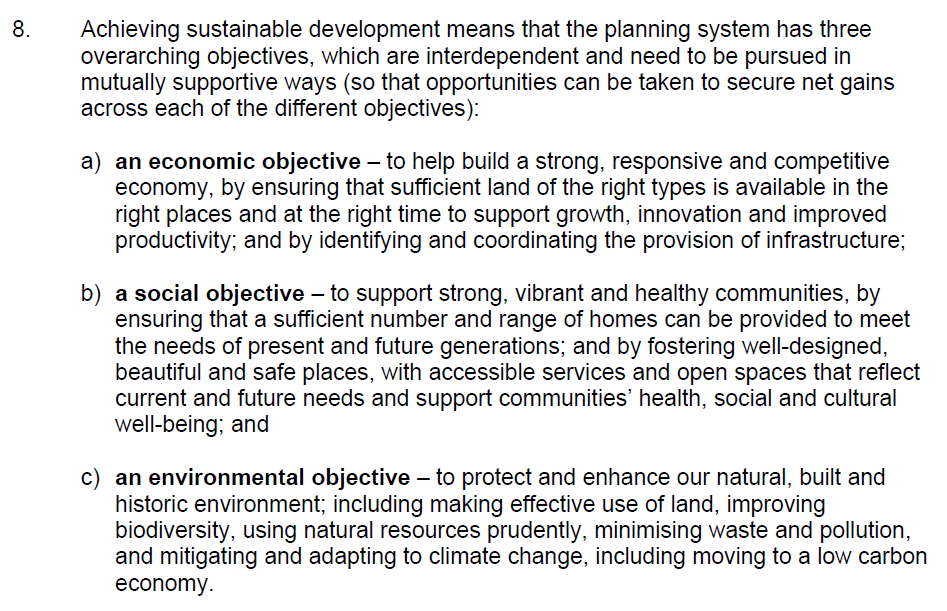
The Framework is the foundation upon which BCS9 is based:
We had hoped that Goram Homes would have set a good example – especially since the Council has recently published its Ecological Emergency Action Plan and announced that it will “embed nature into all decisions” – and abide by these important principles. What has happened to the Framework’s third, overarching environmental objective? Taking Baltic Wharf Caravan Park as an example, it would have been quite straightforward to design any new housing around existing trees, particularly if the focus was on just building affordable and social housing. Instead, nearly all are going. This, it seems, is ‘Placeshaping’, Bristol-style.
And this intransigence has resulted in damaging national press coverage – though note the lovely photo of the trees growing on the site.
Our objections to the proposals are set out here, but we are not the only ones…
Councillor Mark Wright’s experience
Councillor Mark Wright was the councillor for Hotwells and Harbourside until May 2021 when he stepped down. Here he presents his experience of the many attempts he made to engage with the planners and Goram Homes at an early stage to try to secure as good an outcome as possible given that the caravan park was doomed to be closed. They came to nothing.
Mark writes:
‘Sept 2018
Mayor Rees announces that flats will be built on the site.
Dec 2018
I wrote to Cllr Paul Smith (Housing) “There are a number of very nice trees on the caravan park site that residents are already calling for saving (see attached Google 3D image). If done skilfully and at an early enough stage, many of the best trees could be embraced into the development in a way that greatly increases the value of the retail flats. If done too late or not at all, it’s likely that getting planning permission will become a battle over trees, which isn’t what anyone really wants. I think it would be a good demonstration of why Goram is a good thing if it sets the bar high on pre-app planning on things like this – it could really set an example to other developers. I understand that planning policy BCS9 requires the developer (i.e., BCC in this case) to do a tree constraints plan as early as possible – there is no need to wait until the actual plans start to form to do this. Can we get BCC to start this ASAP?” Cllr Smith replied, “I will have a word with officers”, but I got no further response.
I also wrote to the Council’s Arboricultural Officer, Matthew Bennett, asking for a tree assessment report to be done ASAP so that the best trees on the site could be saved and incorporated into the plans. I was interested in getting TPOs put on the best trees, but at that early stage Bennet replied to me: “Our aim through the planning process is to secure the best trees on site and mitigate the loss of those removed through the planning obligations SPD (BTRS). We cannot try and save every tree {…} a tree preservation order would not help the situation because full planning consent overrides a TPO”. That seemed reasonable so I concentrated on trying to get a tree report.
Jan 2019
I contacted officers again for an update but got no info.
Early Feb 2019
Planning Officer Paul Chick told me that no arboricultural tree report would be done until a pre-app was submitted, but no one knew when that would be.
Late Feb 2019
I raised the issue of trees on the site with Cllr Paul Smith and Steve Blake at Goram (Development manager); Cllr Smith said he had raised the issue of trees after my earlier contact, but I heard nothing more.
Jun 2019
I again raised the issue of trees on the site with Steve Blake at Goram and Matthew Bennett but got no response.
July 2019
A tree report was secretly written for the Council, but I wouldn’t see it until December 2020.
Dec 2019
The first concept images of the plans were released to the public. I wrote to Steve, Matthew, and Paul Smith again: “I note with interest the Council’s press release today indicating that a development partner has been selected for this housing site. There is even a picture of the proposed build. I presume this *must* mean that there has been enough preliminary work done to allow a tree constraints report for the site to be drawn up. Please can you assure me that the prime trees currently on the site are being designed into this new plan? A development such as this will be greatly enhanced in value by the intelligent and thoughtful retention of mature trees, and the Council’s reputation as a builder will be greatly enhanced as well, setting a higher bar in the city for other developers to follow…”
I got no responses…
Jan 2020
I wrote to Tim Bluff, a new contact at Goran Homes (taking over from Steve Blake, presumably) I had been given after badgering people. Bluff informed me that a tree report had in fact been done 6 months previously. I had never been told about it, despite asking multiple people for it for 13 months. I was told at this point the document wasn’t public and I couldn’t see it.
Feb 2020
There was a public *showing* of the plans. At this point it was clear that the plans were essentially almost “final” despite there having not been a single public engagement session of any kind, about anything. I declared publicly that I was concerned about both height and loss of trees.
Mar 2020
I discussed with the Bristol Tree Forum doing an informal assessment of the trees, but the Covid lock-down squashed that.
Apr 2020
The pre-app was published privately on the planning portal, but I couldn’t have access.
Early May 2020
The pre-app was made available to me, but not the public. It was clear that all trees on the site would be felled; all that would be saved was some of the boundary hedges. Again, by this point there had still been zero public engagement on any issue, only a showing of the images. The 10-month old Arboricultural report (i.e., July 2019) was still not available to anyone, including the Council’s own Arboricultural officer Matt Bennett, who wanted it too.
Late May 2020
I had a video meeting with Stephen Baker, Development manager at Goram (and Geoff Fox and Glynn Mutton) to discuss the plans. I made it clear I was unhappy with the height, the loss of all trees was a major problem, and the lack of any public input before publishing the plans was a big mistake and contrary to planning requirements on major plans. Steve said the trees were all being lost because the site had to be raised 2m to allow “active frontages” that comply with planning regs. I said that saving trees might be preferable to active frontages inside the site; I asked him who made this critical decision and when, as this was exactly the kind of thing the public should have fed into – at least if the decision had been informed by the public there would be some buy-in. He said he didn’t know and it had all happened before he joined the project. I made clear I was disappointed, but I really didn’t want to end up opposing the plans, and I hoped there would be a reduction in the height.
Oct 2020
Website for the plans went up.
Dec 2020
I finally received a copy of the July 2019 tree report – from the Bristol Tree Forum, not from the Council! It was clear that the decision to fell all trees on site had already been made earlier than July 2019.
Apr 2021
Full Planning app submitted, with no real changes since the pre-application stage. I lodged an objection “with heavy heart”.’







 bristoltreeforum.org