In a boost for the environment, new legislation now obliges most developers to set out how they will achieve at least 10% more biodiversity than already exists on their proposed development sites.
Developers must now show how they will improve the biodiversity of their development site as a result of their works. Developers must record the (baseline) on-site habitats that exist before development starts and show how they will either enhance or replace these on site. If their proposals fail to reach the 10% threshold, the developer may provide the shortfall elsewhere. This post-development mitigation should be done as closely as possible to the development site, or at least within the Local Authority. However, if this isn’t possible, they can use approved sites anywhere in England.
This approach is called the Biodiversity Gain Hierarchy (found in Schedule 7A of the Town and Country Planning Act 1990 at section 37A). The Hierarchy says it’s a priority to avoid the ‘adverse effects’ to ‘onsite habitat with a habitat distinctiveness score … equal to or higher than four.’ If this can’t be avoided, only then is mitigation permitted. In our experience, nearly all developers ignore the requirement to avoid adverse effects and move straight on to mitigation.
Since the introduction of the Bristol Tree Replacement Standard in 2013, developers (and planners) have ignored the policy requirement to avoid tree removal where at all possible. Instead, they’ve moved straight on to providing compensation for the trees lost to the development. As a result, the money set aside for replacement tree planting was not spent (on occasion reaching nearly £1 million) and many of the lost trees were never replaced.
Under the Hierarchy, habitats that score four are designated as having medium distinctiveness. While many habitats have medium distinctiveness, many don’t. For example, managed grassed areas (called ‘modified grassland’) are often found on urban sites but have a low distinctiveness score. So, too, do many other urban habitats such as allotments and gardens. Developers are not required to avoid harming these, though losses to these habitats must still be mitigated.
There’s no definition of what an ‘adverse effect’ is or any guidance on how it is assessed. However, recent advice from the Bristol’s Chief Planner about the meaning of ‘harm’ suggests that this could be interpreted very broadly or simply ignored because some sort of mitigation will always be available.
In the last extreme, developers may purchase biodiversity credits. We wait to see how this and the offsite biodiversity mitigation market evolves, but a 2012 paper published in the Harvard Environmental Law Review suggests that such environmental markets are prisoners of their own geography because the space available is always constrained:
Markets for water quality, biodiversity, endangered species, fisheries, air quality, and aquatic resources, to name a few, must recognize that the commodities they trade exist at particular geographic scales, and set appropriate spatial limits on the redistribution of environmental quality. The size of geographic trading areas has significant implications for the economic viability of markets and the ecological quality of their offsets.
This will be a particular challenge when providing biodiversity mitigation in urban areas.
The squeeze on green spaces
Land use in Bristol is subject to intense competition by many stakeholders. This is especially true for our green and open spaces, which offer many ‘services’ beyond just habitat provision. There is very little, if any, space available for new biodiversity to be created. At best, some green spaces might be enhanced, but opportunities to do this are likely to be very limited.
For example, Bristol Tree Forum’s examination of the three proposals to develop Bedminster Green shows that, if these proposals are allowed, then nearly 400 new trees will need to be planted to compensate for the lost tree habitat – a medium distinctiveness habitat. There’s no room to plant these trees on site, so offsite provision will be needed. There are very few opportunities for doing any new tree planting (as opposed to replacing lost trees) in the surrounding wards or even across Bristol, let alone, as is usually required, within a mile of a development site.
Instead, these replacement trees will have to be planted somewhere else: ‘in some foreign field that is forever Bristol’. This will inevitably lead to a net loss of biodiversity across the city as nature is ‘hollowed out’. This is unacceptable. The whole purpose of the new biodiversity gain regime is to improve overall local biodiversity, but it seems inevitable that Bristol will instead see a steady, inexorable decline.
We are disappointed that the current draft of the new Local Plan addresses none of these issues and have said so in our responses to the latest consultation:
Much has been made of the new rules that require most developments to add at least 10% more biodiversity to a site than was present before development took place. This requirement is known as biodiversity net gain (BNG).
However, a much-overlooked aspect of the new rules is the requirement also to comply with so-called trading rules.
These trading rules set minimum requirements for habitat creation and enhancement to compensate for specific habitat losses resulting from a new development.
If these rules are not followed, a developer cannot claim that there is biodiversity net gain, even if the planning application has achieved the minimum 10% BNG required.
Rule 2 states that biodiversity unit outputs for each habitat type – Area, Hedgerow or Watercourse – must not be added together, traded, or converted between types. The requirement to deliver at least a 10% net gain applies to each separate habitat type.
The trading rules only apply to the point of no net loss of a specific habitat. Once the trading rules have been met for this habitat, the biodiversity net gain requirements can be met by the creation and enhancement of any other habitat, provided it is the same habitat type.
This table from the Statutory Metric sets out how they apply:
The trading rules for the SSM are slightly different. This is because the SSM does not cater for high and very high distinctiveness habitats (if these are present, the Statutory Metric must be used):
Although the calculator warns of any breaches of the trading rules, the design of the SSM does not allow users to identify where the breaches have occurred. However, the Statutory Metric does. So, if the habitats input into the SSM calculator are transposed to the Statutory Metric calculator, this will reveal where the trading rules breaches are and allow the user to consider how to mitigate the losses whilst still complying with the trading rules.
There are special rules for very high distinctiveness habitats and for compensating for loss of watercourses and high distinctiveness woodland, which are not addressed here.
How the trading rules apply to urban tree habitats
Individual trees habitat has medium distinctiveness. This means that this habitat can only be replaced like for like, although higher distinctiveness habitats can be substituted when the Statutory Metric is used.
Other broad habitats with the same distinctiveness cannot be substituted. For example, Woodland and forest habitat cannot be used to replace lost Individual trees habitat unless it has a higher distinctiveness and the SSM is not being used.
As a result, the requirement to replace lost trees can result in many more trees having to be planted (often off site) than will be lost. In one recent example we examined, 116 replacement trees were needed to comply with the trading rules, even though only 12 were being removed.
Hopefully, developers will now think twice before seeking to remove trees to make way for their plans.
A key factor in calculating the value of a habitat under the new Statutory Biodiversity Metric is to work out its size. In the case of trees, their habitat size can be of critical importance to the calculation of their biodiversity valuation which will, in turn, help to preserve our precious tree habitats.
As a result, individual trees in an urban setting are often the most important habitat present.
Unfortunately, developers may be tempted to allocate all trees on their planned development site (especially those in groups) to Woodland and forest habitats rather than to Individual trees habitat, because this gives the trees and the site a lower biodiversity value. An example of this is the proposed development by Goram Homes of Hengrove Park in Bristol, as shown in the image above and discussed below. The whole site was granted outline planning permission in October 2019.
Unfortunately, the Statutory Biodiversity Metric User Guide (the Metric) definitions of these habitats are ambiguous and can make such allocations hard to counter, even in settings that are clearly urban.
The User Guide defines two broad tree habitats types whose areas are measured in hectares (ha):
Woodland and forest
Individual trees
Defining woodland and forest habitat
There are conflicting definitions of ‘woodland’. The Metric User Guide does not define Woodland and forest habitat.
However, the UK Habitat Classification, UKHab, upon which the Metric is based, defines it as ‘Land with 25% or more cover of trees that are five metres or more in height.’ This definition doesn’t mention the minimum land area required.
‘a minimum area of 0.5 hectares under stands of trees with, or with the potential to achieve, tree crown cover of more than 20% of the ground. Areas of young trees, which have the potential to achieve a canopy cover of more than 20%, will also be interpreted as woodland and mapped. The minimum width for woodland is 20 m, although where woodlands are connected by a narrow neck of woodland less than 20 m wide, the break may be disregarded if less than 20 m in extent.‘
Bristol City Council also uses area to define woodland in its 2008 Biodiversity Action Plan (Chapter 5, page 65), which states that ‘this action plan covers all woodlands over 0.5 hectares in extent found in Bristol.‘ As this is a local policy, and aligned with the NFI definition, we have adopted it.
The habitat area of Woodland and forest habitats is based on its total measured canopy area.
Defining individual trees habitat
The Metric User Guide (page 53) advises when to record Individual trees habitat:
Individual trees are classed as ‘urban’ or ‘rural’. You should consider the degree of ‘urbanisation’ of habitats around the tree and assign the best fit for the location.
Use the broad habitat type ‘Individual trees’ to record:
individual rural trees
individual urban trees
lines, blocks or groups of trees found within and around the perimeter of urban land.
In all circumstances ‘Individual trees’ should be used to record ancient and veteran trees, regardless of location. This could include ancient and veteran trees within hedgerows, ‘rural’ lines of trees and woodlands.
Other clarifications
Do not use the hedgerow module classifications ‘line of trees’ and ‘ecologically valuable line of trees’ to record linear formations of trees in the urban environment.
These classifications should only be used for rural lines of trees. Trees within overgrown non-native and ornamental hedges (for example, leylandii) should not be classified as individual trees, or as lines of trees. Record these as nonnative ornamental hedges within the hedgerow module.
Trees recorded as individual trees that will be removed for any purpose, including development, disease, or safety must be recorded in your baseline and recorded as lost.
Do not otherwise record individual trees if they occur within a habitat type characterised by the presence of trees, unless specified within the section on ‘recording individual trees at baseline’, which covers:
trees within private gardens
removal of trees within hedgerows
removal of trees within rural lines of trees
removal of trees within orchards and wood-pasture and parkland
Recording individual trees at baseline
The biodiversity metric uses set values to represent the area of individual trees depending on their diameter at breast height.
This value is a representation of canopy biomass, and is based on the root protection area formula, derived from BS 5837:2012.
Table 14 sets out class sizes of trees and their area equivalent.
The User Guide then deals with specific instances where individual tree habitats also need to be recorded:
Recording baseline trees within private gardens
A private garden is a garden within the curtilage of a privately owned or tenanted dwelling house. Private gardens can contain important features for biodiversity, including mature trees and hedgerows.
record all medium, large and very large trees within private gardens as individual trees
Recording baseline trees within hedgerows and lines of trees
if any medium, large or very large trees within a hedgerow or ‘rural’ line of trees are being removed, record these in the area baseline as individual trees
the removal of trees may influence the linear value of hedgerows and ‘rural’ lines of trees within the hedgerow module
Recording baseline trees within orchards and wood-pasture and parkland
if any medium, large and very large trees within these habitats are being removed, record these in the area baseline as individual trees
this does not change the way in which you would record the area of orchard or wood-pasture and parkland area habitat (see ‘Recording habitat mosaics’ section)
Calculating the number of post-development trees required
Post-development size classes
When planting trees post-development size class is determined by the size of the tree at site-planting. When using the tree helper:
record newly planted individual trees as ‘small’, unless ‘medium’ size or above at the time of site-planting
record trees planted with a DBH less than 7.5 cm as ‘small’
You should not:
record natural size increases of retained trees within post-development sheets
record natural size increases of planted trees within post-development sheets
The post-development private garden has no public access, and biodiversity net gains cannot be legally secured. As these gains cannot be secured you should only record created private gardens as either:
‘urban – vegetated garden’; or
‘urban – unvegetated garden’
You should not:
record the creation of any other new habitats within private gardens
record enhancement of any habitat within private gardens
However, habitats which are recorded in the baseline and remain within a private garden may be recorded as retained.
A garden within the curtilage of a privately owned or tenanted dwelling house. The post-development private garden has no public access, and biodiversity net gains cannot be legally secured.
How these rules affect the tree habitat area calculation
As a result, this approach places a higher value on the areas of all but the largest Individual trees habitats than those that form part of a Woodland and forest habitat. The following graph shows this, with RPA, derived from DBH, representing the canopy biomass of both broad habitats.
We analysed 12 recent planning applications involving 2,116 trees, 612 (29%) of which were identified for removal. Using the Metric User Guide, they have a combined habitat area of 20.2 ha. If they are measured by canopy area it would only be 8.3 ha (41% of their habitat size). If their combined Root Protection Areas (RPA) were used, they would cover only 8.6 ha (43% of their habitat size).
On the basis that all these trees are in poor condition and have no strategic significance, we calculate that, with the minimum 10% biodiversity net gain now required, a total of 1,925 new trees would need to be planted to replace the habitat lost by the removal of these 612 tree – a ratio of just over 3:1.
To illustrate how this can affect actual applications, here’s a pending application by Goram Homes at Hengrove Park in Bristol. The area edged in red is the development site.
This next image shows how the applicant’s ecologists have defined each habitat: the woodland and forest habitats are shown as a diamond pattern on a dark green background. They cover 2.44 ha.
They’ve also identified 0.19 ha of Individual trees habitat, that is, trees not growing within the woodland and forest habitats.
Area 8 in the south of the site (0.99 ha) might legitimately be designated Woodland and forest habitat, but, given that all the remaining trees are growing separately and in groups in an urban park, they should be designated UrbanIndividual tree habitat.
The site is complex, with many trees growing in groups but, by excluding the trees in area 8 and treating all the other onsite trees as UrbanIndividual tree habitat, we calculate that their habitat area is 6.42 ha. This is 4.78 ha more than the applicant’s calculation. This difference will clearly have a significant impact on the final biodiversity net gain calculation, valuing these habitats at 34.07 area habitat units (or 2,989 Small size trees) as opposed to the applicant’s 12.11 (or 1,063 Small size trees).
To give the applicant their due, they at least attempted to calculate the tree habitat area. We have seen other applications where the trees were simply ignored, or were classified as another habitat – bramble scrub in one case, or the method by which the Individual trees habitat area was calculated bore no relationship to the evidence submitted. We must remain ever vigilant against such tricks.
This blog was amended on 09 May 2024 to include the comments of the Nature Conservation Officer dated 03 May 2024 about whether the trees on the Hengrove Park development site are Individual trees habitat or Woodland and forest habitat. The officer writes:
This blog was amended on 14 February 2024 following the obligation for most planning applications to achieve at least 10% biodiversity gain becoming obligatory on 12 February 2024.
Further changes have been made following updates published in July and August 2024, in particular the clarification of the application of BNG in private gardens.
We believe the time has come to revise the Bristol Tree Replacement Standard (BTRS), to reflect our changing understanding of the vital importance of urban trees to Bristol and how they contribute to biodiversity gain.
The current BTRS Standard, adopted nearly a decade ago in July 2014, provides a mechanism for calculating the number of replacements needed for any trees that are removed for developments. It was ground-breaking in its time as it, typically, required more than 1:1 replacement of trees lost to development.
Since then, Defra has published the statutory version of the Biodiversity Metric (SM) (on 29 November 2023), which became mandatory on 12 February 2024. In addition, Bristol has adopted Climate and Ecological Emergency Declarations, so an updated BTRS would be an important part of implementing these declarations. It would require all new developments, subject to some exceptions, to achieve a Biodiversity Net Gain (BNG) of at least 10%. Where developments are exempt, BTRS will still apply.
Although Councillors rejected our proposals for a new Standard at their meeting on 31 October last, we’ve revisited our July 2023 proposals and recast our calculations. These proposals, set out below, provide a mechanism for complying with the new requirements and align the BTRS with the BNG provisions of the EA 2021.
The purpose of the BTRS is that it should only ever be a last resort and not the default choice – which, unfortunately, it has become. When considering any development involving established trees, the presumption should always be that trees will be retained. If this is not possible, then the impact of the proposed development must be mitigated. Only if this is impossible, should compensation for their loss be considered. This is the meaning of the Mitigation Hierarchy, as set out in paragraph 180 a) of the National Planning Policy Framework, which states:
If significant harm to biodiversity resulting from a development cannot be avoided (through locating on an alternative site with less harmful impacts), adequately mitigated, or, as a last resort, compensated for, then planning permission should be refused.
This is reflected in the Bristol Core Strategy, policy BCS9(page 29),which states that:
Individual green assets should be retained wherever possible and integrated into new developments.
This is repeated in the proposed replacement for BCS9 – Policy BG1: Green infrastructure and biodiversity in new development(page 124) – which ‘aims to ensure that green and blue infrastructure and provision for nature is incorporated into new development’ so that, among other things:
The provision of green infrastructure in new development should … Retain and incorporate important existing green infrastructure such as trees (Policy BG4 ‘Trees’), hedgerows and water features …
It is a shame that the requirement is only an aspiration, not an obligation.
Background
Under the new proposed policy – BG4: Trees (page 131) – trees lost to development will be replaced using this table:
Table 1 The proposed BG4 tree replacement table.
However, when the balance of EA 2021 takes effect, the current version of the BTRS will not, in most cases, be enough to achieve the 10% BNG minimum required for nearly all developments. A new Section 90A and Schedule 7A will be added to the Town and Country Planning Act 1990 and will set out the level of BNG required.
Under the statutory framework for biodiversity net gain, subject to some exceptions, every grant of planning permission is deemed to have been granted subject to the condition that the biodiversity gain objective is met (“the biodiversity gain condition”). This objective is for development to deliver at least a 10% increase in biodiversity value relative to the pre-development biodiversity value of the onsite habitat. …
Many development proposals will aim to achieve more than the minimum 10% gain voluntarily. Others may not but will still need to achieve much more in order to comply with the SM trading rules (page 140). This is based on the habitat type lost and its distinctiveness. In the case of Individual tree habitats – Urban or Rural – losses must be replaced within the same broad habitat (i.e. more Individual trees) or with a habitat of a higher distinctiveness.
However, for the sake of certainty, we propose only using the minimum 10% BNG required.
Our proposed new BG4 (BTRS) model
We propose that the table in BG4 be amended to reflect the requirements of the EA 2021 and SM and that the BG4 table (Table 1 above) be replaced with Table 2 below:
Table 2 Our proposed BG4 tree replacement requirement
The Replacement Trees Required number is based on the habitat area of each of the four SM tree category sizes (Table 13 below), divided by the area habitat of one BNG 4.0 Small category tree (see section 3 below) plus a 10% net gain. This is rounded up to the nearest whole number (since you can’t plant a fraction of a tree).
The reasoning for our proposal is set out below:
1. Applying the Biodiversity Metric to Urban trees
Use the broad habitat type ‘Individual trees’ to record trees where:
they are found as an individual or as part of a group;
are over 7.5cm in diameter at breast height (DBH).
Individual trees should also be recorded where they meet the definition of an irreplaceable habitat but would not otherwise be recorded.
Do not otherwise record individual trees if they occur within an area habitat type characterised by the presence of trees, examples of these are:
woodlands
orchards
wood-pasture and parkland
Individual trees are classed as ‘urban’ or ‘rural’. You should consider the degree of ‘urbanisation’ of habitats around the tree and assign the best fit for the location.
2. Calculating Individual trees habitat
Table 13 in the SM User Guide is used to calculate the ‘area equivalent’ of individual trees:
The biodiversity metric uses set values to represent the area of trees depending on their diameter at breast height. This value is a representation of canopy biomass, and is based on the root protection area formula, derived from BS 5837:2012.
You should report the number of individual trees within your project and input tree count into the ‘tree helper’ within the biodiversity metric tool to generate area values for data input. For multi-stemmed trees, use the DBH of the largest stem. You should:
account for each individual tree within a group or block of trees.
record the habitat underneath the tree canopy separately.
not reduce any area generated by the tree helper.
not deduct the area of individual trees from other habitats.
make clear in the user comments how many trees contribute towards the total area.
Recording trees within private gardens
You should assess most individual trees that are recorded in private gardens. You should record:
any medium, large and very large trees as individual trees
any small trees that are ancient or veteran
Recording trees within hedgerows
You should assess most individual trees that are recorded within hedgerows. You should record:
any medium, large and very large trees as individual trees
any small trees unless they are ancient or veteran.
You must assess the linear value of hedgerows within the hedgerow module separately.
Individual Tree habitats have medium distinctiveness and so, under Rule 1 of SBNG, ‘Losses must be replaced by area habitat units of either medium band habitats within the same broad habitat type or, any habitat from a higher band from any broad habitat type.’
3. Forecasting the post-development area of Individual trees
The SBNG User Guide provides this guidance:
You should use the tree helper to calculate the area for created trees.
You should categorise most newly planted individual trees as ‘small’, unless the tree is medium sized or above at the time of planting.
You should not factor in the age of nursery stock when using the ‘creation in advance’ function. The ‘creation in advance’ function should only be used where trees are planted in advance of the development (for example, as screening or as structural landscaping).
Exceptions
You cannot count:
newly planted trees within private gardens
natural size increases of baseline trees
trees planted as part of hedgerow creation or enhancement as individual trees.
Our calculations are based on Small category replacement trees being planted as per the SM guidance.
4. The likely impact of this policy change
We have analysed tree data for 1,038 surveyed trees taken from a sample of BS:5837 2012 tree surveys submitted in support of previous planning applications. Most of the trees in this sample, 60.5%, fall within the SM Small tree category, 32.9% are within the Medium tree category, 5.4% are in the Large tree category with the balance, 1.3%, being categorised as Very Large.
Table 4 below sets out the likely impact of the proposed changes to BG4. It assumes that all these trees were removed (though that was not the case for all the planning applications we sampled) and replaced with SM Small category trees:
The Mayor has now published the next iteration of the proposed new Local Plan (LP). This will be brought before you at Full Council on 31 October next. The Mayor recommends (item 8) that, under Regulation 19 of the Town and Country Planning (Local Planning) (England) Regulations 2012, the draft LP will be formally published in order for representations to be made and then submitted to the Secretary of State for examination.
The sustainability appraisal documents are published on the Local Plan Review web page.
In our opinion the proposed LP is not yet ready for further consultation, let alone independent examination, for the following reasons:
It does not contain enough detailed information about the sites in the adopted LP to allow for a proper consultation or independent examination.
Protection for green spaces has been reduced, contrary to adopted Council policy.
Despite the recent Ecological and Climate Emergency Declarations, this draft provides fewer environmental protections than the adopted LP.
Comments on earlier drafts appear largely to have been ignored, rendering the consultation process flawed.
Our response in detail
Section 20 (2) of the Planning and Compulsory Purchase Act 2004 states that the authority must not submit the proposed LP unless they think the document is ready for independent examination. In our view, the proposed LP is not yet ready for further consultation, let alone independent examination. Our reasons are set out in detail below:
A proper consultation has not been conducted. In a 2001 judgement Lord Woolf defined a proper consultation as containing four elements.[1] The final element is that ‘the product of consultation must be conscientiously taken into account when the ultimate decision is taken’. You have not responded to our carefully considered comments on both the 2019 and the 2022 consultations on earlier drafts of the LP and there is no evidence that the Local Plan Working Party even discussed them. We do not know how many other organisations who submitted comments were also ignored, because these have not been published.
When the 2019 document, New Protection for Open Space, was published for consultation, a schedule with maps was produced so that consultees could see which sites were being proposed and with what designation – Local Green Space (LGS) or Reserved Open Space (ROS). No such document has been produced in this version, which means that there is no easy way for consultees to see what has been changed, added or removed – save for slavishly working though the only document showing the new designations set out in 08.3 Appendix A3 Policies Map. Whilst this may be sufficient for those interested only in the information at ward level, it is nigh on impossible for those with a city-wide interest.
An interactive GIS map of the proposed Bristol Local Plan Policies Map should be made available to facilitate examination. The pdf version provided has 38 layers in the Key and many sites have multiple designations, which makes it very difficult to interpret. The current Local Plan Policies map does this.
Whilst the document Appendix 3 Assessing the effects of the Publication Version Policies, cross-references, to a limited extent, how some proposed new policies relate to policies in the adopted LP, there is no equivalent schedule for the adopted policies which will be removed – Core, Site Allocation and Development Management Policies (SADMP) and ancillary Supplementary Planning Documents (SPDs) etc. – nor any comprehensive cross-tabulation showing which of the adopted LP policies have been transferred to the proposed LP and which have not.
No schedule has been prepared showing those sites protected under the adopted LP and whether they will be protected under the proposed LP. For example, SADMP DM17 currently provides protection for sites designated as Important Open Spaces, Unidentified Open Spaces and Urban landscapes. It appears that DM17 will be removed but that these current protections will not be adopted in the proposed LP. We have mapped 523 Important Open Space sites covering over 2,000 hectares. As far as we can see, some 1,000 hectares of these and all Unidentified Open Spaces and Urban landscapes, will no longer have any protection. If this is the case, then the proposals should make this clear. Our recent article, Will Councillors Honour Their Promise To Protect Bristol’s Green Spaces? addresses our wider concerns.
SNCIs are currently given protection from development under SADMP DM19. This states that ‘Development which would have a harmful impact on the nature conservation value of a Site of Nature Conservation Interest will not be permitted’. It is proposed that DM19 will be removed in its entirety. Under proposed new policy BG2: Nature conservation and recovery, this protection has been changed to read: ‘Development which would have a significantly harmful impact on local wildlife and geological sites, comprising Sites of Nature Conservation Interest (SNCIs) and Regionally Important Geological Sites (RIGS) as shown on the Policies Map, will not be permitted.’ This is a dilution of the current protection enjoyed by SNCIs (and RIGS); the phrase ‘significantly harmful’ is a subjective judgement and undermines the current protection provided, especially when the Chief Planning Officer has recently advised Councillors that damage to an SNCI which is offset by onsite mitigations under the Biodiversity Metric is not harm.
Whilst we are very pleased to see that our campaign to have all those Sites of Nature Conservation Interest (SNCIs) which were allocated for development in 2014 (save for BSA1305 – why?) has succeeded and have had their Site Allocations removed, we are concerned to note that not all of the 108 sites (not 85 as is wrongly suggested) have also been designated as LGS – some are ROS and some have no designation at all. No explanation has been given for this.
No schedule of the sites identified in BG2 has been produced. As we have pointed out, there are 108 SNCIs, not the 85 stated in Appendix 1: Sustainability Appraisal Updated Scoping Report 2023 A1-4 (at page 26). A schedule of all these sites will enable consultees to identify and locate them.
In September 2021 the council unanimously resolved to protect the Green Belt and Bristol’s green spaces. Despite this, around 30 of the 96 sites proposed for residential development are green spaces (nearly 40 hectares) and three areas in our urban Green Belt are proposed to be removed from the Green Belt for development. No new green or open spaces are proposed.
Proposed policy BG4: Trees is deeply flawed. As currently drafted it will allow developers to offset tree losses by using habitats that are not allowed under BNG 4.0. If allowed this will result in the hollowing out of Bristol’s trees and frustrate the One City plan to increase tree canopy (see Annex A below).
The proposal that replacement trees ‘should be located as close as possible to the development site’ will still allow developers remove trees to build, because all they need to do is pay compensation for their replacement with no concern for where they are to be planted. This will result in trees and their biodiversity being lost from those areas under greatest development pressure, with any offsite compensation being exported to already green suburbs and creating even greater tree inequalities.
It is proposed that development which would result in the loss of ancient woodland, or ancient or veteran trees, will not be permitted, but neither Bristol’s known veteran trees nor its 11 ancient woodlands are mapped or expressly protected on the Bristol Local Plan Policies Map.
No express protection is given for other urban woodlands that are not ancient (woods that have not existed continuously since 1600), are not in a conservation area or are not protected with a TPO.
Our request
Bristol City Council has recently declared both Climate and Ecological Emergencies and resolved to protect our green spaces. The Environment Act 2021 with its still-to-be-published regulations (which will be fully implemented in 2024 together with a proposed new version of the National Planning Policy Framework) will provide even greater environmental protections and the next iteration of the One City Plan aspires to achieve a significant increase of tree canopy. Yet, against all this, the proposed new Local Plan will result in reduced protection for the environment when compared with the current, adopted Local Plan.
In light of this, we ask you to reject the Mayor’s recommendation until the above crucial issues have been addressed and insist that Bristol’s nature does not continue to suffer yet more decades of decline but is properly protected.
The Bristol Tree Forum
24 October 2023
Annex A – Email to BCC Specialist Planning Policy Officer 21 October 2023
Dear Michael,
I see that the latest iteration of the proposed Local Plan has been published. We are examining it and will comment in due course, but we have to express serious concerns about the proposed new wording of Policy BG4: Trees.
We are disappointed that our proposal for BTRS has not been adopted, but we are also very concerned that this paragraph in particular, will provide developers with an opportunity to avoid replacing lost trees at all: ‘Where the tree compensation standard is not already met in full by biodiversity net gain requirements (policy BG3 ‘Achieving biodiversity gains’), for instance because biodiversity net gain requirements do not apply to the development or because biodiversity gains are provided through a different habitat type, development will still be expected to meet the tree compensation standard on-site or off-site through an appropriate legal agreement.‘
As you know, most trees in an urban environment will be classified as broad Individual tree habitat under BNG 4.0. This broad habitat has only two sub-types – rural and urban – and can only be replaced with the same broad habitat type (Individual tree) or by a more distinctive, High or Very High habitat. This means that other Medium (e.g. most woodland habitats) or Low distinctiveness habitats cannot be used without breaking the BNG 4.0 trading rules – as BG4 currently suggests it can. These High or Very High distinctiveness habitat types are rare, especially in the urban space.
In this case, developers (who will not have the space to create all the Individual tree habitat that BNG 4.0 will demand**) will offer these or Individual tree habitats elsewhere and, because there are no such sites in Bristol, will offset the BNG losses out of the city, resulting in the hollowing out of Bristol’s trees and frustrating the One City plan to increase tree canopy.
We suggest that the proposed wording could also make BG4 unworkable because it is contrary to the BNG 4.0 rules and guidance. We suggest that you delete the words ‘or because biodiversity gains are provided through a different habitat type.’
Can you clarify whether the current Bristol Tree Replacement Standard SPD will remain, please. Is there a list of proposed deprecated policies and SPDs etc. available?
** For example, one small single dwelling development we are looking at which would require five BTRS trees to be planted to replace the three lost, will require 148 BNG 4.0 Small category trees to be planted to achieve a net gain of just 10%. There is not enough room on the site to plant the five BTRS trees, let alone 148.
Subsequent email to BCC Local Plan Team Manager 26 October 2023
Dear Colin,
I am sure you have seen our request to councillors in advance of next week’s Extraordinary Full Council meeting to adopt the Mayor’s recommendation to allow the draft Local Plan to progress to Regulation 19/20 consultation and then to independent examination. If not, I attach a copy.
We Bristolians are as much entitled to know which of their places (and a Local Plan is surely all about place) will not be protected under a new Local Plan as they are to know which will be. Yet, as far as we can see, this information has not been published with the papers laid before Councillors. Please correct me if I am wrong.
For example, we are aware that, under the 2019 document, New Protection for Open Space, it was proposed that Important Open Spaces, currently protected under SADMP DM17, would be replaced with new policies for Local Green Space (LGS) and Reserved Open Space (ROS) (para 2.13). It was obvious then that this would result in a large number of sites, currently protected under this part of DM17, losing this protection because they were not going to be designated as either LGS or ROS nor given any other protections. You will recall that it took us quite some time to get a list of these deprecated sites which we then listed in Appendix A of our response to that consultation. We have no idea whether our representations were considered. From what we have seen, it appears that, if they were, then they were ignored.
It also appears that those other places also given protection under DM17 – Unidentified Open Spacesand Urban landscapes – will also no longer be protected under the new plan, though this has not been expressly stated as far as we can see. It may well be that other place protections have also been quietly dropped and not replaced, but we cannot tell. This is why we are calling for the following schedules (preferably geolocated) to be published before the next stage of the consultation begins:
All proposed LGS/ROS designations.
All sites (places) currently protected under the adopted Local Plan and how they will be protected (or not) under the new LP.
Currently adopted policies which will be removed – Core, Site Allocation and Development Management Policies (SADMP) and ancillarySupplementary Planning Documents (SPDs) etc. – cross-tabulated to show which of these policies have been transferred to the proposed LP and which have not.
All sites proposed to be protected under BG2.
All known veteran and ancient trees and woodland within the city boundaries.
If this information is not provided then it will be impossible for those who wish to respond to the consultation to make an informed decision whether or not to accept what is being proposed and the whole consultation process will, we suggest, be fatally flawed.
I have also heard it suggested that, should Councillors not approve the Mayor’s recommendation then the current adopted Local Plan will lapse and allow developers to proceed as they wish. You know as well as I do that this is not correct. It may well be that, on appeal, developers may argue that Paragraph 11d of the NPPF applies because the Local Plan is out-of-date (Homes England argued this in the recent Brislington Meadows appeal), but this is a very different matter from what I understand has been suggested. Hopefully you will ensure that Councillors are not misled if this is repeated.
I look forward to hearing from you.
[1] R v North & East Devon Health Authority, ex parte Coughlan [2001] QB 213, [2000] 3 All ER 850, 97 LGR 703
There’s a climate emergency and we need to act. With higher temperatures and more severe weather events than just a decade ago, we must take action at the local as well as the global level.
Bristol City Council declared a Climate Emergency in 2018, reflecting the need to reduce the city’s contribution to the causes of climate change, and to adapt and be resilient to further expected climate impacts. For the declaration to be meaningful, it has to result in practical changes, for example the protection of existing trees on development sites. With important urban trees being routinely felled, there is no evidence that this is the case. If Bristol continues in this way, the city will become unliveable in the climate crisis.
The Council is now drafting a tree strategy for the city, which we hope will become a key element of the forthcoming revised Local Plan. We hope that the strategy will protect existing trees and prioritise the planting of replacement and new trees across the city. We have asked for 18 principles to be included in the strategy.
If our urban environment is going to be liveable in the long term, we need to create new developments that can cope with the changes in the local climate expected in the future. The benefits of trees in the fight against climate change are now well understood: trees lock up carbon, reducing pollution and flooding. They are also the best way of reducing the urban heat island effect, decreasing the temperatures of heatwaves by up to 10°C . It’s therefore vital that green infrastructure forms part of any proposed development. This is particularly crucial in the city centre.
On every occasion that trees are felled, we’re told it will be all right, as they will be replaced. Often these replacement trees are never planted because there is nowhere to plant them, or if planted, they die and are not replaced. At any rate, we need tree canopy and shade now, not in 50 years’ time when any new trees that might survive will replace the canopy lost. This is why we must protect existing trees, and if trees must be lost, local tree replacements must be planted and not just promised.
A warmer climate increases the risk of overheating and heat-related illness, even death. In the heat wave of 2003, around 70,000 people died across Europe due to the extreme heat, with older people and children particularly vulnerable. However, we can reduce much of the risk without the need for active cooling, by incorporating effective measures into development proposals from the earliest design stage. New buildings and external spaces must be designed to provide year-round comfort and support well-being. On-site tree planting for shade will contribute to this by minimising the amount of heat entering buildings. All new developments will be expected to demonstrate through ‘sustainability statements’ how they would incorporate such measures into their design from the outset.
How green (and blue) infrastructure reduces climate impacts
Developers must take into account that changes in the local climate are likely to: increase flood risk and water stress; change the shrink-swell characteristics of clay soils affecting foundations and pipework; affect slope stability; and affect the durability of building materials. Incorporating green and blue infrastructure, such as trees and water features, in developments will help to reduce all these effects. Green and blue infrastructure should be multifunctional, that is, provide ecology and biodiversity benefits as well as climate adaptation in developments. Where appropriate, this should include the use of living roofs with a sufficient substrate depth to maximise cooling benefits. However, the cooling effect of green roofs is a fraction of that afforded by trees.
Long-term thinking
As we build more homes, businesses and communities, it’s essential that we retain and integrate important existing trees within any new development. We must also consider carefully the size, species and placement of new trees provided as part of any planned landscape treatment, for example in terms of:
ensuring that any new streets are tree-lined
focusing once again on large-form trees that will be long-lived and provide substantial shade, rather than small, short-lived trees such as Rowan or Amelanchier
reducing or mitigating run-off and flood risk on the site
increasing on-site canopy cover and providing shade and shelter
ensuring that newly planted trees will be maintained in the long term and replaced if necessary.
Where tree loss or damage is unavoidable, and not merely expedient, within a development site, new replacement trees of an appropriate species must be provided either on or off site and their long-term management and maintenance secured.
A small grove massacred to the last ash,
An oak with heart-rot, give away the show:
This great society is going to smash;
They cannot fool us with how fast they go,
How much they cost each other and the gods.
A culture is no better than its woods.
W.H. Auden from ‘Bucolics, II: Woods’
Nearly six weeks ago, on 17 April, our hopes of preserving our beloved Brislington Meadows were dashed. Homes England has been allowed to continue with its plans to use the land for housing. The almost universal cry of ‘No!’ from across the city has fallen on deaf ears; Homes England will carry on regardless.
But we haven’t given up. We have all – The Bristol Tree Forum, Greater Brislington Together and Save Brislington Meadows Group – been searching high and low to find a way to stop this, even at the eleventh hour. And we’ve succeeded! We’ve found serious omissions in the planning inspector’s decision which, we believe, give us grounds to have it overturned.
Here’s a summary of the reasons why we think the decision should be set aside. They are a bit technical, but they are important:
The Inspector’s Decision has entirely missed the fact that part of the site – part of the proposed vehicle access at the north-west corner to Broomhill Road, with a strip of housing development there (the only viable point of access onto the development site) – is designated in the adopted Site Allocations and Development Management Policies (SADM) as ‘Important Open Space: Belroyal Avenue, Brislington’.
SADM policy DM17 states: ‘Development on part, or all, of an Important Open Space as designated on the Policies Map will not be permitted unless the development is ancillary to the open space use.’ The failure to have regard to this clear conflict with policy was a breach of s.38(6) and s.70 of the Planning and Compulsory Purchase Act 2004. It’s notable that this part of the site is outside of the Site Allocation, discussed below, which the Inspector placed so much weight on.
What’s more, this same part of the development was confirmed by the Council as a public open space called Belroyal Avenue Open Space in its 2008 Bristol Parks and Green Space Strategy. Because of this and its historic use for recreation, the site is protected by a statutory trust under s.10 of the Open Spaces Act 1906. However, when this land was sold to Homes England in March 2020, the Council failed to meet the requirements of s.123(1) and (2A) of the Local Government 1972. As a result, the site remains subject to the statutory trust, held for the enjoyment of the public, and may not be developed. The principle of the statutory trust was recently confirmed by the Supreme Court in the case of Day v. Shropshire. Even though this case was not brought before the planning inspector (it was published only three days before our three-week planning appeal ended), the legal principle at the heart of it was a material consideration that should have been taken into account in the Inspector’s 17 April decision. This is especially so, given the earlier 1 November 2016 Cabinet decision (item 12) to ignore the 2012 decision of the Greater Brislington Partnership not to declare this land surplus to their Green Space requirements and decide that the land should be sold anyway. Site ‘1’ on map N5954e – which was available when the Cabinet met in November 2016 – clearly shows the Belroyal Avenue Open Space as owned by the Council and subject to its 2008 Bristol Parks and Green Space Strategy designation.
The Brislington Meadows Site Allocation policy, BSA1201 (at page 154), states that ‘the development should retain or incorporate important trees and hedgerows within the development which will be identified by a tree survey.’ The Inspector identified a number of ‘relatively important trees for the purposes of BSA1201’ which would be lost. To allow this must be a breach of the BSA1202 requirement. Despite this, they then found compliance with the policy. This is irrational, as is the fact that they judged that ‘broadly speaking, the most important hedgerows would see the most retention’. This must mean that some of the other most important hedgerows will be lost. This is also in conflict with BSA1201.
Compliance with BSA1201 is also used to reduce significantly the weight accorded to the breach of DM17 in respect of the requirement to integrate important existing trees. This gives another ground of challenge in relation to the Inspector misinterpreting the criterion in BSA1201 and/or irrationally failing to acknowledge that the loss of important trees and hedgerows constitutes a breach of BSA1201, being compounded by a consequential reduction in weight accorded to the conflict with DM17.
For all these reasons, we’ve a strong case to make to overturn the inspector’s decision. Time is running out, though – we only have until this coming Friday, 26 May, to issue proceedings. It is tight, but we could do it. But we’ll need to find at least £50,000 to bring and argue our case.
No doubt Homes England would be determined to fight us all the way and, whilst they seem to have access to almost limitless public funds and can afford the most expensive lawyers, we don’t. We’re just a group of local volunteers doing the best we can to save this precious green space. We don’t have much money – certainly not £50,000! Any money we can raise will depend on the generosity of the public. This is a big ask, especially as times are hard and money is tight. Also, should we lose (and we could), Homes England will want their costs paid as well. This is just too much of a risk.
We’ve written to the Council asking if they plan to challenge the decision and have said why we think they have a case. Sadly, we’ve had no answer. We suspect they’ll be reluctant to do so and expose themselves, yet again, to criticism for their mistakes and misjudgements. This is perhaps especially true given that, as well as losing the appeal, the Inspector has also ordered them (actually, us tax payers) to pay a large part of Homes England’s appeal costs.
Bristol City Council is currently writing a tree strategy for Bristol. This is welcome news, as we have been calling for such a strategy to be developed for more than a decade.
A tree strategy should be an evolving process rather than a document which may quickly become out of date. This is particularly true in our rapidly changing world – environmentally, climatically and politically. To provide an effective response to the challenges these present, a group of representatives from both civic and professional groups (along the lines of the Bristol Advisory Committee on Climate Change (BACCC), should be established to help coordinate further research and make recommendations to Bristol City Council and other stakeholders as the situation changes.
We also recommend that the development of a tree strategy should take full advantage of exemplars from other local authorities[1]. We should have the ambition to make Bristol’s tree strategy the best.
Here follow 18 key points that we would expect to see included in a strategy.
Buy in from all the stakeholders involved. Many council departments (as well as Parks, there is Highways, Education and Planning) have a role to play in the management of Bristol’s trees. We need to see evidence that all such departments are fully involved in the development of the strategy. In particular, with the current review of the Local Plan, it is essential that Planning is fully engaged with the strategy, and that the two documents are consistent and properly cross-referenced. The tree strategy needs to be incorporated into the new Local Plan. In addition, other important landowners (such as the universities, utilities providers, housing associations, schools and hospitals) have a role to play in contributing their expertise to the strategy and implementing its goals. As well as the Bristol Tree Forum, many community groups have an interest in tree planting in Bristol and should be involved and consulted.
When council trees are removed, they must be replaced. At present there are more than 800 street tree stumps and empty tree pits around the city – sites where trees once grew. A plan to plant all these missing trees within five years needs to be included. In the future, when any council trees are damaged or felled, they should be replaced within the next planting season.
There needs to be community engagement in tree management decisions both at the level of individual trees and in strategic decisions. In recent years we have seen a rise in community led campaigns to protect trees, such as the Ashley Down Oak, the M32 maples and Baltic Wharf, and this is indicative of a disconnect between the Council and the communities it serves. When the balance of the Environment Act 2021 takes effect later this year, Councils will be obliged to consult when street trees are being considered for removal[2]. This is too narrow and should be extended to include where any public tree is being considered for removal. Therefore, part of the strategy should be promoting community engagement, providing mechanisms for engagement and then taking account of the concerns of the community and tree campaigners alike.
There should be one person responsible for trees within Bristol City Council. At present we have tree planning officers, tree maintenance officers and tree planting officers with no single individual or office accountable overall, often resulting in a lack of appropriate action or people working at cross-purpose. It is also concerning that Highways are able to remove street trees without any consultation.
There needs to be a plan to address the massive inequality in tree cover in Bristol, which often mirrors social and financial deprivation in the City. For instance, additional protections could be given to trees, and tree planting prioritised, especially in deprived areas such as the City Centre, Harbourside and St Pauls.
When developers remove trees, the replacements required should be planted by BCC. Too often developers have shown themselves incompetent or unconcerned when planting trees, so the trees fail or are never planted. In the case of Metrobus, there has been a more than 100% failure rate of trees in some places (trees have been replaced multiple times). We have an excellent tree planting team in Bristol and we should benefit from requiring them to organise and implement the planting required. The cost should be funded by the developer.
Retaining existing trees must be a major part of the strategy. A tree strategy cannot be just about planting new trees, the benefits of which will not be realised for decades, but crucially about retaining and protecting existing trees and the benefits they are already providing. As such, the strategy must address the threats to existing trees. Planning is crucial in this so we would expect major engagement with Development officers to address the current and future problems.
Planning Enforcement must address the illegal removal of or damage to trees. At the moment there are no consequences following the unauthorised damage or destruction of trees. This must change. Other neighbouring local authorities manage to do this but not Bristol. A strategy must include a review of the reasons for the existing lack of effective enforcement and make recommendations as to how this can be rectified.
Developments should be built around existing trees as is already required[3]. Other local authorities do this but not Bristol. This will require a change of culture in the planning department so that pre-application discussions with developers make it clear that this will be required.
The sites for the replacement trees must be agreed before Planning Applications are approved. This is required by planning policy (BCS9 and DM17), but currently developers are being allowed to, instead, pay a “fee” into Section 106, and frequently the replacement trees are never planted. Trees form an important part of our urban habitat. The calculation of tree replacements required to compensate for their loss must be aligned with the Biodiversity Metric as adopted under the Environment Act 2021.
Spend the £ 900K+ reserved for tree planting. Connected with the above point, a strategy needs to include a mechanism for spending the existing £900K+ of unspent tree planting Section 106 money within the next three years.
A strategy to increase Bristol’s tree canopy cover (or at the minimum, maintain existing canopy cover) needs to have a route to implementation This must include addressing the loss of street tree canopy cover by being bolder in selecting new tree planting sites and planting large-form trees wherever possible. Trees such as rowans and flowering cherries are short-lived and will never provide much canopy or become robust enough to survive our challenging urban environment in the long-term.
Canopy Cover needs to be measured with an agreed methodology with confidence limits (levels of doubt in the estimate) made clear. In the first instance, we need to establish the baseline year and percentage tree cover from which progress will be measured. Only then will it be possible to show whether a trend has been determined. Two measurements using different methodologies should not be used to claim an increase in canopy cover. The metric should take account of trees lost so that the figure reflects the true increase, or loss.
Include trees within road changes. There needs to be proper engagement with Highways at early stages of the design process for road changes to look at retaining the maximum number of existing trees and including innovative planting opportunities for new large-form trees, such as pavement build-outs.
For new developments, trees should be properly considered at the pre-application stage, with appropriate consultation with stakeholder groups. Too often, the mitigation hierarchy requiring the removal of trees to be a last resort is disregarded, so that it is only after the design has been finalised that the existing trees are considered and removed where they conflict with the design scheme.
Biodiversity Net Gain (BNG) calculations need to be checked by the Local Planning Authority and biodiversity loss must not be monetised as BTRS has been. BNG, if properly implemented, makes sure that biodiversity on development sites is properly measured and will provide a net gain (soon to be least 10%) is factored in. However, at present, developers’ calculations are not being checked. When we have provided properly evidenced calculations, these have been dismissed by the LPA as mere differences of opinion. You cannot have differences of opinion on facts. The LPA must require that BNG calculations are presented in a way that can be checked by anyone interested and actually do the checking. In addition, ensuring BNG must require that the development site does not lose its biodiversity. If this is not possible, then its immediate local environment must be used to offset any onsite losses. Onsite losses must not be compensated for in some faraway place completely removed from Bristol.
Planning Applications involving trees must mention this fact in the title. Too often, applications that involve the loss of important trees (or plans to avoid the planting of new trees[4]) do not even mention this fact in the title. This means that it is extremely difficult for community organisations to engage.
Once a planning application has been issued, no removal of trees. A moratorium should be placed on any tree felling pending the outcome of the planning application. This includes applications to demolish buildings which should exclude tree or other habitat removal.
[3] Bristol Core Strategy, policy BCS9 states that, “Individual green assets should be retained wherever possible and integrated into new Developments.”
The latest version of the Biodiversity Metric (BNG 4.0), just published by Natural England, is likely to become mandatory when the balance of the Environment Act 2021 comes into force later this year. We have revisited our June 2022 proposals and reviewed our calculations. Here is the revised version.
The Bristol Tree Replacement Standard (BTRS), adopted a decade ago, provides a mechanism for calculating the number of replacements for any trees that are removed for developments. It was ground-breaking in its time as it, typically, required more than 1:1 replacement of trees lost to development.
The presumption when considering any development involving established trees should always be that trees will be retained. The application of BTRS should only ever be a last resort. It should not be the default choice which it seems to have become.
The starting point for any decision on whether to remove trees (or any other green asset for that matter) is the Mitigation Hierarchy. Paragraph 180 a) of the National Planning Policy Framework sets it out as follows:
If significant harm to biodiversity resulting from a development cannot be avoided (through locating on an alternative site with less harmful impacts), adequately mitigated, or, as a last resort, compensated for, then planning permission should be refused.[1]
BTRS is and should always be ‘a last resort’. This is reflected in the Bristol Core Strategy, policy BCS9 adopts this approach and states that:
Individual green assets should be retained wherever possible and integrated into new developments.[2]
However, with the development of a new Local Plan for Bristol, we believe that the time has come for BTRS to be revised to reflect our changing understanding of the vital importance of urban trees to Bristol in the years since the final part (SADMP) of the Local Plan was adopted in 2014.
In addition, Bristol has adopted Climate and Ecological Emergency Declarations so a new BTRS will be an important part of implementing these declarations. Nationally, the Environment Act 2021 (EA 2021) will come force later this year. This will require nearly all developments to achieve a Biodiversity Net Gain (BNG) of at least 10%. Our proposal provides a mechanism for complying with this new requirement and so aligns BTRS with the BNG provisions of the EA 2021.
Background
Under current policy – BCS9 and DM17[3] – trees lost to development must be replaced using this table:
Table 1 The Current DM17/BTRS replacement tree table.
However, when the balance of EA 2021 takes effect, the current version of BTRS will not, in most cases, be sufficient to achieve the 10% BNG minimum that will be required for nearly all developments. A new section 90A will be added to the Town and Country Planning Act 1990 and set out the level of BNG required (see Schedule 14 of EA 2021).
The Local Government Association says of BNG that it:
…delivers measurable improvements for biodiversity by creating or enhancing habitats in association with development. Biodiversity net gain can be achieved on-site, off-site or through a combination of on-site and off-site measures.[4]
GOV.UK says of the Biodiversity Metric that:
where a development has an impact on biodiversity, it will ensure that the development is delivered in a way which helps to restore any biodiversity loss and seeks to deliver thriving natural spaces for local communities.[5]
This aligns perfectly with Bristol’s recent declarations of climate and ecological emergencies and with the aspirations of the Ecological Emergency Action Plan,[6] which recognises that a BNG of at least 10% net gain will become mandatory for housing and development and acknowledges that:
These strategies [the Local Nature Recovery Strategies] will guide smooth and effective delivery of Biodiversity Net…
Our proposed new BTRS model
We propose that the Bristol Tree Replacement Standard be amended to reflect the requirements of the EA 2021 and BNG 4.0 and that the BTRS table (Table 1 above) be replaced with Table 2 below:
The Replacement Trees Required number is based on the habitat area of each of the three BNG 4.0 tree category sizes (Table 8-1 below) divided by the area habitat of one BNG 4.0 Small category tree (see section 3 below) plus a 10% net gain. This is rounded up to the nearest whole number – you can’t plant a fraction of a tree.
The reasoning for our proposal is set out below.
Applying the Biodiversity Metric to Urban trees
The most recent Biodiversity Metric (BNG 4.0) published by Natural England this April, defines trees in urban spaces as Individual trees called Urban tree habitats. The User Guide states that:
Individual trees may be classed as ‘urban’ or ‘rural’. Typically, urban trees will be bound by (or near) hardstanding and rural trees are likely to be found in open countryside. The assessor should consider the degree of ‘urbanisation’ of habitats around the tree and assign the best fit for the location.
Individual trees may also be found in groups or stands (with overlapping canopies) within and around the perimeter of urban land. This includes those along urban streets, highways, railways and canals, and also former field boundary trees incorporated into developments. For example, if groups of trees within the urban environment do not match the descriptions for woodland, they may be assessed as a block of individual urban trees.
Calculating Individual trees habitat
Table 8-1 in the BNG 4.0 user guide is used to calculate the ‘area equivalent’ of individual trees:
Note that the tree’s stem diameter will still need to be ascertained using BS:5837 2012,[7] and that any tree with a stem diameter (DBH) 7 mm or more and of whatever quality (even a dead tree, which offers its own habitat benefits) is included. Under the current DM17/BTRS requirement, trees with a DBH smaller than 150 mm are excluded, as are BS:5837 2012 category “U” trees. This will no longer be the case.
The Rule 3 of the BNG User guide makes it clear that like-for-like replacement is most often required, so that lost Individual trees (which have Medium distinctiveness) are to be replaced by Individual trees rather than by other habitat types of the same distinctiveness.[8]
Forecasting the post-development habitat area of new Individual trees
The BNG 4.0 User Guide provides this guidance:
8.3.13. Size classes for newly planted trees should be classified by a projected size relevant to the project timeframe.
• most newly planted street trees should be categorised as ‘small’
• evidence is required to justify the input of larger size classes
8.3.14. When estimating the size of planted trees consideration should be given to growth rate, which is determined by a wide range of factors, including tree vigour, geography, soil conditions, sunlight, precipitation levels and temperature.
8.3.15. Do not record natural size increases of pre-existing baseline trees within post-development calculations.
Our calculations are based on ‘small’ category replacement trees being planted.
The likely impact of this policy change
We have analysed tree data for 1,038 surveyed trees taken from a sample of BS:5837 2012 tree surveys submitted in support of previous planning applications. Most of the trees in this sample, 61%, fall within the BNG 4.0 Small range, 38% are within the Medium range, with the balance, 1%, being categorised as Large.
Table 4 below sets out the likely impact of the proposed changes to BTRS. It assumes that all these trees were removed (though that was not the case for all the planning applications we sampled):
The justification for requiring obligations in respect of new or compensatory tree planting is set out in the Environment Act 2021, Policies BCS9 and BCS11 of the Council’s Core Strategy and in DM 17 of the Council’s Site Allocations and Development Management Policies.[9]
Trigger for Obligation
Obligations in respect of trees will be required where there is an obligation under the Environment Act 2021 to compensate for the loss of biodiversity when Urban tree habitat is lost as a result of development.
Any offsite Urban tree habitat creation will take place in sites which are either on open ground or in areas of hard standing such as pavements and are located as close as possible to the site of the lost tree.
Where planting will take place directly into open ground, the contribution will be lower than where the planting is in an area of hard standing. This is because of the need to plant trees located in areas of hard standing in an engineered tree pit.
All tree planting on public land will be undertaken by the council to ensure a consistent approach and level of quality, and to reduce the likelihood of new tree stock failing to survive.
Level of Contribution
The contribution covers the cost of providing the tree pit (where appropriate), purchasing, planting, protecting, establishing and initially maintaining the new tree. The level of contribution per tree is as follows:
Tree in open ground (no tree pit required) £765.21
Tree in hard standing (tree pit required) £3,318.88[10]
The ‘open ground’ figure will apply where a development results in the loss of Council-owned trees planted in open ground. In these cases, the Council will undertake replacement tree planting in the nearest appropriate area of public open space.
In all other cases, the level of offsite compensation required will be based on the nature (in open ground or in hard standing) of the specific site which will has been identified by the developer and is approved by the Council during the planning approval process. In the absence of any such agreement, the level of contribution will be for a tree in hard standing.
The calculation of the habitat required to compensate for loss of Urban trees is set out in Table 8-1 of the Biodiversity Metric (BNG), published by Natural England. This may be updated as newer versions of BNG become mandatory under the Environment Act 2021.
The following table will be used when calculating the level of contribution required by this obligation:
[8] Table 3-2 Trading rules (Rule 3) to compensate for losses. Any habitat from a higher distinctiveness band (from any broad habitat type) may also be used.
[9] These references may need to be changed to reflect any replacement policies adopted with the new Local Plan.
[10] These values should be updated to the current rates applicable at the time of adoption. The current indexed rates as of May 2023 are £1,143.15 & £4,958.07 respectively.
The Bristol Tree Replacement Standard (BTRS), which was adopted nearly a decade ago in 2013, provides a mechanism for calculating the number of replacements for any trees that are removed for developments. It was ground-breaking in its time as it typically required more than 1:1 replacement.
The presumption should always be that trees should be retained. The application of BTRS should only ever be a last resort. It should not be the default choice, which it seems to have become.
The starting point for any decision on whether to remove trees (or any other green asset) is the Mitigation Hierarchy[2] which states, firstly, avoid; then, if that is not possible, minimise; then, if that is not possible, restore; and, as a last resort, compensate (the purpose or BTRS). BCS9 adopts this approach and states that:
Individual green assets should be retained wherever possible and integrated into new developments.
However, with the emergence of a new Local Plan for Bristol, we believe that the time has come for BTRS to be revised to reflect our changing understanding of the vital importance of trees to the city in the years since the last version of the Local Plan was adopted in 2014.
In addition, Bristol has adopted Climate and Ecological Emergency Declarations so a new BTRS will be an important part of implementing these declarations. Nationally, the new Environment Act 2021 (EA 2021) is coming into force late next year.
Our proposal provides a mechanism for complying with the new legal requirement for 10% Biodiversity Net Gain (BNG) which will be mandatory when EA 2021 takes effect.
Background
Under current policy – BCS9 and DM17 – trees lost to development must be replaced using this table:
Table 1 The Current BTRS replacement tree table
However, when the balance of the Environment Act 2021 (EA 2021) takes effect late in 2023, the current version of BTRS will not, in most cases, be sufficient to achieve the 10% biodiversity net gain (BNG) that will be required for nearly all developments. Section 90A will be added to the Town and Country Planning Act 1990 and will set out the level of biodiversity net gain required ( Schedule 14 of the EA 2021).
The Local Government Association says of BNG that it:
…delivers measurable improvements for biodiversity by creating or enhancing habitats in association with development. Biodiversity net gain can be achieved on-site, off-site or through a combination of on-site and off-site measures.[3]
GOV.UK says of the Biodiversity Metric that:
where a development has an impact on biodiversity, it will ensure that the development is delivered in a way which helps to restore any biodiversity loss and seeks to deliver thriving natural spaces for local communities.[4]
This aligns perfectly with Bristol’s recent declarations of climate and ecological emergencies and with the aspirations of the Ecological Emergency Action Plan,[5] which recognises that a BNG of 10% net gain will become mandatory for housing and development and acknowledges that:
These strategies [the Local Nature Recovery Strategies] will guide smooth and effective delivery of Biodiversity Net…
Our proposed new BTRS model
We propose that the Bristol Tree Replacement Standard be amended to reflect the requirements of the EA 2021 and BNG 3.1 and that the BTRS table (Table 1) be replaced with Table 2 below:
Table 2 The proposed new BTRS tree replacement table
The Replacement Trees Required number is based on the habitat area of each of the three BNG 3.1 tree categories (Table 7-2 below) divided by the area habitat of one 30-year old BNG 3.1 Small tree (Table 3 below) plus 10% net gain. This is rounded up to the nearest whole number since you can’t plant a fraction of a tree.
The reasoning for our proposal is set out below:
Applying the Biodiversity Metric to Urban trees
The most recent Biodiversity Metric (BNG 3.1) published by Natural England, defines trees in urban spaces as Urban tree habitats. The guidance states that:
the term ‘Urban tree’ applies to all trees in urban situations. Urban trees may be situated within public land, private land, institutional land and land used for transport functions.
Table 7-1 divides Urban tree habitats into three categories:
Paragraph 8.5 of the 3.1 BNG Guidance makes it clear that lines of trees in an urban environment should not be treated as a linear habitat:
Urban trees are considered separately to lines of trees in the wider environment, since they generally occur in an urban environment surrounded by developed land.
Calculating Urban tree habitat
Urban tree baseline habitat area is measured in hectares and is based on the Root Protection Area[7] (RPA) of each tree impacted by a proposed development. RPA is used instead of tree canopy because it is considered to be the best proxy for tree biomass.
In most cases, RPA is obtained from an Arboricultural Impact Assessment (AIA), which complies with British Standard 5837 2012 – Trees in relation to design, demolition and construction (BS:5837).
Where no AIA is available, Table 7-2 is used:
Note that the tree’s size will still need to be ascertained, and that any tree with a stem diameter (DBH) 75mm or more and of whatever quality (even a dead tree, which offers its own habitat benefits) is included . Under BTRS, trees with a DBH smaller than 150 mm are excluded, as are BS:5837 category “U” trees.
The guidance also makes it clear that, given the important ecosystem services value provided by trees, where possible like-for-like compensation is the preferred approach, so that lost Urban trees are replaced by Urban trees rather than by other types of urban habitat.[8]
Replacing lost trees
To calculate the number of trees required to replace Urban tree habitat being lost, table 7-2 above is used on this basis:
Size classes for newly planted trees should be classified by projected size at 30 years from planting.
We have used the median DBH sizes for new stock trees as set out in BS 3936-1: Nursery Stock Specification for trees and shrubs as the basis for calculating the eventual size of a newly planted trees after 30 years and assumed that a tree adds 2.54 cm (1”) to its girth annually.
This results in a predicted stock tree size after 30 years’ growth. This is then assigned to one of the three Urban tree categories set out in table 7-2: Small, Medium or Large. In all cases save for Semi-mature tree stock, the eventual size of stock trees after 30 years falls within the BNG 3.1 size category Small, which has a habitat area of 0.0041 hectares. This value is then used to calculate how many new trees will be required to replace trees lost to the development, plus a 10% biodiversity net gain. This gives a compensation size per replacement tree of 0.0045 ha (0.0041 hectares + 10%).
Table 3 below shows the basis our our calculation:
Table 3 Annual stock tree growth predictions
The Trading Rules
It may be that a notional positive biodiversity net gain can be achieved by replacing fewer trees than this analysis indicates. However, this is not enough. The calculation should also comply with the Trading Rules that apply to Urban tree habitats.
Paragraph 7.6 of the 3.1 BNG Guidance states:
The mitigation hierarchy and trading rules apply to Urban trees. Given Urban trees are a ‘Medium’ distinctiveness habitat, trading rules stipulate that the same broad habitat type (or a higher distinctiveness habitat) is required. However, given the important ecosystem services value provided by trees, where possible ‘like for like’ compensation is the preferred approach (i.e. where possible any loss of Urban trees should be replaced by Urban trees – rather than other urban habitats).
Rule 3 of the User Guide states: ‘”Trading down’ must be avoided. Losses of habitat are to be compensated for on a ‘like for like’ or ‘like for better’ basis. New or restored habitats should aim to achieve a higher distinctiveness and/or condition than those lost…’
The likely impact of this policy change
We have analysed tree data for 1,038 surveyed trees taken from a sample of AIAs submitted in support of previous planning applications. Most of the trees in this sample, 61%, fall within the BNG 3.1 Small range, 38% within the Medium range, with the balance, 1%, categorised as Large.
Table 4 below sets out the likely impact of the proposed changes to BTRS. It assumes that all these trees were removed (though that was not the case for all the planning applications we sampled):
Table 4 Proposed BTRS impact analysis
The spreadsheet setting out the basis of our calculations can be downloaded here – RPA Table 7-2 Comparison.
This article was amended on 7 November 2022 to include references to Lines of Trees in the urban environment, the application of the Trading Rules to Urban tree habitats and fix a broken link.
Appendix 1
Our proposed changes to BTRS, set out in the Planning Obligations Supplementary Planning Document, page 20.
Trees – Policy Background
The justification for requiring obligations in respect of new or compensatory tree planting is set out in the Environment Act 2021, Policies BCS9 and BCS11 of the Council’s Core Strategy and in DM 17 of the Council’s Site Allocations and Development Management Policies.
Trigger for Obligation
Obligations in respect of trees will be required where there is an obligation under the Environment Act 2021 to compensate for the loss of biodiversity when Urban tree habitat is lost as a result of development.
Any offsite Urban tree habitat creation will take place in sites which are either on open ground or in areas of hard standing such as pavements.
Where planting will take place directly into open ground, the contribution will be lower than where the planting is in an area of hard standing. This is because of the need to plant trees located in areas of hard standing in an engineered tree pit.
All tree planting on public land will be undertaken by the council to ensure a consistent approach and level of quality, and to reduce the likelihood of new tree stock failing to survive.
Level of Contribution
The contribution covers the cost of providing the tree pit (where appropriate), purchasing, planting, protecting, establishing and initially maintaining the new tree. The level of contribution per tree is as follows[9]:
Tree in open ground (no tree pit required) £765.21
Tree in hard standing (tree pit required) £3,318.88
The ‘open ground’ figure will apply where a development results in the loss of Council-owned trees planted in open ground. In these cases, the Council will undertake replacement tree planting in the nearest appropriate area of public open space.
In all other cases, the level of offsite compensation required will be based on the nature (in open ground or in hard standing) of the specific site which will has been identified by the developer and is approved by the Council during the planning approval process. In the absence of any such agreement, the level of contribution will be for a tree in hard standing.
The calculation of the habitat required to compensate for loss of Urban trees is set out in Table 7-2 of the Biodiversity Metric (BNG), published from time to time by Natural England. This may be updated as newer versions of BNG are published.
The following table will be used when calculating the level of contribution required by this obligation:
[6] DBH = Diameter at Breast Height. RPAr = Root Protection Area radius. Area = the calculated BNG habitat area.
[7] RPA area = π × r2 where r is 12 x the tree’s DBH for a single stemmed tree. For multi-stemmed trees, the DBH of the largest stem in the cluster should be used to determine r.
[9] These values should be updated to the current rates applicable at the time of adoption. The current indexed rates as of April 2022 are £1,041.6 & £4,517.89 respectively.
[10] DBH = Diameter at Breast Height. RPAr = Root Protection Area radius. Area = the calculated BNG habitat area.
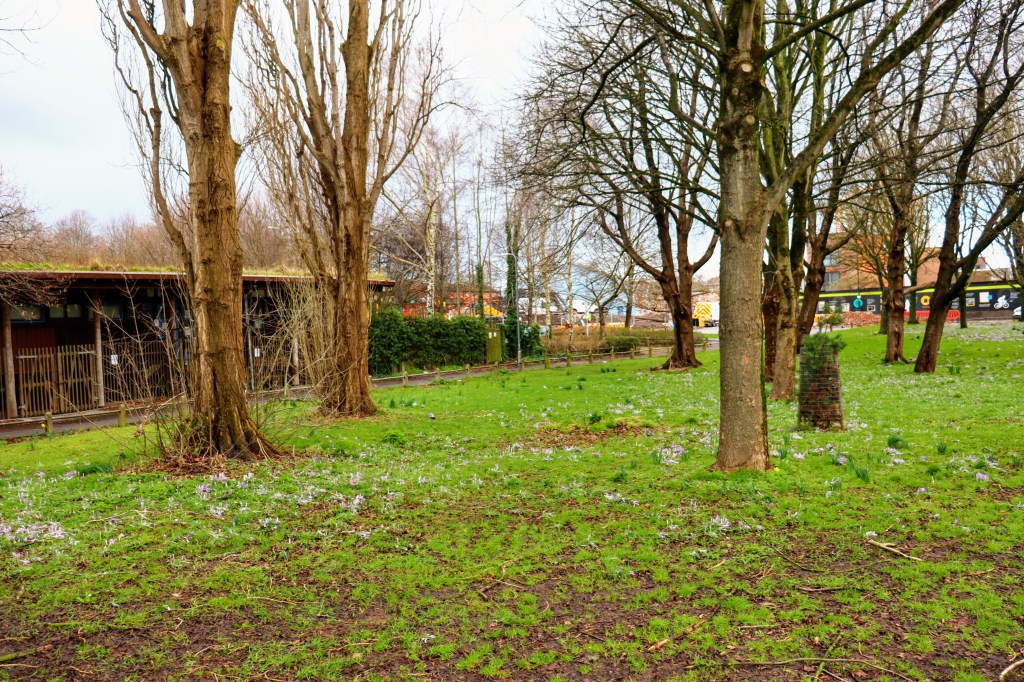
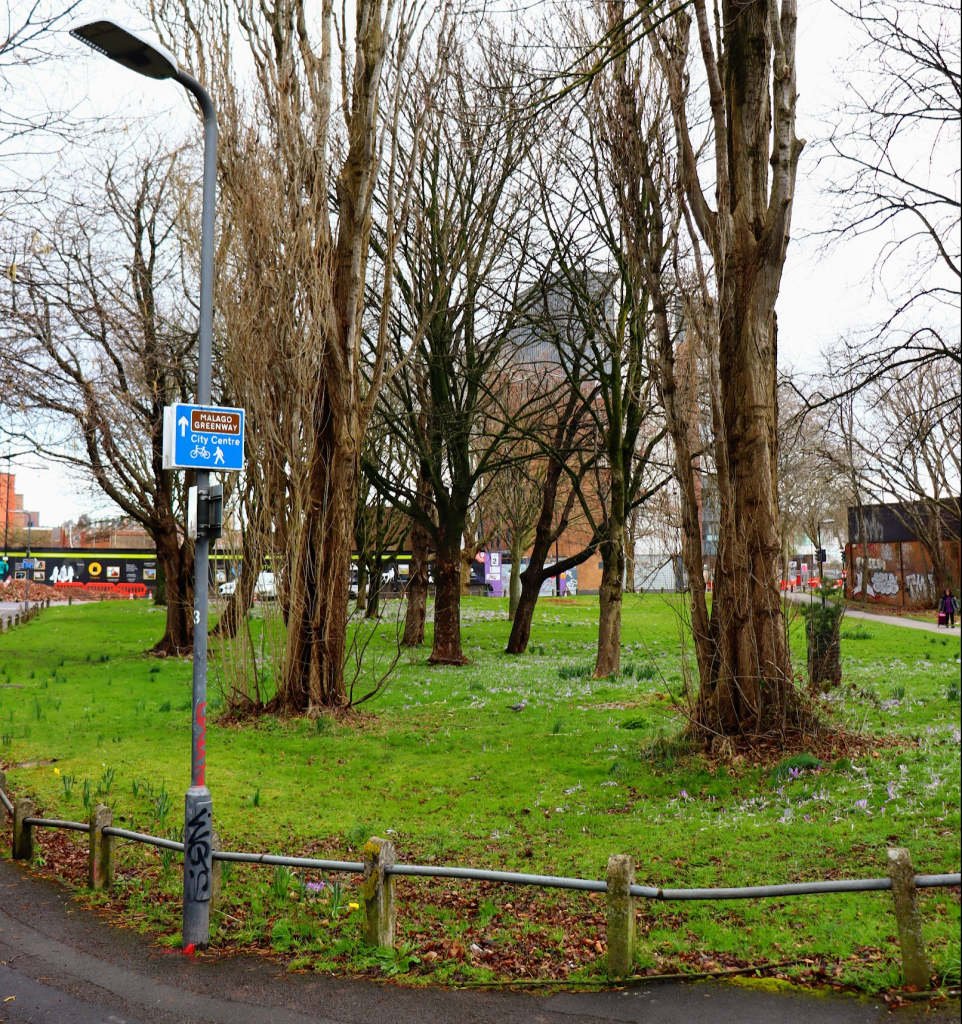

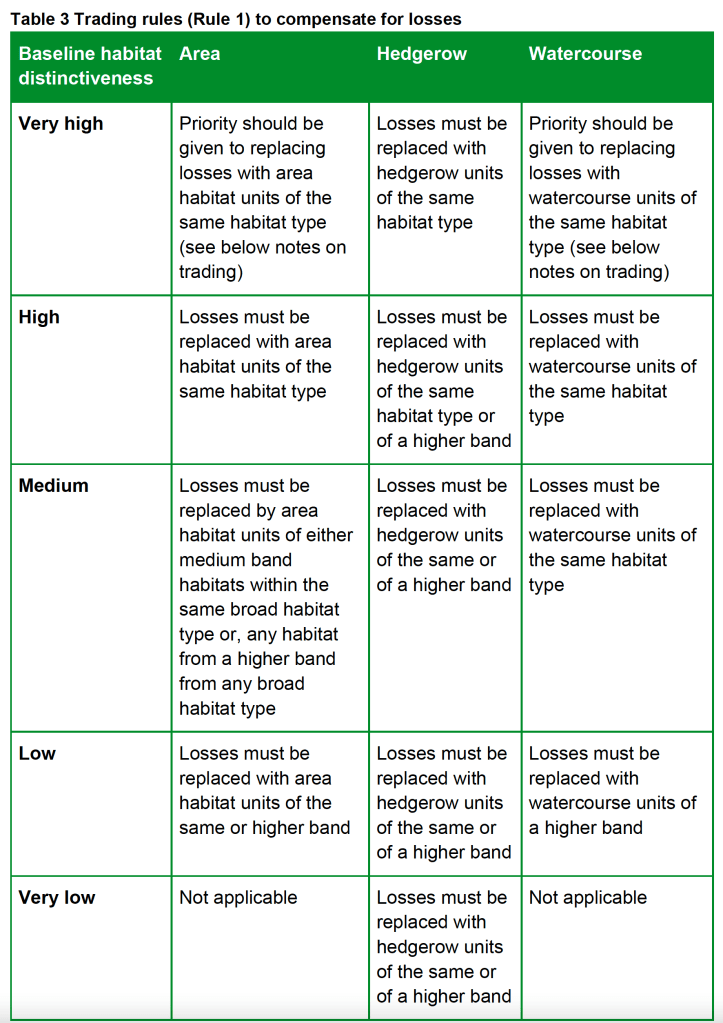
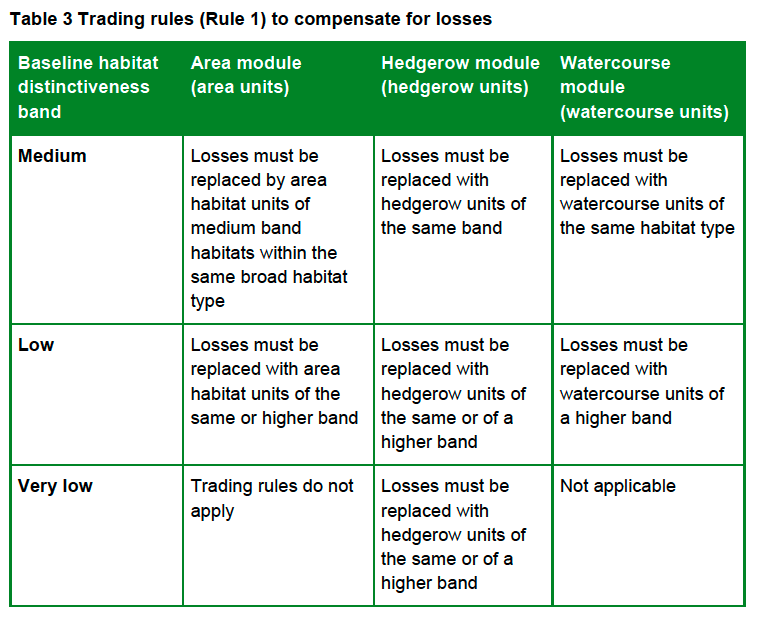
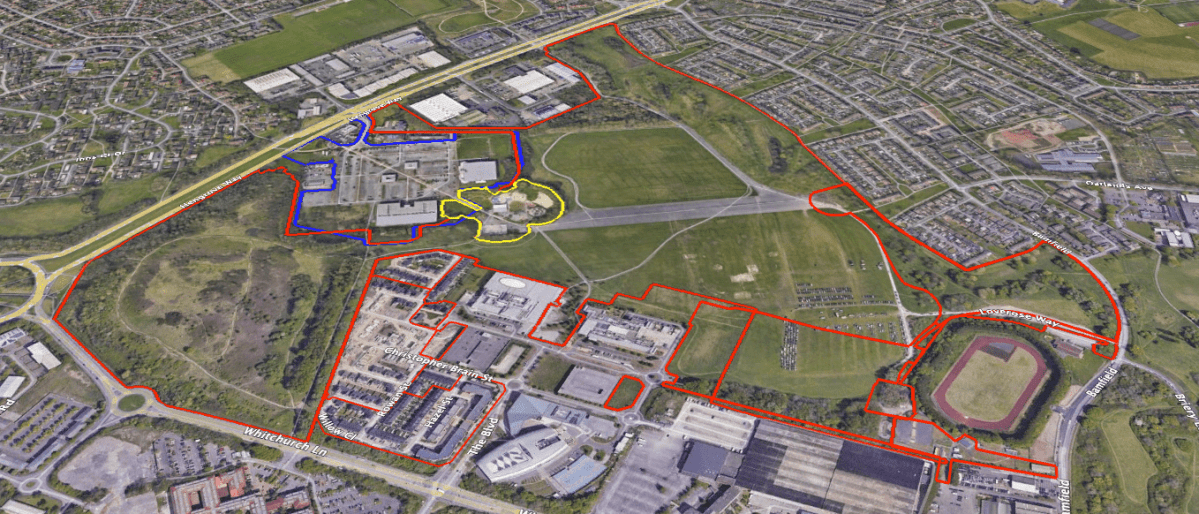
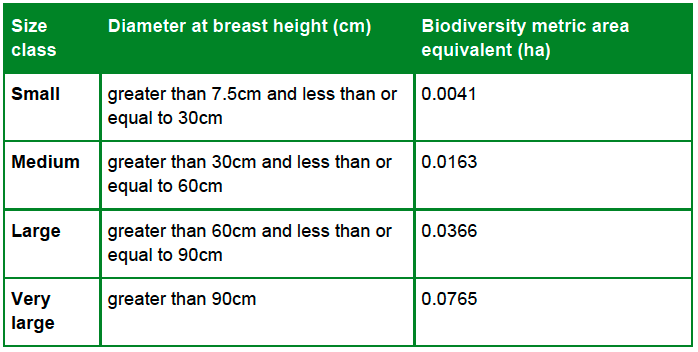
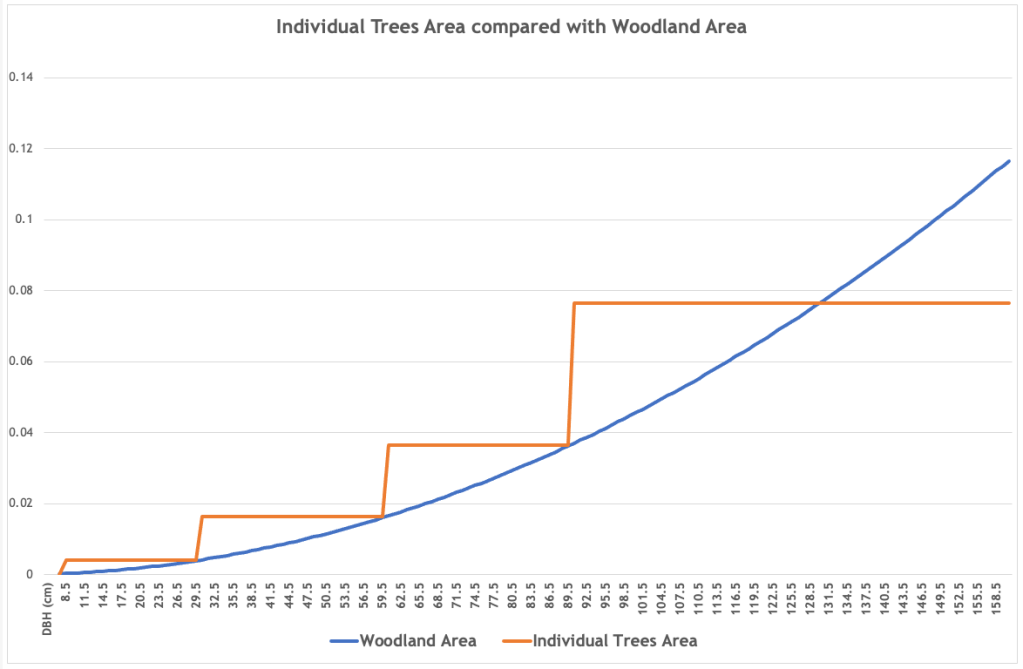
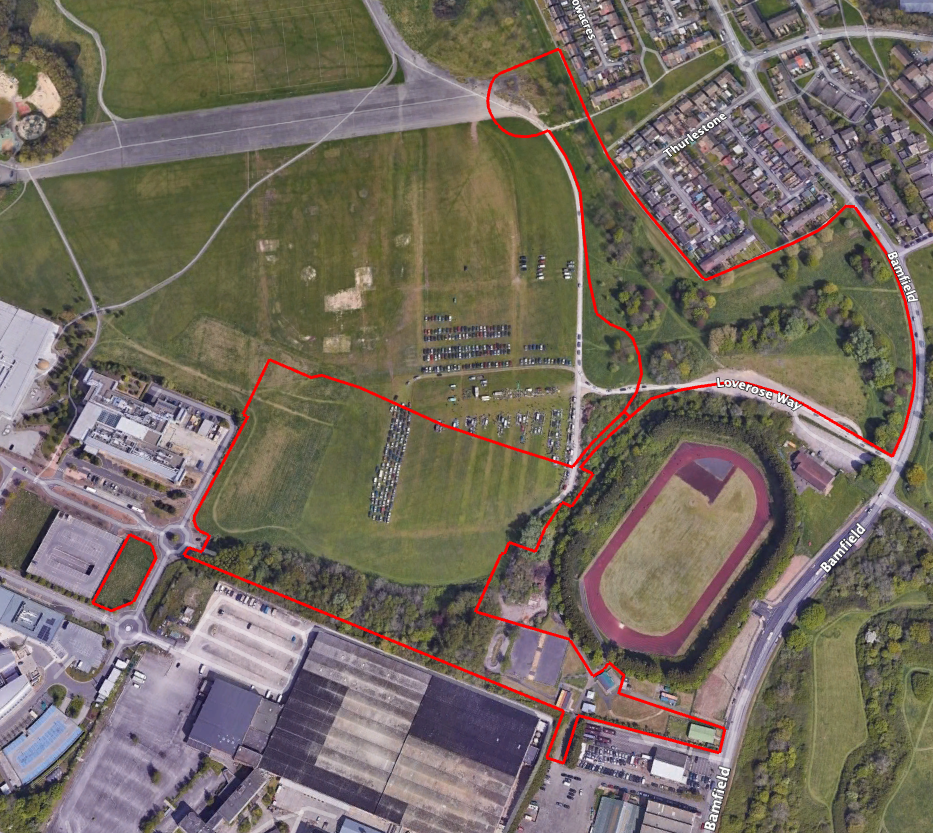
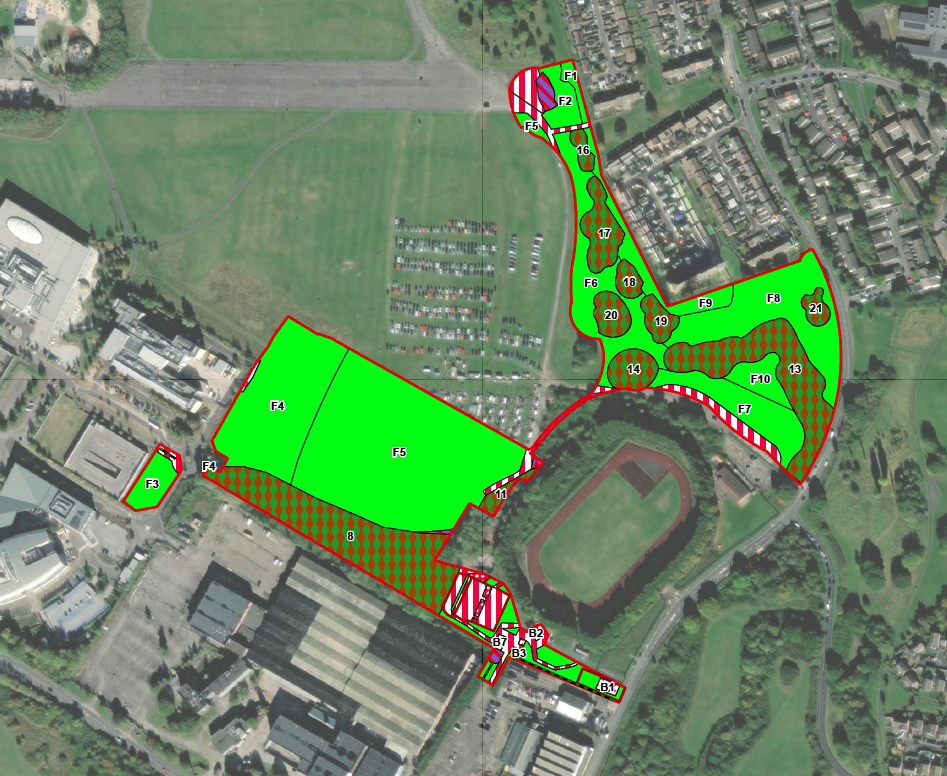
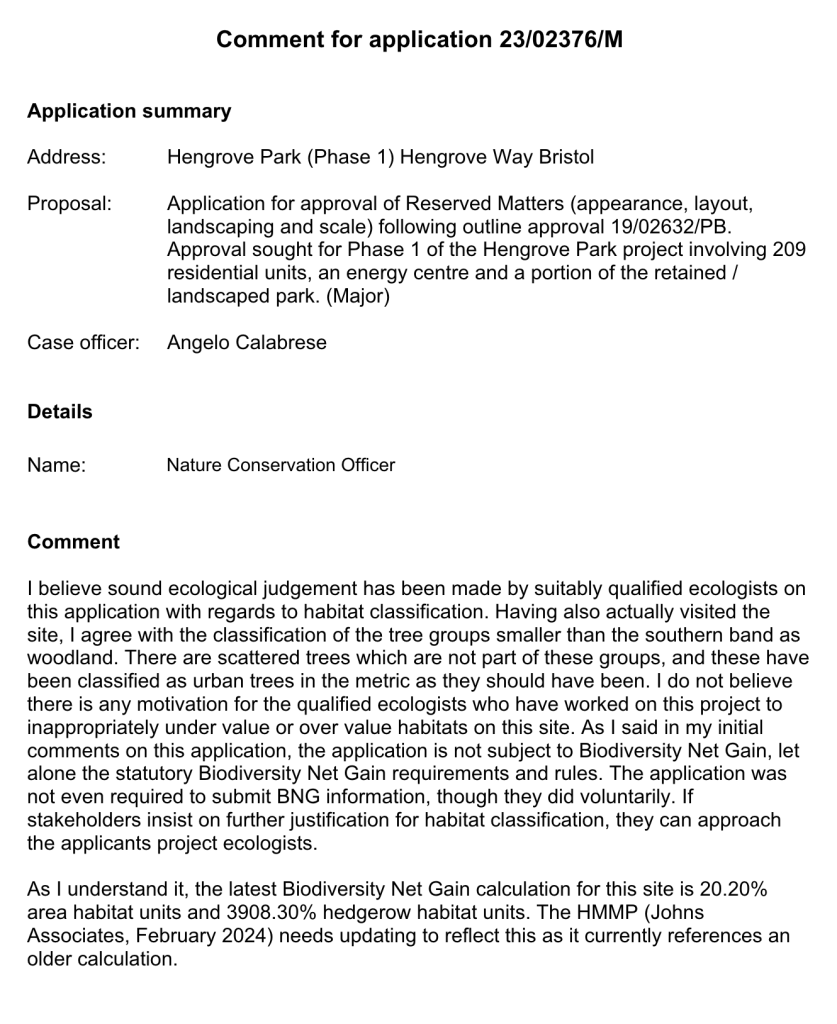
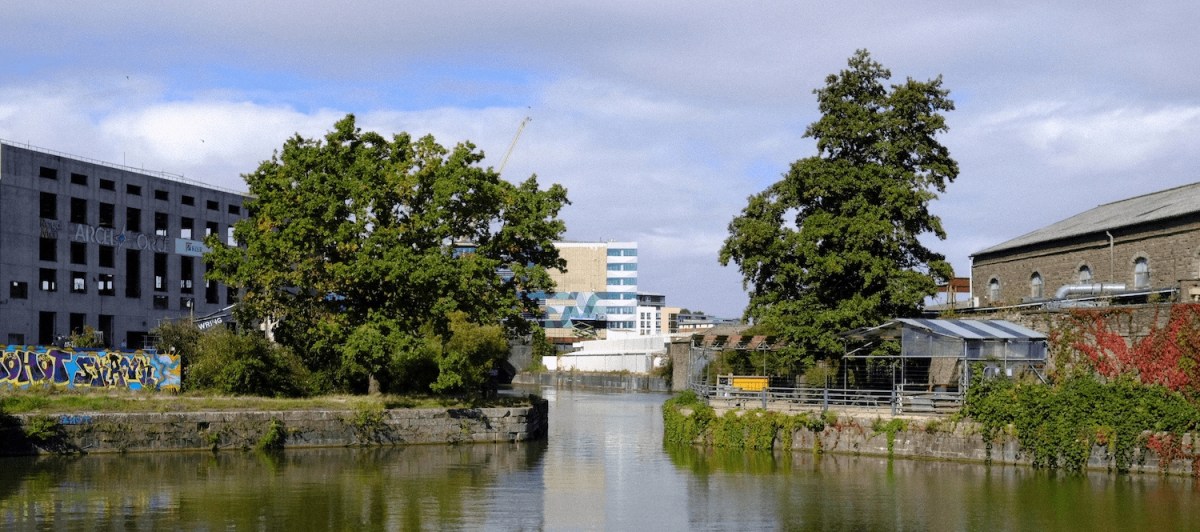
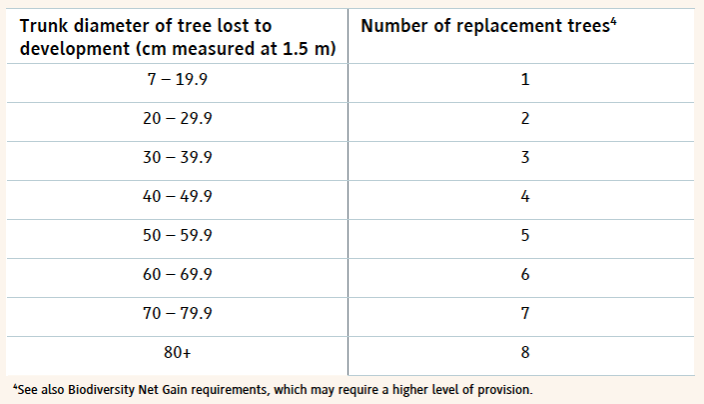

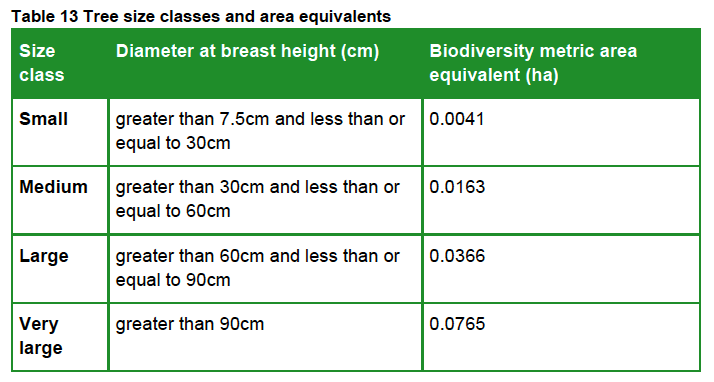
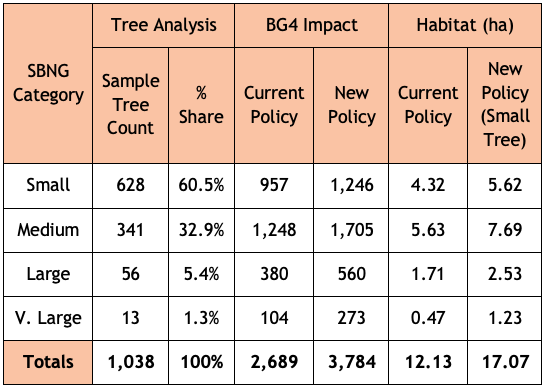
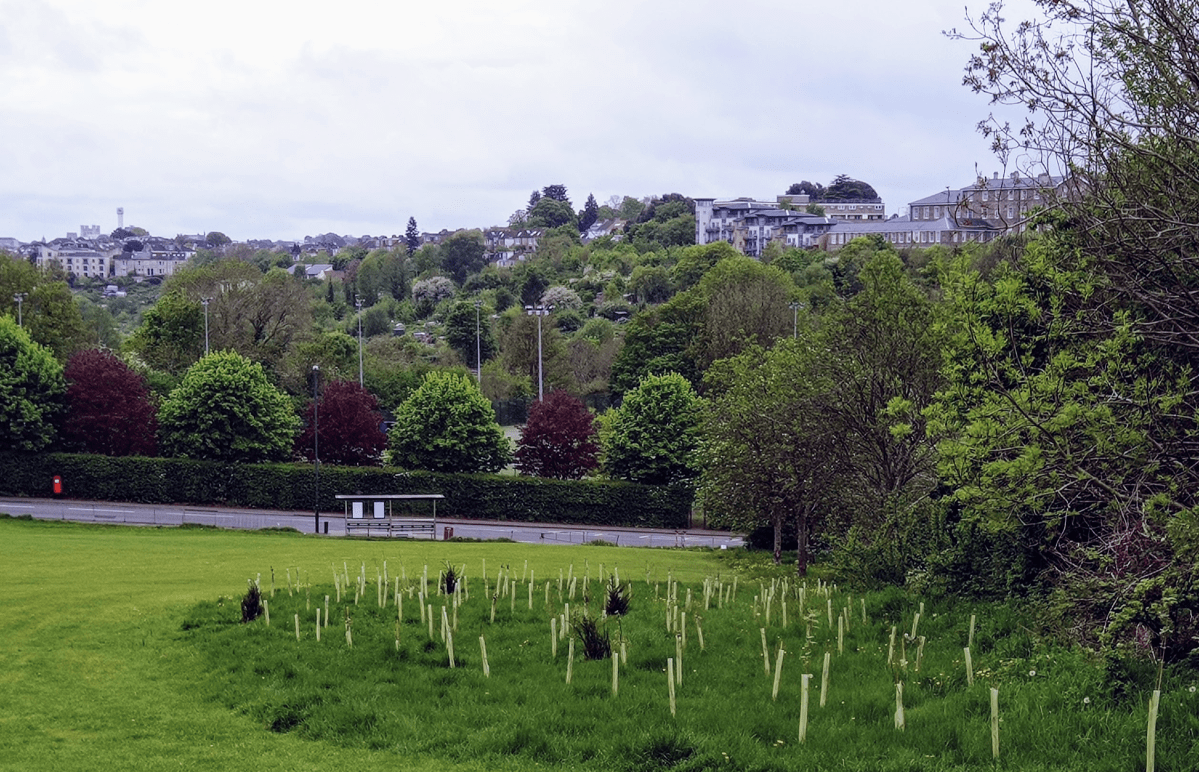
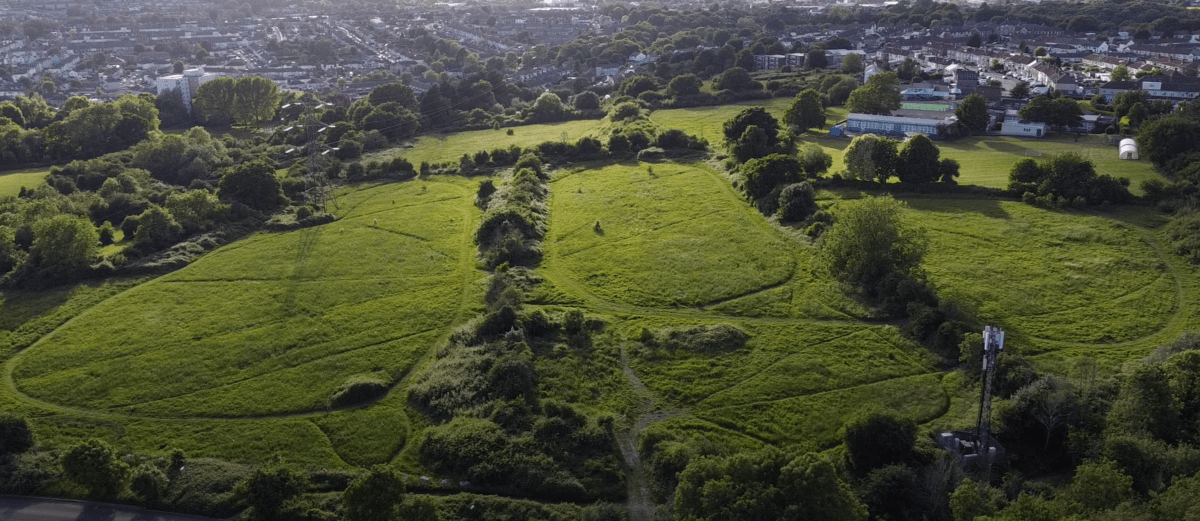

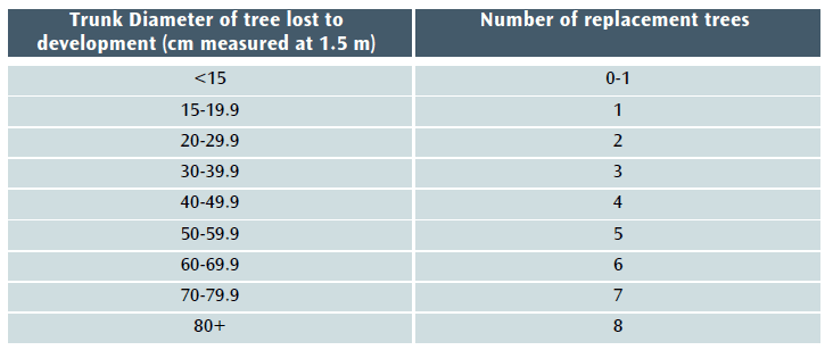
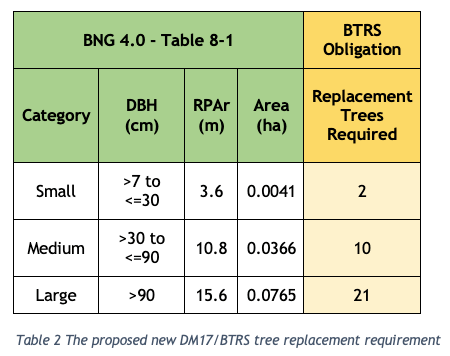
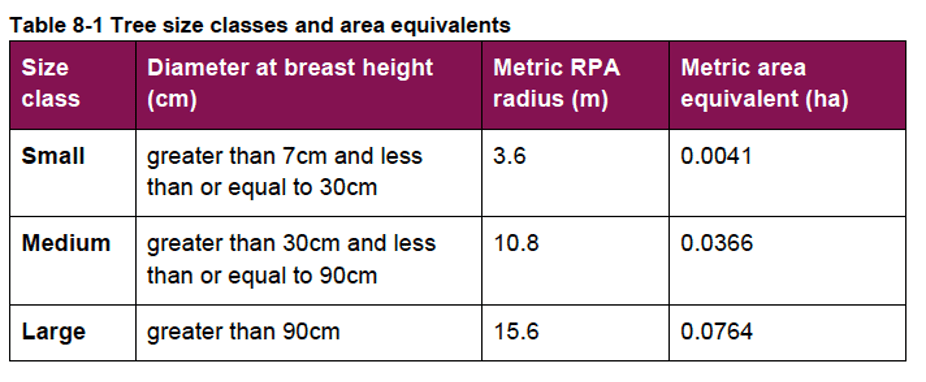

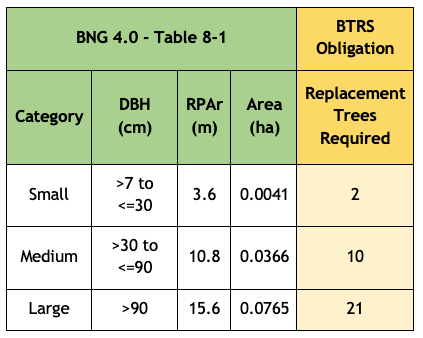
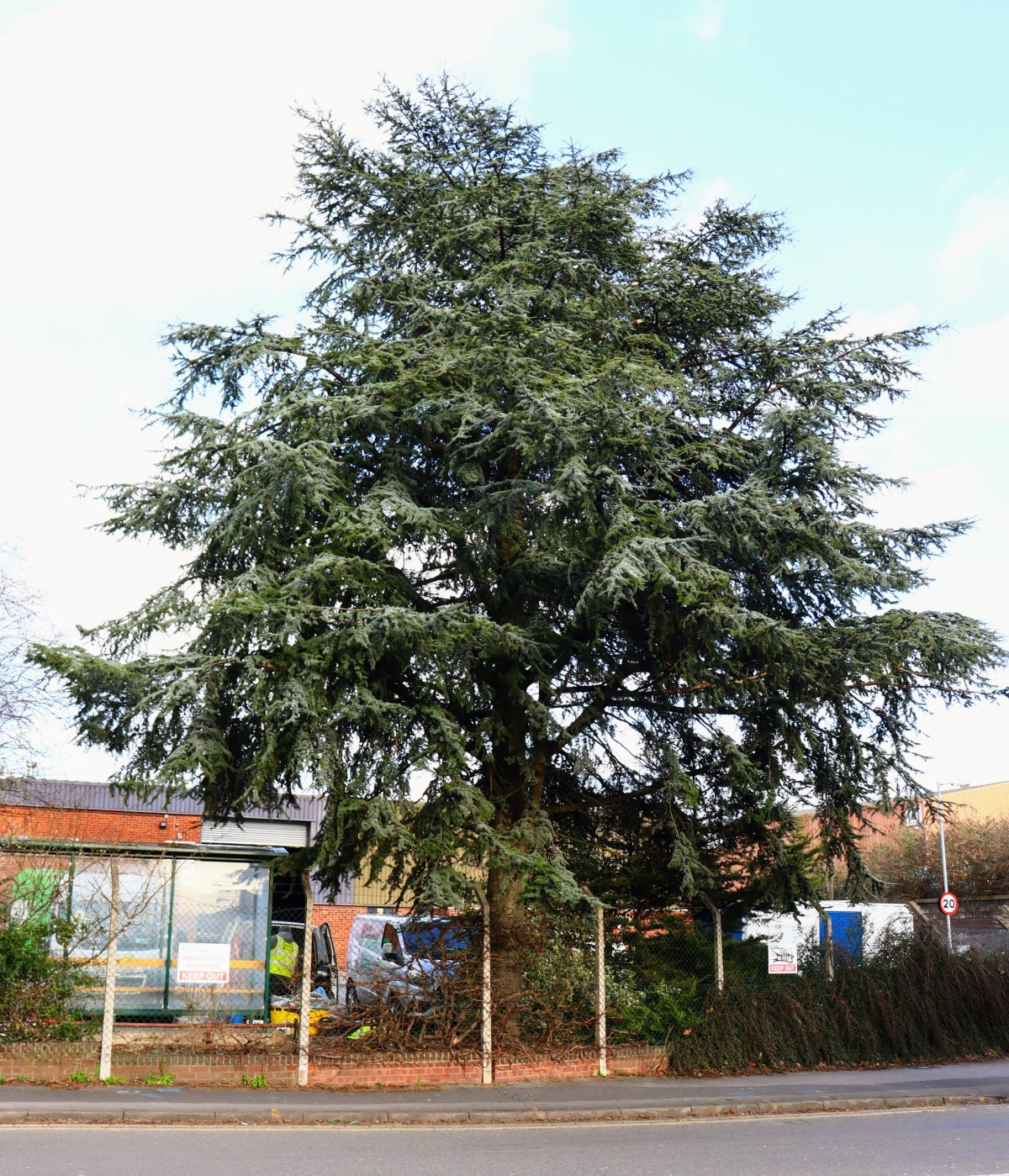
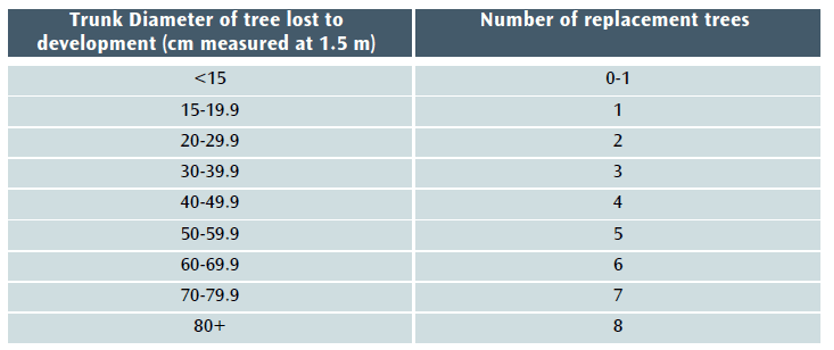
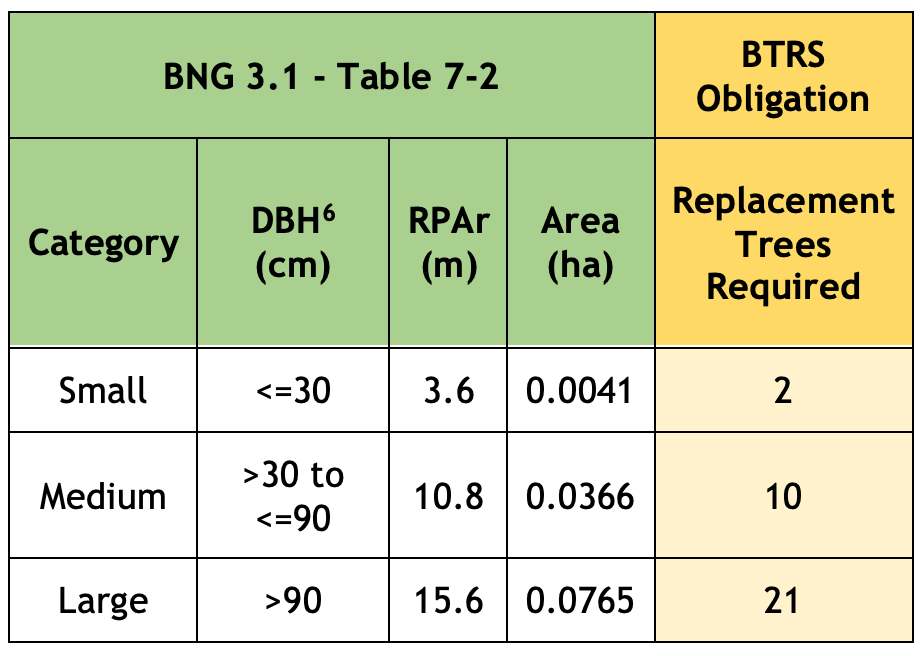
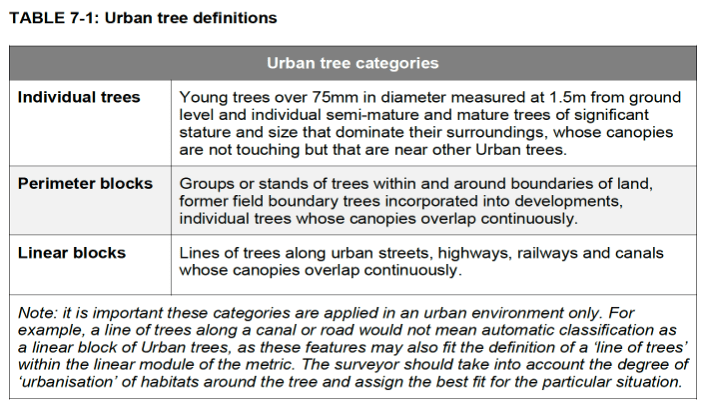


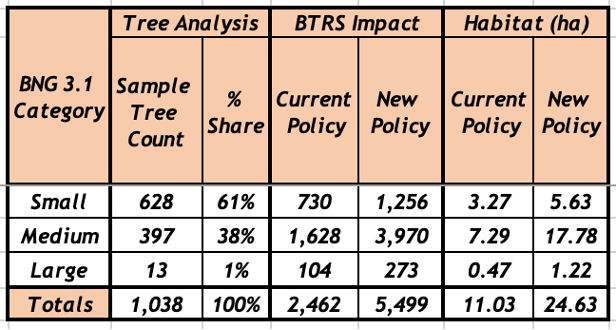
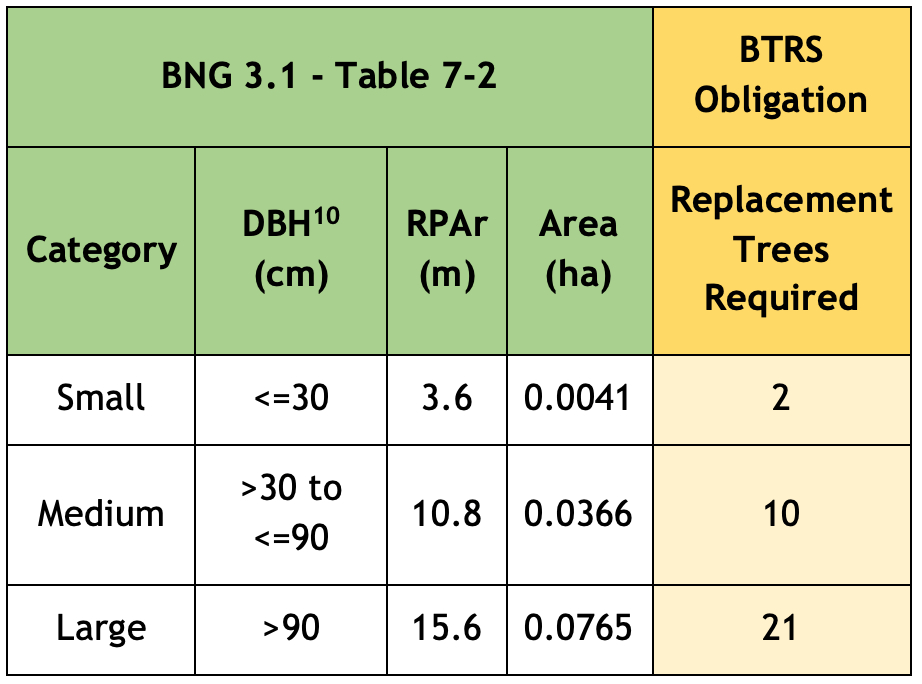
 bristoltreeforum.org